Issue ID: 27
n.1 (2025)
ABSTRACT In 1894, Cesare Lombroso (1835–1909) published L’antisemitismo e le scienze moderne (Anti-Semitism in the Light of Modern Science), the most important among the few thematic books released in fin-de-siècle Italy. Himself an Italian Jew, the renowned criminologist tried to build an authoritative defense of Jewish emancipation challenged by European anti-Semitism, by adopting the tools of his social science. The alarming political phenomenon was interpreted through the lenses of his Darwinian psycho-sociological thought, and anti-Semitic racist ideology was rejected in the name of a scientifically ‘correct’ solution of the anthropological problem of Jewish racial status. This essay focuses on Lombroso’s L’antisemitismo through an intellectual-biographical approach, which is also attentive to the criminologist’s subjective Jewishness. I will regard it as the climax of a decades-long Lombroso’s scientific engagement with the Jewish question, by reconstructing the genesis of his ideas on Jewish racial status and on the origins of anti-Jewish hatred well before the 1893 project of the book. Then, I will reconstruct its publication process, its contents and its reception by Italian public opinion, both Gentile as Jewish.
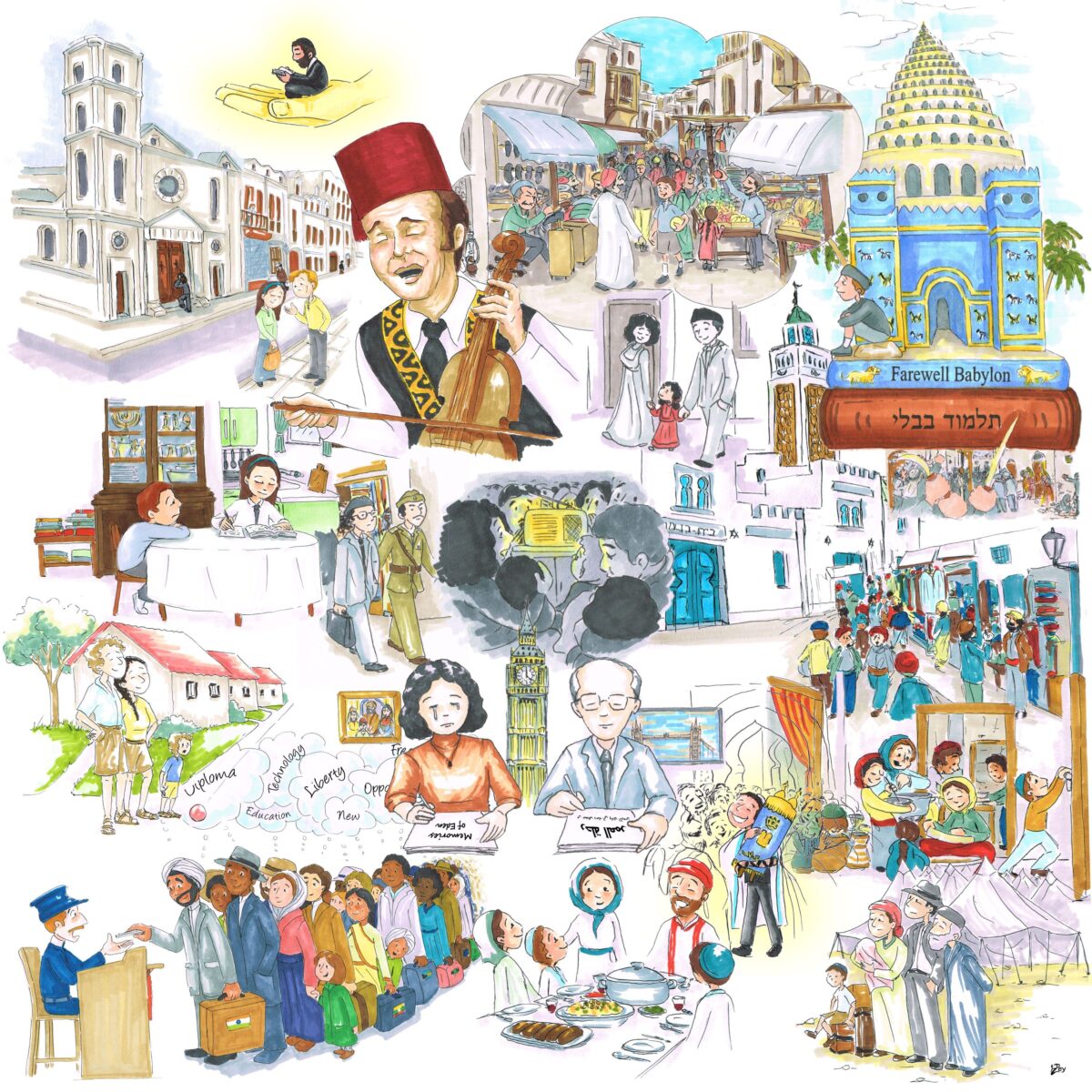
ABSTRACT Cheikh Mwijo was a central figure in the “Moroccan troubadour scene,” a grassroots cultural phenomenon that emerged within Moroccan immigrant communities in Israel’s periphery during the 1950s. Like other troubadours, he traveled across the newly established state, singing in the immigrants’ language, preserving the cultural heritage of Moroccan Jewry, and documenting their encounters with Israeli society. This article analyzes three “political ballads” he composed and performed, focusing on how they reflect the “mental maps” Moroccan immigrants used to interpret the divisions within Israeli space. By uncovering themes of mental mapping in Cheikh Mwijo’s ballads, the article explores how emotional experiences contributed to gradual shifts in consciousness—such as polarization and radicalization—among Moroccan immigrants as a result of social, cultural, and political marginalization in Israel. I argue that these shifts unfolded within the context of two major historical developments: the emergence of radical Mizrahi discourse and the rise of Mizrahi politics in the 1980s and 1990s. The article concludes with insights into the common duality in Moroccan Jews’ attitudes toward Israeli society—marked, on one hand, by sharp and even subversive criticism, and on the other, by moderation and forgiveness aimed at overcoming emotional burdens and integrating into society.
ABSTRACT On 1–2 June 1941, an anti-Jewish pogrom known as the Farhud took place in Baghdad, claiming a toll of 179 Jews murdered, thousands wounded, multiple women raped, and much property looted. This article tracks the accounts of two memoirists—Jews born in Baghdad who reconstructed their experiences of the Farhud from their subjective perspective in their biographical present in London. Through these agents of memory who documented their individual and collective memories, I show that the story of the Farhud and the Jews’ emigration from Iraq can be told in many different contexts. This contrasts with the many historiographic studies that deal with political aspects of the Farhud and, in this context, stirs debate among historians about the circumstances of the mass exodus of Jews from Iraq and addresses the manner in which the consciousness of the Farhud and its place in the collective memory in Israel are shaped.
ABSTRACT This paper explores the microhistory of Rebecca Goldman, a Polish Jewish woman born in Kalisz who, after studying at the École Normale Israélite Orientale in Versailles, relocated to Beirut in 1935 as a teacher for the Alliance Israélite Universelle. Drawing extensively on her correspondence and educational reports preserved in the AIU archives, the article investigates Goldman’s interactions with and perceptions of the local Jewish community in Beirut. Rebecca Goldman’s narrative encapsulates the tensions of cultural identity experienced by Eastern European Jews navigating new socio-political environments. The paper also emphasizes how her Polish background and French educational formation created a significant cultural disconnect that affected her integration into the Lebanese Jewish community, leading to conflicts and misunderstandings. By examining Rebecca Goldman’s personal journey, this research contributes to broader discussions on the emotional landscapes of Jewish migration, identity formation, and the intricate interplay between personal narratives and collective histories.