


Introduction
Interpreter: We are police officers, acting on behalf of the public prosecutor’s office in Dortmund, charged with investigating those responsible for the arrests, deportations, and killings of Jews in Italy during the period of occupation. The majority of Jews were deported to concentration camps such as Auschwitz, where they were killed. The principal person accused of these actions against the Jews in Italy is SS commander [comandante] Bosshammer, who is under investigation for murder, and we are grateful that you have accepted Dr. Ravenna’s invitation to give a statement.1
Beniamino Costi:2 But who are these gentlemen? I don’t quite understand…
Interpreter: They are official representatives of the German judiciary.
Costi: Ah, judges from the Federal Republic of Germany, I see.
Interpreter: You are certainly aware that most deportees ended up in Auschwitz…
Costi: Well, my wife was in Auschwitz.3
Interpreter: An investigation is currently underway against SS-Sturmbannführer Bosshammer, accused of murder, and we are therefore very grateful that you have been willing to give up some of your time so that we may put a number of questions to you.4
On 19 May 1967, in Milan, on the top floor of an elegant building just off the Corso Sempione, in the offices of the Centro di Documentazione Ebraica Contemporanea (CDEC), two officials from the public prosecutor’s office in Dortmund—Wilhelm Kaup and “Herr Schaffrath”—sat facing Beniamino Costi, one of approximately fifty witnesses whose testimonies they planned to hear over the following ten days. Beside him sat an interpreter, who was in turn accompanied by Eloisa Ravenna, the general secretary of the CDEC.
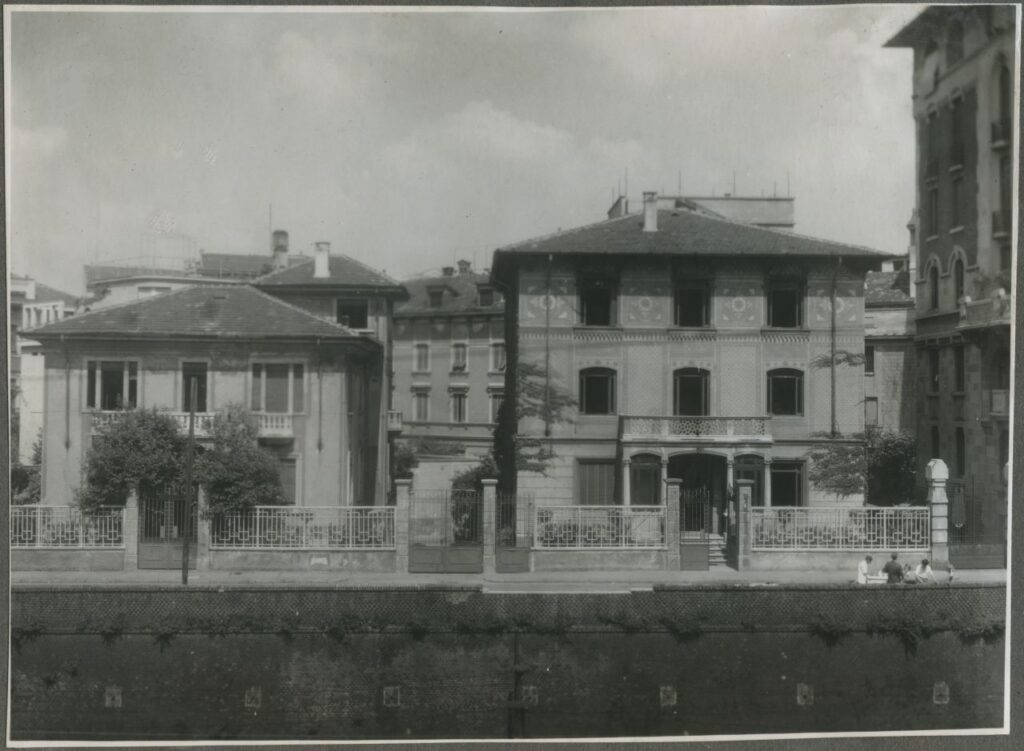
The questions were put by Wilhelm Kaup, while “Herr Schaffrath” was responsible for recording the information, both manually and by means of a reel-to-reel tape recorder. Eloisa Ravenna listened, occasionally intervened to clarify, and consistently took handwritten notes of everything that was said during the hearing.
Kaup and Schaffrath had been sent to Milan by Günther Obluda, a public prosecutor from the Dortmund court, who since 1964 had been conducting investigations for the purpose of bringing proceedings against Friedrich Bosshammer. The aim of the hearings was to gather information that could be used to establish the role and responsibility of Bosshammer5 and of the Nazi officials operating in Italy under his command, who were involved in the arrest, deportation, and killing of Jews after 8 September 1943.
The hearings took place between 19 and 29 May and involved forty-nine witnesses, including former deportees and what might be termed “indirect” witnesses—prison guards from San Vittore, antifascists who had assisted Jews, and family members able to testify about their relatives’ experiences. For decades, the transcripts, produced in 1974 by Giuliana Donati—one of Ravenna’s closest collaborators—remained the only trace of these hearings, and they became a key source for subsequent research on the deportation of Jews from Italy, including Liliana Picciotto’s foundational Il libro della memoria.6 The original recordings, however—the ones made on tape—were long considered lost: the reels had officially been declared “missing.”
However, as sometimes—and indeed often—happens in archives (and in our own homes), a move brought to light what had long seemed irretrievably lost.
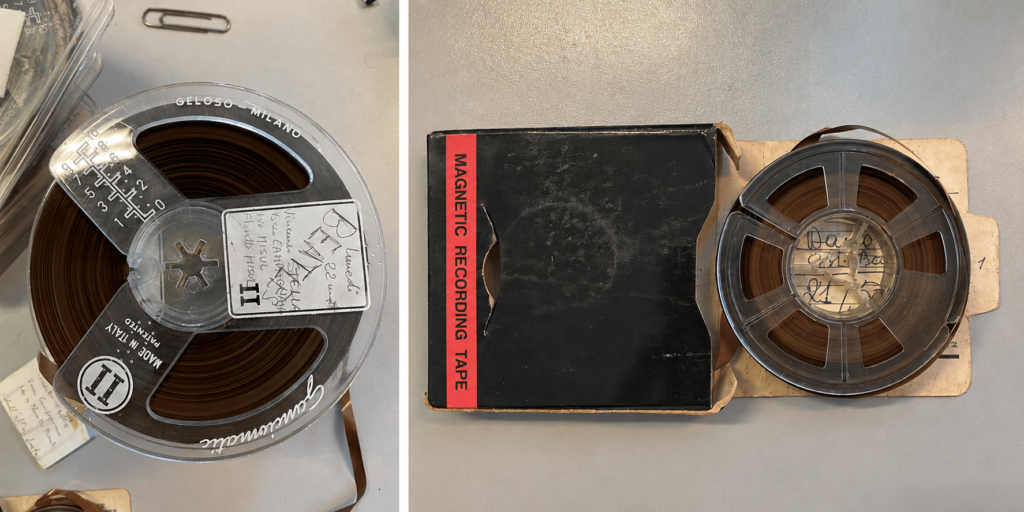
In 2022, during the transfer of the CDEC archives from via Eupili to the Memoriale della Shoah in Milan, the reels containing the recordings from May 1967 resurfaced. Inside a box, sealed and pushed to the back of a cabinet, a package wrapped in brown paper and sealed with adhesive tape was found, bearing a handwritten label: “Testimoni 1967.” It contained seven reel-to-reel magnetic tapes (Geloso model), on whose cases were written several names and, in some instances, precise dates. Every indication suggested that these were the missing recordings. Only through digitization was it possible to confirm both the good state of preservation of the tapes and the correspondence between the labels and their actual contents.7
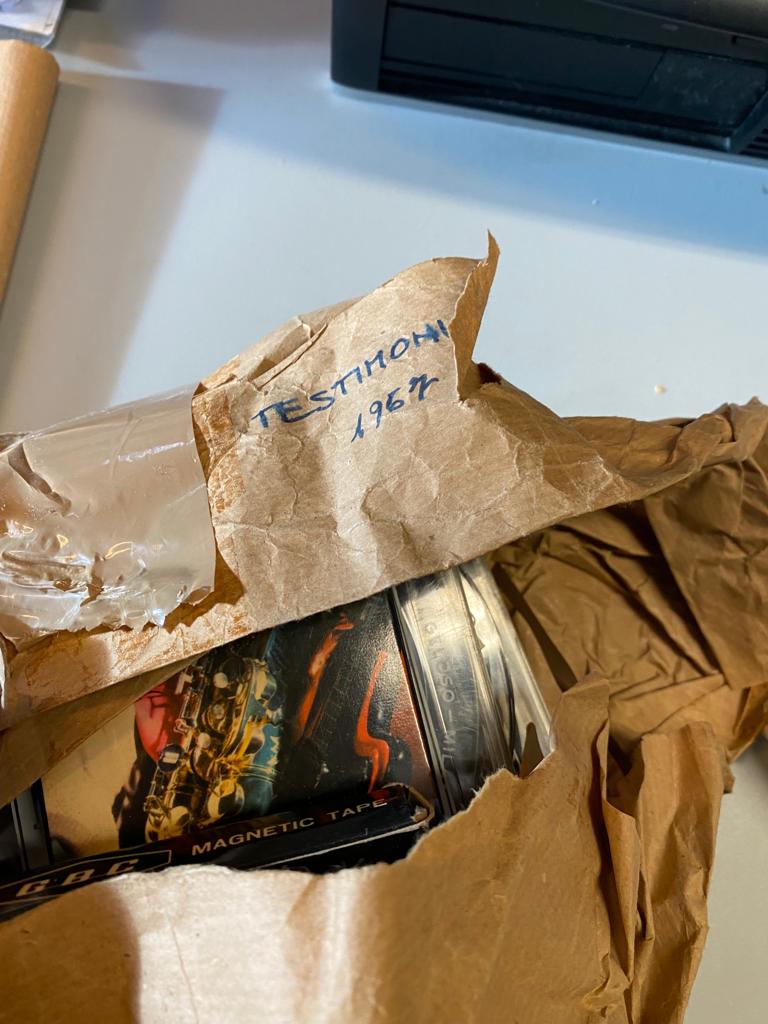
Photo. by L. Brazzo.
If the digitization process had confirmed the integrity of the tapes and their expected contents, listening to them brought back the voices of numerous witnesses—voices that, in some cases, had not been heard since then; the unknown voices of the officials Kaup and Schaffrath, those of the interpreters and of Eloisa Ravenna; and also the ambient sounds, the pauses, the incidental exchanges, the emotional states. Listening to the recordings brings to light a dimension of testimony that written transcripts could not—and were never meant to—convey, and which, when considered alongside a renewed reading of the extensive correspondence between the CDEC and the Dortmund prosecutor’s office, opens up new lines of analysis, not so much on the strictly historical level—where many of the facts are now well established—as on the historiographical one.
Listening to the hearings and re-examining this correspondence not only make it possible to add a further element to the reconstruction of a particular historical phase—one in which historians and judges worked side by side, and in which even the smallest detail could constitute a discovery—but also, on the basis of this case, to bring back into focus the relationship between judicial investigation and historical research.8
“A basic groundwork is needed…”
The CDEC and the Beginning of the German Investigations into the Deportation of Jews from Italy
The issue of the persecution and deportation of Jews from Italy had been brought to the attention of the Dortmund judiciary by Dieter Zeug, a public prosecutor working at the Zentrale Stelle der Landesjustizverwaltungen zur Aufklärung nationalsozialistischer Verbrechen in Ludwigsburg.9 Zeug had begun to take an interest in the matter in the autumn of 1962, following the discovery of a file concerning the awarding of the War Merit Cross to nine SS officers in the Bundesarchiv in Koblenz.10 At the top of the list was the name Friedrich Bosshammer.11
In the justification for the award—signed on 31 July 1944 by Wilhelm Harster, head of the Security Police and Security Service in Italy (BdS Italien)12—it was stated: “Since February 1944, Bosshammer has been conducting the struggle against the Jews in Italian territory [die Bekämpfung der Juden im italienischen Raum], distinguishing himself personally in numerous actions and acquiring significant merits in the Endlösung der Judenfrage.”13
Following this discovery, Zeug initiated a first attempt to gather information on Italy. The available material consisted largely of documentation produced for the Eichmann trial,14 which, however, proved insufficient for the purposes of opening formal judicial proceedings. What was needed were more specific elements concerning Bosshammer and, above all, witnesses—because, as Zeug wrote to Eytan Otto Liff of the Tel Aviv Police Unit for the Nazi Crimes, “the majority of the accused claim to have been unaware of the purpose and destination of the transports.”15
For Zeug, therefore, it was essential to clarify the timing and modalities of the deportations from Italy, as well as to verify whether killings of Jews had taken place on Italian soil. In an attempt to gather this information, through a network of contacts, in March 1963, Zeug reached Guido Valabrega, then secretary of the CDEC.16 He asked him a series of precise and direct questions: How many transports carrying Jews had departed from Italian territory to the Auschwitz extermination camp? What was the fate of the deportees? Had they, for the most part, been gassed? Had there been transports to other camps? Beyond the events at Lake Maggiore,17 had other killings of Jews taken place in specific locations in Italy? And who was responsible for them?18
Valabrega pointed out that these questions were extremely complex and far from admitting of any rapid answer. As he wrote on 12 March 1963:
Most esteemed counselor, the problems you raise are, as I believe you are aware, extremely complex. Not only has a considerable amount of time now passed since the events took place—which makes the search for witnesses and documents difficult—but even those who remember and might be able to testify were not, at the time during the war and the persecution—in a position to fully understand what was happening around them.19
As for the “existing literature” and the available documentation, the former—Valabrega observed—was still largely lacking,20 while the latter, although held at the CDEC,21 remained in a “raw state”: it was necessary “to take them out of the archive, to organize them, to study them, to look for others—many others—in order to arrive at a precise assessment. “In particular,” he added, “in order to reconstruct the places and stages of the deportation, it is necessary to read the testimonies of former deportees in our possession.” In short, what was required was to “carry out a basic groundwork,” [“lavoro di base”] something that the CDEC, at that time, was not in a position to undertake.22
That “groundwork,” which was necessary to respond to Zeug’s questions, would in fact be taken up by the new secretary of the Centre, Eloisa Ravenna,23 following a renewed request for collaboration—this time from the public prosecutor’s office in Dortmund. This marked the beginning of a new phase.
“If Not Us, Who?”
Eloisa Ravenna and the Investigations for the Dortmund Prosecutor (1964-1967)
Toward the end of September 1964, a long typewritten letter in German arrived at the CDEC, addressed to Guido Valabrega and signed by Günther Obluda. He explained that the proceedings concerned former members of the Security Police and the SD command operating in Italy, with particular reference to the headquarters in Verona, and that he had taken over the case from the Zentralstelle in Ludwigsburg.
Obluda reported that despite having already conducted numerous interrogations, the investigations had so far produced insufficient results24 to bring the case to trial: most of the accused continued to claim that they had no knowledge of the deportations or that they believed them to have been initiatives carried out by the Italian authorities. In order to give a decisive impulse to the investigation, he requested the CDEC’s support in locating documentation and testimonies relating to eleven points, which he summarized as follows:
- A list of names and information concerning the personnel of the office of BdS Italien in Verona and of its external branches in central and northern Italy.
- Documents concerning the so-called Jewish referents (for example, Dr. Bosshammer and Dannecker in Verona, in Milan, etc.) employed at these offices, and concerning their activity (correspondence, orders, directives, reports, and communications).
- Orders, directives, instructions, circulars, guidelines, and correspondence issued by German offices, in particular the BdS, concerning the so-called measures against the Jews in Italy.
- Testimonies, reports, publications, official records, etc., concerning persons arrested in various locations in Italy, indicating the exact date, the names and number of those arrested, the names and positions of those who carried out the arrests, and the German personnel and units involved.
- Documents concerning the subsequent fate of these persons (transport lists, notifications of arrival, release notices, collection lists, prisoners’ letters, death notices, testimonies, etc.).
- Documents concerning the establishment, composition, and dissolution of the camps of Fossoli and Bolzano,25 and possibly of other “concentration camps” run by the Germans in Italy.
- Documents concerning the names of the camps26 and their guards, as well as the relations of command and subordination.
- Information, documents, and testimonies concerning the number of Italian Jews interned in the camps, the number of transports to Germany and to extermination camps, and the dates, executions, and destinations of the transports.
- Names of the persons and German units that accompanied these transports from the camps in Italy to the German extermination camps.
- Copies of judgments issued by Italian courts in which Germans had been convicted of actions against Jews in Italy (for example, Kappler in Rome, Schuster in Bolzano).
- Texts of laws and regulations issued by the Italian authorities after August 1943 concerning the treatment of Jews in Italy.27
The eight pages Obluda sent were received not by Valabrega, but by Eloisa Ravenna, who had replaced him at the end of 1963. Given the state of knowledge at the time, and the “extremely modest resources” [“modestissime risorse”] of a young institution such as the CDEC—which relied largely on voluntary work—this was a request of extraordinary scope.28 Nevertheless, after an initial brief and preliminary reply,29 she devoted herself fully to the task.
It was, in her view, a responsibility that went far beyond the mere search for documents. “If not us, who?” she would say a few years later in an interview for the Swiss Italian Radio [Radio della Svizzera Italiana]. Who else could undertake such work? How could a trial on the deportation of Jews from Italy take place without the contribution of Italian Jews themselves—“without testimony from us, without help from us…?”30
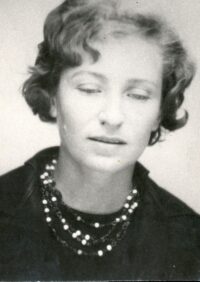
It was evidently with this feeling, at its core, that Ravenna began her excavation work in the still “raw” archive of the CDEC. In 1964, the requests formulated by Obluda—which today might appear relatively straightforward to address—implied a painstaking process of reconstruction, detail by detail, starting from a base that was, in many respects, almost non-existent.
The correspondence between Ravenna and Obluda offers an extraordinarily rich and eloquent record of this slow process of gathering and piecing together clues and information. It is precisely with the intention of showing the gradual construction of knowledge—the literal discovery of names, places, and events that are today taken for granted—that I quote from it at length here. Through it, one can clearly see how Ravenna’s work did not consist merely in what might be called “digging” in the archives, but also in the selection, reading, comparison, verification, and organization of heterogeneous and almost always fragmentary sources.
From this correspondence, it is possible to grasp, in an almost photographic manner, the state of the CDEC Foundation Archives (and Library) in the early 1960s; at the same time, in some cases, it makes it possible to restore the context and provenance of documents now preserved in the CDEC’s collections that are still lacking such information. From October 1964 onward, Ravenna engaged in an intense exchange of letters with Obluda, often accompanied by a substantial number of documents—sometimes sent as copies, sometimes on loan. In a letter dated 29 October, for example, she announced the imminent dispatch of documentation relating to the San Vittore prison and the Bolzano camp, together with testimonies of former deportees preserved at the Centre:
In the next few days, I should be able to send you […] photocopies of several pages from the registration records of inmates at San Vittore for the period March-November 1944, indicating those who were Jewish, as well as some from a similar register from the Bolzano camp, together with information on both places of detention (materials that I have only been able to locate in recent days). As for direct testimonies from some former deportees, these are held at our Centre, and it will certainly be possible to provide you with copies. I know that Dr. Enzo Collotti, whom you have already contacted, has already sent you a publication of his entitled “Dati sulle forze di polizia fasciste e tedesche nell’Italia settentrionale nell’aprile 1945.”31
In the following weeks, the flow of documents became more substantial. On 19 November, Ravenna sent two publications concerning the deportation of Jews from Rome:
Today, I am sending you two publications concerning the deportation of Jews from Rome, which may perhaps be of use to you: one is a brochure [sic] published by the Jewish Community of Rome, entitled “Ottobre 1943: Cronaca di un’infamia,” containing a report by the president of the community, Ugo Foà, on the racial measures implemented in Rome directly by the German occupation authorities after 8 September;32 the other is a study by Tagliacozzo entitled “La Comunità di Roma sotto l’incubo della svastica. La grande razzia del 16 ottobre 1943,” published in a volume issued by our Centre (1963).33
On 25 November, she then sent a detailed dossier on the Bolzano camp:
With reference to points 6, 7, 8, 9, 10 of your letter of 22.9.64, I am sending you the material collected so far on the concentration camp of Bolzano […] a photocopy of a list of Jews who were in the Bolzano camp (5 pages)34 […]. I have attached a photocopy of the cover of the register to the sheets of the list. The designation “Ebrei” is legible on the second page of the list, in the bottom right. It is likely that this list dates from the final months of the camp’s activity, since on the second page, one may read the name of the internee De Benedetti Leblis Anna, an elderly Jewish woman who survived deportation. A handwritten testimony by her on the “Life of the Bolzano Camp” is preserved in our archive, of which I am sending you a typed copy.35
The material, as can be seen, included, among other things, internment registers, handwritten testimonies, nominal lists, clandestine correspondence, and administrative documentation. Ravenna emphasized its fragmentary nature and the difficulty of interpreting it, while nevertheless attempting to extract potentially useful information from it, even from the smallest details: the designation “Ebrei” [Jews] appearing in the registers, the markings used in the camp, the information transmitted clandestinely to the outside, and the cross-references between testimonies and local sources.36
On 10 December 1964, Ravenna sent another letter, which contained a great deal of information. The importance of this communication—also for the subsequent development of the investigation—is such that it is worth quoting from it at length:
Dear Mr. Obluda, to follow up my letter of yesterday, I am sending you documentation concerning Jews in the San Vittore prison in Milan.37 First of all, I am sending you a photocopy of twenty-three pages from the Registration Registers [Registri di Matricole],38 which were compiled, by order of the prison administration (the SS German administration), by the Registration Office (an internal office of the prison). On the basis of the records kept by the Registration Office, the prison administration updated its “card index,” in which the detainees were recorded.
The originals of the four registers from which I was able to make these reproductions cover the period from 11 March 1944 to 14 November 1944, and are still preserved in Milan: one is held by a municipal museum,39 three are the property of Don Franco Rimoldi […], who was arrested and detained in San Vittore for political reasons in 1944. […]
In a signed statement preserved at this Centre, Don Franco Rimoldi recalls the particular treatment reserved for Jews in the [San Vittore] Prison:40 the humiliating body searches carried out in order to locate money and valuables; their confinement in the large dormitories on the top floor and their complete segregation from other detainees; the different treatment in the distribution of food, reduced to a minimum (whereas other detainees received three portions of food during the day, however meagre, Jews were given only the morning coffee and the midday soup); the lack of food distribution in the hours preceding departure from the prison (and sometimes the wait lasted for many hours!); the ill-treatment, at the moment of departure, inflicted even on weak, sick, and elderly persons (a pregnant woman was kicked in the abdomen by an SS man; children were literally thrown onto the trucks, on top of others, due to lack of space, etc. etc.); there is a recollection of a Jew who was flogged to death by an SS man for having been “suspected” of attempting to escape.
From the period in which he was detained in San Vittore, Don Rimoldi recalls that the prison administration was headed by two SS men: Klims41 (or Klinzer?) and FRANZ [sic].42 Some years after 1945, according to information obtained through a network of informants that had formed among members of charitable organizations (Opera Pontificia, etc.), former resistance fighters, and private individuals interested in following the fate of these criminals, FRANZ [sic] was in Berlin, employed in a corps of civic guards […].
Also with regard to the conditions of Jews in San Vittore, I had the occasion to speak with Dr. Cesare Gatti of Milan, who at the time was a doctor at the [San Vittore] Prison and who told me that he had been strictly forbidden to treat Jews. Despite this prohibition, Dr. Gatti nevertheless tried to visit them when necessary, and was reprimanded twice (by Saevecke43): once because he had opposed the departure of a pregnant Jewish woman, and once because he had arranged for milk to be given to very young children.
As for testimonies, many more could be collected (and it will also always be possible for me to provide you with names and addresses of persons still living and still able to testify). Here, I limit myself to sending you only a few items, for information purposes and, one might say, by way of example.
I enclose, for example, a typed copy of the testimony given to this Centre by Mrs. Guglielmina Basevi44 concerning the deportation of her mother, Enrichetta Forti, after a period of detention in San Vittore. And a photocopy of the testimony of Dr. Giuseppe Lanza concerning the deportation of his mother-in-law, aged seventy-six, which took place after several weeks of detention in San Vittore.
I am also sending you photostatic copies of certain passages taken from three memoirs by former deportees who were detained in San Vittore:
– From the book Triangolo rosso (3rd ed. – Milan, 1953) by Don Paolo Liggeri, now director of the “La Casa” Institute in Milan, arrested in March 1944 at the Opera Pia Cardinal Ferrari, which he directed and in which he sheltered Jews and organized their escape, I have had the following pages reproduced: 50-51, 53-54, 68-69, 85, 86, 99, 200-201, which are relevant to the subject of your investigation.
– From the book Dal Carcere di S. Vittore ai lager tedeschi sotto la forza nazifascista (2nd ed., 1954) by Gaetano De Martino, arrested probably for political reasons (he was an anti-fascist, but the reason for his arrest was not communicated to him), I have had the following pages reproduced: 43-44, 65-66, 97.
– From the book Un uomo a tre numeri (Edizioni Avanti, 1955) by Enea Fergnani,45 arrested on 10 December 1944 and deported for political reasons, I have had the following pages reproduced: 20-21, 23-24, 44-45-46-47-48-49, 62, 78, 83, 97-98-99-100.
– From the book Un popolo piange (La tragedia degli ebrei italiani) by G. Ottani,46 I had begun to have a photocopy made of p. 37 (on San Vittore), but since there are numerous passages that may be of interest to you, I am sending you the book on loan, marking in pencil the passages relating to the subject of your investigation […].
I also enclose several copies of documents collected by Dr. Giovanni Melodia, secretary of the Associazione Nazionale Ex Deportati Politici nei campi nazisti […]:47
– On the two sheets entitled “Caso Saevecke” (signed: G. Melodia), there are some references to Koch,48 Hans, Franz, Gratzach. Mention is also made of Antonio Ingeme and Gina Righi, arrested, detained in San Vittore, deported, and died in Germany after being accused of assisting Jews (their entry into San Vittore is recorded on p. 25, 24 March 1944, of the above-mentioned registers, and the page is among those enclosed).
– In the “Notiziario per la Stampa” (22.2.1962), on p. 2 the SS Klinzer [sic], Klem (Klemm), Mosner, Franz are mentioned, and on p. 4, Gratzach.
– From the “Deposizioni del giorno 22.3.1963,” given in the presence of Dr. Melodia himself and Dr. Wiedemann (official of the Ministry of the Interior in Germany), I am sending you the testimony of Mr. Aldo Ravelli (Via Borgogna 7 – Milan), for certain remarks that may be of interest to you.
In the testimony of Prof. Giuliana Cardosi concerning the deportation of her mother, Clara Pirani (4 pages, with annexes),49 the texts [both] of circular no. 3968/442 of the Ministry of the Interior (7 March 1944)50 and of an order by Koch (8 May 1944) are reproduced […].
In addition to the material already mentioned in my letter of 25 November, I am preparing a list of dates of departures from the Fossoli camp for Germany (departures, that is, of convoys of deportees); in this regard, it should be recalled that these convoys generally included both Jews and non-Jews: 7,495 Jews51 were deported from Italy, but overall, including both Jews and non-Jews, approximately 33,000 Italians were deported to Germany (among civilians), and also lists of the various contingents of Jews deported from individual cities.
I would be very grateful if you could send me an acknowledgement of your receipt of this and of the previous letters as soon as possible, also because I would like to know from you whether this work of mine, which is necessarily very fragmentary and incomplete, may be of any use to you.52
Obluda was rather sparing in his replies, and only in mid-December did he respond to the numerous letters that Ravenna had sent in the preceding weeks. He confirmed that he had received all the materials sent and, although his office had not yet been able to translate everything, he was nevertheless already in a position to inform her that they constituted material and information “of great importance,” since they had brought to light “new facts for the investigation and therefore of particular importance.”53 He further added that the identity of the German guard units at Fossoli and Bolzano had been almost completely established: “The camp commander named Tito, Hans Haage, […] Else Lächert (‘the tigress’), an assistant of Lächert (‘the little tigress’), Günter Beermann, Sain (or a similar name), two Ukrainians of unknown name.”
Obluda then wrote that he needed the exact dates of the transports departing from Fossoli and Bolzano “bound for Germany, Austria and Poland,” as well as information on the identity of the SS personnel attached to the BdS in Verona.54 In the meantime, he had been able to ascertain that the Judenreferent was SS-Sturmbannführer Friedrich Bosshammer and that he had held the position probably from February or April 1944 until the autumn. It is said that after this period, he became head of the detachment in Padua. His predecessor in his capacity as Judenreferent (Ref. IV B 4) was probably SS-Hauptsturmführer Theodor Dannecker.55 His collaborators may have been: an SS-Hauptsturmführer Müller, an SS-Hauptscharführer Arendt56 (or a similar name).57
At the end of 1964, everything was still in the conditional: dates uncertain, names yet to be verified. And yet, slowly, the picture was beginning to take shape; what was now needed was to find witnesses capable of confirming or refuting these first reconstructions.
Thus, in the first half of 1965, alongside archival research, Ravenna added direct fieldwork with witnesses. After Genoa,58 between late June and early July (24 June-4 July), we find her gathering information in Padua and Verona. In a long letter dated 15 July 1965, she explained in detail everything she had been able to reconstruct by speaking with local people.
She reported that in Padua, she had found confirmation of the information according to which “Bosshammer” had been in charge of the SD command: the director of a clinic in Padua, Professor Giambattista Belloni, “vaguely” remembered the name, but was unable to say when Bosshammer had actually arrived in the city. Another witness, Professor Oselladore, told her that he might have arrived “approximately” in the “early months of 1944.” The same Oselladore recounted that the clinic had been requisitioned by the German Security Police in order to establish their offices there, along with prisons and a torture chamber in the basement; he also still remembered the “large fire” [grande falò] that the Germans had lit in the courtyard before leaving.
Professor Giorgio Erminio Fantelli, a former partisan, had also provided her with some information about Bosshammer, and Ravenna reported his testimony directly in the letter, “as she had been able to transcribe it”:
Bosamer [sic]59 was certainly SS. He was also known as a big shot commander [grosso comandante]: they called him “the Major [il Maggiore]; I believe that he was in Padua only briefly, just passing through, between ’44 and ’45. Don Ugo Orso […] told me that it was this Bosamer [sic] who, in April ’45, gave the order to shoot, in reprisal, the members of the Venetian [veneto] CLN who had been captured on 7 January ’45. In October (or August) ’44 he must have been in the Grappa area, between Bassano and Montebelluna, to direct a roundup. Don Ugo Orso was chaplain to the Italian SS (Banda Carità)60
Bosshammer, Ravenna went on to report, had also been mentioned by Professor Mario Mosconi, also from Padua, who in his memoir of his time as a detainee (Mai più come allora. 100 giorni alla Polizia criminale nazista [Venice, 1955]) referred to him together with a “Lieutenant Kofler, a Captain Danzer, and a Lieutenant Smith, all of the SD.”
In Padua, Ravenna also stated that she had been given access to the diary of an inspector of the Italian Red Cross, Lucia De Marchi, who had been serving in the city since 1940. From that diary, she had copied the entry for 19 October 1943, which referred to “a train loaded with Roman Jews on its way to deportation, which stopped at the station and whose wagons were whose wagons were opened, contrary to normal procedure [eccezionalmente aperti].”61
With regard to the Jews of Padua, Ravenna explained that she had learned that those arrested—“around fifty”—from 3 December 1943 onward had been “detained in an old villa in Vò Vecchio, converted into a concentration camp, where—according to witnesses—they were treated fairly humanely by the Fascist guards […] until 17 July 1944, the day on which they were brutally taken away by German SD soldiers.” In support of this information, she then quoted a fragment of testimony collected by the parish priest of Vò Vecchio, Don Giuseppe Rasia, whom she had visited in search of information:
On Monday, 17 July 1944, in the afternoon, they were all deported by German soldiers and taken first to Padua, then to Germany: they were not allowed to take anything with them. Mr. Gesses,62 at the moment of the arrest, was in Padua to have his teeth treated [governarsi i denti [sic!]]. Having learned of what had happened, he returned here immediately, because the Germans had threatened that if he could not be found, the camp commissioner would be arrested in his place and deported. Once the camp had been dissolved, the commissioner was being sought by the Fascists—at least, so I was told—because he was accused of having treated the Jews too well.63
In both Padua and Verona, Ravenna had proceeded along several lines, speaking with individuals both from the Jewish community and from circles of former partisans. Others, however, she had decided from the outset not to approach, because, as she explained, “for reasons connected with their political past, they would not have spoken, and might even have avoided seeing me. Nevertheless, I attempted to approach some of these people as well, and in some cases not without result.”
As for the BdS archives, which Obluda had inquired about, she reported that at least two people had confirmed to her that they had been destroyed by the Germans themselves:
I was told that both in Padua and in Verona, before leaving the city, the respective commands set fire to large quantities of documents,(testimony of Professor Guido Oselladore […] for Padua, and of Dr. Giulio Sancassani […] for Verona[ ) ]. Professor Oselladore, then director of the clinic at Via Armando Diaz 9, which had in fact been requisitioned by the SD command in Padua in order to establish its offices there and, in the basement, prisons and a torture chamber, still recalls the “large fire” that was lit in the courtyard of the clinic itself.64
After the summer of 1965, the exchange between Ravenna and Obluda continued steadily. The work focused in particular on the systematic collection of lists of deportees, requested from the various Italian Jewish communities and organized according to criteria relevant to the investigation: date of arrest, places of detention in Italy, and date and destination of deportation. At the same time, the search for both testimonies and documents continued, in particular at the Central State Archives.
At the end of November 1965, Ravenna had the opportunity to travel to Germany and to meet Günther Obluda and his family in person.65 It was an experience charged with emotion (“stimulating and full of impressions”): Ravenna returned with “a sense of liberation and great ease.” Until then, she had considered it impossible to have German friends with whom she could spend time together at ease; yet this is precisely what happened, thanks to the warm welcome from Obluda and his family and friends, and to the possibility of openly addressing even the most painful aspects of the past with them. And this despite (or perhaps thanks to) the use of a language—English—that was not native to any of them.
I am very pleased with our meeting: perhaps some years ago I would have considered it impossible for me to make friends with a German, to look pictures together, to laugh with him and drink beer together. Then, our common work, my firm belief that Mr. Obluda makes his inquiries with an unbias [sic] mind trying hard to go to the bottom of the matter made me change some positions of mine. Though our possibilities of communicating, outside the Landgericht office were rather scanty I think that in the essential things we managed to understand one another pretty well: now, that we have spoken togethers [sic], now that I know we can use a common language, now that I have realized that also among you there is somebody who still feels burden of the past, somebody who tries hard to edify the present on entirely new bases, all that gave me a sense of liberation and of great ease. I must say that this was all due to you two, and mostly to the conversations with you, Mr. Obluda, who on every occasion showed a keen sensibility, a sincere intention not to drop certain subjects, not “to choose silence,” not “to wish to forget.” And all that was necessary so that we could speak freely about all things of life, […] Friday night when we parted at Bochum station I was really moved, and after so many fears and anxieties here in Italy, at last I experienced some peace within myself.66
Whether personal or work-related, Obluda’s replies by letter remained sporadic: he responded to the personal letter from December only in March 1966, and to the many work-related letters that followed, Ravenna, as late as June 1966, was still prompting a reply: “Since I was in Dortmund, I haven’t received any ‘official’ letters from you.” She asked him to provide at least an acknowledgement of his receipt of the material sent “from time to time,” but also requested an update on the progress of the investigation: “I should be glad if you could tell me how your work is getting on, and when you expect that the trial will begin, and who the accused will be.”67
No reply came, but Ravenna continued to send lists, testimonies, and documents; she also continued to supplement, verify, and update the names and contact details of individuals who, through direct or indirect experience, might be called upon as witnesses. It was only in the spring of 1967 that all this preparatory work seemed to begin to take concrete shape. In a letter dated 5 May 1967,68 Obluda announced the arrival in Milan of two officials from the German public prosecutor’s office, Wilhelm Kaup and “Herr Schaffrath,” tasked with “interviewing, for informational purposes, the witnesses you have identified in Milan and the surrounding area, in order to determine which of these witnesses will still need to be heard through judicial assistance from the Italian authorities.”69
It was an official communication, but one that reached Ravenna with some delay, certainly after an initial informal contact—in English and undated—in which Obluda had already urgently requested her assistance in organizing the mission, asking her to verify the availability of the witnesses, to ensure the presence of an interpreter, and to receive the two officials at the CDEC.70 In essence, he entrusted Ravenna with the entire practical organization of the investigation in Milan.
Ravenna set to work immediately. On 10 May 1967, she informed Obluda that she had personally verified the availability of numerous witnesses through an intensive series of telephone calls—“I spent some seven hours yesterday on the phone”71—and enclosed a list of those “ready to come, on appointment, to the C.D.E.C., to testify.”72 In the same letter, she outlined her availability, proposing 18 May as the most suitable date for the arrival of the two officials and confirming that she would assist them during their stay in Milan: “I’ll take care of them and they will be provided with an interpreter.”73
Two days later, Obluda confirmed that Kaup and Schaffrath would arrive in Milan on the 18 May—“Mr. Kaup and Mr. Schaffrath will arrive in Milano with their motor car at Thursday, the 18.5.1967 in the morning.” They would go directly to the Via Eupili, where together, they could define “the program for the next days.”74
“He Had an Apple in His Mouth, He Was Eating…and Spitting It Out.”
The Hearings of May 1967
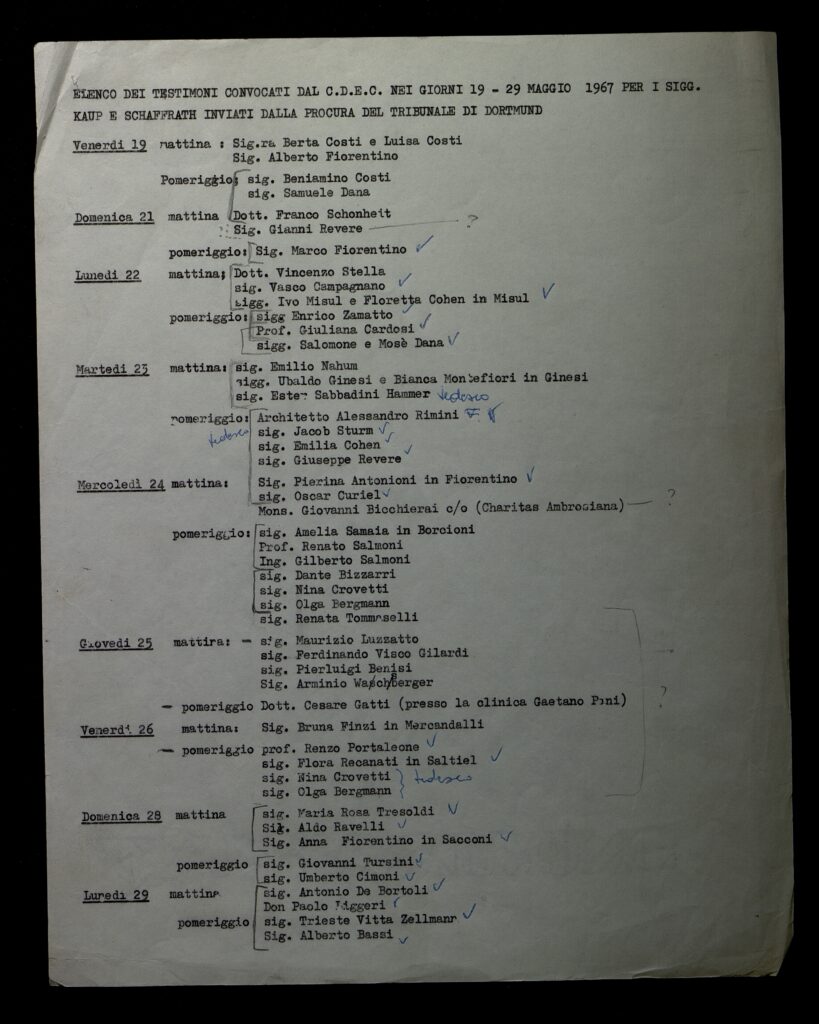
From one of the notebooks that Ravenna used to take notes, it is possible to reconstruct the schedule of the hearings held at the CDEC between 19 and 29 May 1967. It shows that in those days, around fifty people took turns in the offices on the via Eupili: both former Jews and anti-fascists deportees who had passed through San Vittore, Fossoli, Bolzano, Bergen-Belsen, Auschwitz, and Buchenwald, and indirect witnesses—former prison guards, medical officers. All were called upon to report what they had seen, heard, and experienced firsthand after 8 September 1943:
Friday 19 May: 9:30 Berta and Luisa Costi; 11:00 Alberto Fiorentino; 15:30 Beniamino Costi; 16:30 Samuele Dana.
Sunday 21 May: 10:00 Franco Schönheit; 15:00 Marco Fiorentino.
Monday 22 May: 8:00 Vincenzo Stella; 10:00 Vasco Campagnano; 11:00 Misul Flora née Cohen and Ivo Misul; 15:00 Enrico Zamatto; 16:30 Giuliana Cardosi; 17:00 Salomone Dana and Mosè Dana.
Tuesday 23 May: 9:30 Emilio Nahum; [?] Bianca and Ubaldo Ginesi; [?] Ester Sabbadini-Hammer; 15:00 Alessandro Rimini; 17:00 Jacob Sturm; 18:00 Giuseppe Revere; [?] Emilia Costi, widow Cohen.
Wednesday 24 May: 9:00 Pierina Antonini in Fiorentino; 10:00 Oscar Curiel; [?] Amelia Samaja and Alfredo Borcioni; 16:30 Gilberto and Renato Salmoni; 18:15 Dante Bizzarri; 19:00 Nina Crovetti née Neufeld, Olga Bergmann née Stahl, Renata Tomaselli née Einhorn.
Thursday 25 May: 9:30 Maurizio Luzzatto; 10:30 Ferdinando Visco-Gilardi; 13:00 Arminio Wachsberger; [?] Pierluigi Benisi; [?] Cesare Gatti.
Friday 26 May: 10:00 Bruna Mercandalli, widow Finzi; [?] Nina Crovetti née, Olga Bergmann née Stahl; 15:30 Renzo Portaleone; 16:30 Flora Recanati in Saltiel.
Sunday 28 May: 9:30 Maria Rosa Tresoldi; 10:30 Aldo Ravelli; 11:30 Anna Fiorentino; 16:00 Giovanni Tursini.
Monday 29 May: [?] Antonio De Bortoli; [?] Don Paolo Liggeri; 12:00 Maria Tresoldi; [?] Trieste Vitta Zelman; 17:00 Alberto Bassi75.
Over the course of eight days, forty-nine people were summoned, and a total of fifty-two hearings were conducted, with two witnesses heard twice (Crovetti and Bergmann). The overall impression is one of intense work, carried out almost without interruption: witnesses were scheduled at intervals of one to one and a half hours; sometimes individually, sometimes in pairs in cases of spouses or siblings.
From the transcripts of the hearings prepared by Giuliana Donati in 1974, it is possible to reconstruct the type of questions put to the witnesses, which varied depending on the witnesses and their experiences. As a rule, however, the questioning followed a progression “from the general to the particular”: first the arrests—where they had taken place and by whom; then the interrogations and the violence witnessed or suffered in prison; and then, in increasing detail, leading up to the identification of names and faces—commanders and officers of the San Vittore prison, the Fossoli camp, or Bolzano.
Some examples:
Vasco Campagnano,76 hearing May 22, 1967
[Wilhem Kaup’s Interpreter]: Who carried out the arrests? Italians or Germans?
[Vasco Campagnano]: They were Germans and…they were led by someone who spoke Italian… […].
[WK-I]: Was he in uniform?
[VC]: No, no, no…in civilian clothes. In fact, he even advised me not to resist, because…
[WK-I]: Were the Germans in uniform?
[VC]: No, no. There were six of them: two came into the house, two stayed at the door, and two were outside the door.
[WK-I]: Where were the others?
[VC]: Outside the door…under the window…two were inside…two were outside the front door and two were under the window, because I lived on the ground floor.
[WK-I]: Were you able to find out which unit these Germans belonged to?
[VC]: Eh…who could ask that? No, because from there, they took me straight to San Vittore prison. Then there was the lieutenant there…the one who was in charge at the time…the lieutenant…then there was Hans…a certain Hans…
[WK-I]: Were you taken to the Jewish section or the political section at San Vittore?
[VC]: To the Jewish section.
[WK-I]: Immediately?
[VC]: Yes, immediately. There, the lieutenant called me in, whose name… I don’t know now… at the time what his name was…he was a man of about thirty-five, I’d say…he interrogated me and told me: “You have been arrested for racial reasons.” And he sent me up to the sixth [sic] wing, where all the other Jews were.77
Emilia Cohen née Costi,78 hearing May 23, 1967
[Wilhem Kaup’s Interpreter]: Were you arrested by the Germans?
[Emilia Cohen]: By Marshal Koch himself. I only found out later, when they took me to San Vittore. Before that, I didn’t know it was him.
[WK-I]: When you were arrested, were there other people besides Marshal Koch?
[EC]: There was another one. Just one. There were two of them.
[WK-I]: Was he also a German or an Italian?
[EC]: I don’t remember exactly; I think one was Italian and one was Marshal Koch.
[…]
[WK-I]: Apart from Marshal Koch, do you remember anyone else among the German personnel?
[EC]: The only one I remember, who took me down into the basement, was Franz […].
Ubaldo and Bianca Ginesi,79 hearing May 23, 1967
[Wilhem Kaup’s Interpreter]: Did you know who was in charge of San Vittore prison?
[Ubaldo Ginesi]: It was said…there were two Germans, Franz and Klemm?
[WK-I]: Was Franz a first name or a surname?
[UG]: Well, nobody knows, everyone called him that…since in our section there were also partisans, in that fifth wing, downstairs there were the partisans…
[WK-I]: Just a moment—Franz and Klemm, did you personally know them? Could you say: This is Klemm and this is Franz?
[UG]: Yes, one was blond and the other…
[WK-I]: If someone came toward you, could you say: This is Franz…
[Bianca Ginesi]: Yeees, Klemm always walked around with a dog.
[…]
[photographs are shown]
[WK-I]: Try to see if you recognize anyone.
[UG?]: Klemm was tall, blond, he had blue eyes. They’re also in civilian clothes. We saw them in uniform—how can one tell? There were many like that. This one with the dog could be Klemm. One of them had a dog, he always went around with a dog, a big wolf like this. Klemm was more effeminate. How can one tell? Klemm was a blond, elegant, like a film type. I wonder if Hage is here too. Well. The uniform changes everything [fa tanto la divisa].
[…]
[WK-I]: You were probably in the section at Bolzano where the women were?
[Bianca Ginesi]: Yes.
[WK-I]: Were there male guards or female guards?
[BG]: The guard was a woman they called “the Tigress,” we didn’t know anything else, she was someone who came from the camps in Germany.
[WK-I]: Which camp?
[BG]: We didn’t know.
[WK-I]: Why did you call her “the Tigress”?
[BG]: Because she was terribly cruel. She whipped everyone, took them into the cells, there were cells.
[WK-I]: What did she whip them with?
[BG]: With a riding crop.
[WK-I]: A riding crop for horses?
[BG]: Yes, they all had those. They all had them. Everyone had them, even the soldiers.
[WK-I]: What kind of crop was it?
[BG]: Who knows. I remember Panciolini’s,80 because it was a piece of tubing with at the end…
[WK-I]: A piece of tubing—what kind, rubber, metal?
[BG]: Tubing made of…it must not have been metal, because it was flexible…81
All were able to recount what they had personally experienced, but few were able to remember names or recognize the faces of their captors. Monsignor Bicchierai was the only one to recall Bosshammer’s name, although he had never met or seen him. By contrast, Dante Bizzarri recounted the cold-blooded killing of a Roman Jew at Fossoli, while Franco Schönheit described the composition of the last convoy departing from Fossoli and suggested that Nina Crovetti82 be called to testify, as—being the secretary to the commandant of the Fossoli camp—she had personally drawn up the transport lists of the departing convoys.
From the point of view of the proceedings against Bosshammer, the hearings proved less decisive than might have been expected. From the perspective of the historical reconstruction of the dynamics of the Nazi persecution of the Jews in Italy, however, they represented an important step forward: as Liliana Picciotto would later write, “during the investigations and the examination of witnesses, a considerable amount of information and new data had emerged that needed to be taken into account.”83
The “considerable amount of information and new data” collected by Kaup became accessible in a clear and organized form thanks to the transcription of the recordings. We know, in fact, that the May recordings, after being transcribed by the Dortmund prosecutor’s office, were immediately sent back to the CDEC, and that only a few years later the CDEC entrusted Giuliana Donati with their “recovery.” Donati transcribed both the recordings and the notes that Ravenna regularly took during the hearings. The result is what I have illustrated in the few examples above: transcripts with a linear structure—question and answer—in which the interviewer asks questions and the interviewee responds. Both questions and answers are rendered in Italian.
However, listening to the recordings rediscovered in 2022 reveals a far more complex picture. This does not alter the substance of the information provided by the witnesses, but it confronts us with a source that is very different from that represented by the transcripts.
The hearings followed a structure that was at once precise and fragmented: each exchange unfolded in four stages—the question in German, the translation of the question into Italian, the answer in Italian, and the translation of the answer into German. The result was an inevitably slowed-down form of communication, at times subject to shifts in meaning, but also marked by voices that not infrequently overlapped—this often occurred when witnesses understood, and sometimes even spoke, German, and therefore did not wait for Kaup’s questions to be fully translated.84
The fragmentation—and, at the same time, richness—revealed by the recordings shows us very clearly what is absent from the transcripts: the entire portion of the hearing conducted in German is missing; often, there is no indication of who is speaking (the interpreter? the witness? Eloisa Ravenna, who occasionally intervenes?); the “timing” of the responses is missing, as are the difficulties of communication and comprehension that in some cases arose between those formulating the questions and those expected to answer them.
In light of this, we understand that Donati’s work was not exactly the transcription of an oral source, but rather the construction of a working document.85 From this perspective, one can account for certain condensations of spoken language, the transcription of only the Italian portions, and also a certain disregard for the figures present in the hearing setting—namely, Ravenna and the interpreters.
Listening to the recordings shows that the interpreters played a key role. Not only did they make communication between Kaup and the witnesses possible, but they also acted as genuine mediators. The two female interpreters in particular seem to have established a relationship of trust and familiarity with the witnesses, which, one may assume, could also have facilitated their interaction with the two German officials. In this sense, the interpreter emerges as a point of reference not only linguistically, but also emotionally (a role that can be even more clearly inferred from the brief conversations that can be heard before or after the hearings).
A further aspect that emerges from the recordings is how memory is shaped in the act of recollection. In Donati’s transcripts, one can perceive an attempt to reproduce the uncertainties and pauses of spoken language, but also a tendency to privilege the outcome of the response—that is, the information deemed relevant. Listening to the recordings, by contrast, reveals in every case a process of elaborating responses that is far more complex than what appears in the transcripts.
The recovery of the recordings thus makes it possible to shift our perspective beyond reading these testimonies as a mere “container” of information. They can, in fact, also be considered documents of emotional experience, and, precisely for this reason, they require—as David Boder86 observed—a true art of listening,87 capable of grasping not only the content, but also the manner and the context in which experiences are narrated—through hesitations, pauses, self-corrections, and inflections of the voice. These features are an integral part of the source and must be taken into account.
Let us take, for example, the testimony of Trieste Vitta Zelman.88 The transcript records that at a certain point, she was shown a set of photographs and asked to indicate whether, among the portraits presented, there was also that of Otto Koch, who—according to her testimony—had interrogated her immediately after her arrest:
Madam, please look carefully at the heads [ed.: that is, faces] between the two columns of the two upper rows.
It looks like this one to me…I wouldn’t swear to it. Koch, it seems to me it’s this one. Is this Koch? Eh? 7 [sic] Koch.
He’s the one who interrogated me. It’s Koch, is that right? It’s him, he interrogated me at…
Please also look carefully at the photographs on these two pages.
I recognized that other one.
Madam, on this page are you able to recognize Koch?
No, no.
I may have recognized that other one, perhaps these are earlier, earlier than the photograph you showed me. Because they seem to me…they are thinner…whereas that one there I recognized because he had a round face. Perhaps these are from three, four, five years earlier and the features change, at least in my view, earlier, you see…
Whereas when I saw him, he was not so young, here he is younger…he must have been about forty-five when I saw him, you can tell him that…
You have already recognized him, madam, it was indeed Koch. Was the man you recognized in this photograph the one who interrogated you?
Yes, he interrogated me through an interpreter.
What did he want to know about you, madam?
Ah, twenty-three years that I have been… ………
Did he perhaps tell you the reason for your arrest?
No, no, no…he was eating, he had an apple in his mouth, he was eating…
During the interrogation?
Yes, during the interrogation89.
This transcript, in which there is no indication of who is speaking, appears to present a simple two-way dialogue. In the recording, however, the voices that alternate and overlap are at least three—four, when Ravenna intervenes. The interpreter’s voice—a woman’s—is understanding and caring, and the witness seems to seek reassurance from her (and perhaps also from Ravenna):
Transcript of the Italian portion from the recording
[Italics indicate passages omitted from Donati’s transcript/translation]
Interpreter: Madam, please look carefully at the heads [sic] in the two columns of the two upper rows.
Trieste Vitta Zelman: It seems to me it’s this one, but I wouldn’t swear to it.
Koch. It seems to me it’s this one. Is this Koch? Eh? [ed.: in a tone of satisfaction and self-assurance]
Is it Koch? You see…? He’s the one who interrogated me.
It’s Koch, this one. Is that right? It’s him. It’s this one here, who interrogated me at…at…oh God, sorry…
I: Would you please look carefully at these photographs, madam, here,
[ed.: silence]
TVZ: I recognized that other one.
I: Madam, on this page are you able to recognize Koch?
TVZ: NO. [ed.: pause] No.
I may have recognized that other one because…
Perhaps these…are earlier [ed.: here and in the following lines, Vitta Zelmann seems to be thinking things through with Ravenna, while the interpreter, in the background, translates for Kaup]
Earlier than the photograph you showed me…
Eloisa Ravenna: One could ask…one could ask why, because also this morning…
[ed: inaudible]
TVZ: Because they seem to me…these…they are thinner!... Whereas that one there I recognized because he had a round face.
Perhaps these are from three, four, five years earlier and then the features change, at least in my view…
earlier, you see…it’s…
…whereas when I saw him, he was not so young…
They are younger!
Here he is younger…he must have been about forty-five when I saw him, you can tell him that…
I: You have already recognized him, madam, it was indeed Koch
I: The man you recognized in this photograph—was he the one who interrogated you?
TVZ: Yes. He interrogated me through an interpreter
I: What did he want to know about you, madam?
TVZ: Ahhh, I have been… for twenty-three years, eh… that I have been………so, what was it that he asked me…?
I: Were you told the reason for your arrest?
TVZ: No no… no no no no no no.
He was eating…he had an apple in his mouth…he was eating…and spitting it out [ed.: in a low voice and with embarrassment; she seems to want to say this only to the interpreter, almost as a confidence]
I: During the interrogation?
TVZ: Yees! During the interrogation!90
Another interesting case, in terms of both structure and complexity, is the testimony of Nina Crovetti91 on 24 May. The hearing also took place in the presence of Olga Bergmann and Renata Tomasselli, and was conducted entirely in German, without an interpreter,92 as all three witnesses were native German speakers. In this case, the transcript is simultaneously a translation from German into Italian. Listening to the recording makes it clear that Donati condensed certain passages in her translation.
At one point in Donati’s transcript/translation, we read:
WK.: Did you travel from Fossoli directly to Auschwitz?
NC.: No, from Fossoli we went by L.K.W. (= Lastkraftwagen, that is, a military truck) [sic] as far as Verona, and then by train to Auschwitz.
WK.: Were you in cattle cars?
NC.: Of course.
WK.: How many people were there in each wagon?
NC.: Twenty, twenty-five.
Olga Bergman.: There were up to forty per wagon.
NC.: There was no selection immediately on the ramp; instead, we were taken to Birkenau. The selection took place many hours later. The next day. Mengele was there, and two others. He saw me and said: “Die ist kräftig, die Sau-Jüdin” (This dirty Jewess is strong—“Questa sporca ebrea è robusta”), “Die kann noch arbeiten” (she can still work). I had grey hair, but he said to me: “Yes, you can still work.”
They put me in one group, and the children and the elderly in another. They were told: “You are going to a camp where people do not have to work.”93
At this point in the recording, the exchange appears more articulated, both in the responses and in the ongoing interaction between Crovetti and Bergmann:94
[Italics indicate passages omitted from Donati’s transcript/translation]
Wilhem Kaup: How many people were there in each wagon?
Nina Crovetti: This is difficult to say, but I would think at least…how many could there have been? About twenty, twenty-five.
Olga Bergmann: There were up to forty per wagon.
NC: In ours? No, I don’t think so…
OB: Yes, there were also…
NC: No, I don’t think so…
OB: When the convoys were full and left, there were forty people.
NC: Yes, perhaps so.
OB: There were usually 400 people in one transport…
K and C: Yes [ed: said together while Bergmann is speaking].
OB: …where we were loaded…
NC: In the wagons…
K: How many wagons did a transport have? Approximately?
NC: I have no idea!!
K: Yes…
NC: You know, I was thinking about something else, I didn’t look! [ed.: raises her voice]
K: When you arrived in Auschwitz and were unloaded, on the ramp, was there a selection?
NC: There was no selection immediately on the ramp, but we were taken to the camp in Birkenau, I think, or Auschwitz, I cannot say. Then we waited several hours. And then the selection.
K: So you cannot say whether it was Auschwitz or Birkenau?
NC: I believe it was Birkenau…
K: And then?
NC: And then the selection. First the children, then the elderly.
K: Did it take place the same day? Or the following day?
NC: I think the following day. But I cannot say with certainty [ed.: tone of regret].
K: Where were you assigned, with which group?
C: Mengele was there…
K: Mengele was there…
C: There was Mengele and two others. He saw me and said: “Die Sau-Judin, die ist kräftig genug, die kann arbeiten” [That filthy Jewess—she is strong enough, she can work— “quella lurida ebrea—è abbastanza forte, può lavorare]. He even asked me how old I was. I had grey hair at the time, and I answered forty, but he said to me: “Yes, you can still work.” He sent me to work. They put me in a group with the young people, while the children and the elderly were placed in another group. They were told: “You are going to a camp where people do not have to work.” But people already knew…95
In this case as well, as in the previous one concerning Trieste Vitta Zelman, what the recording brings out is not so much different information from what was already known, but rather the complexity of its elaboration. Whereas in Donati’s transcript, the answers appear linear, coherent, and clear-cut, in the recording they emerge as the result of interactions, hesitations, second thoughts, and prompts from those asking the questions—or simply listening.
Listening thus confirms that the witnesses’ answers are the outcome of a process of probing and working through their own memories, which Donati only partially conveyed in her transcript, privileging the information contained in the answer rather than the process through which that information takes shape.
Ultimately, these recordings very clearly show the difference between judicial testimony and testimony of a memorial nature. In these hearings, the witness is not a “protagonist,” and the account of their personal story is not the aim of the questions to which they are subjected. In this context, the witness is above all an “eyewitness”:
Oscar Curiel: [he] …was out of his mind and took off his clothes and I saw that…that they…shot him.
Interpreter: You saw…you saw them shoot
[…]
Intepreter: How was Lombroso killed?
OC: Well, I think…with…a pistol…a shot to the back of the head…or something like that…
I: In any case, he was shot?
OC: Shot.
I: Did you see the shot with your own eyes? That is, were you present at the moment of the shooting?
OC: No, I was not present…I was not present…
I: You were not present…?
OC: No, I was not present at the shooting. I saw that they killed him.
I saw, I saw… Now! after twenty-five years I cannot say…
I saw the body! That is, if I want to be precise…
[…]
OC: …there is no point in saying this…it does not matter now, and after twenty-five years, to say whether I saw them shoot…what is certain is that they killed him!
[…]
I: For the gentlemen, this is important, because they want to know exactly who killed him.
OC: Ah, that’s the point, that’s the point…. That is right, but I cannot say it…96
In the 1967 recordings, alongside the re-emergence of memory, we also encounter ambient sounds and background conversations: the phone calls that Ravenna receives during the hearings of Alessandro Rimini and Oscar Curiel; the offer of a lift home by car that Don Liggeri97 is heard receiving from Antonio De Bortoli,98 and the flask of wine that the latter—“had he known”—would have brought. And then: the words of appreciation, gratitude, and “solidarity” expressed by the vice-president of the Jewish Community of Milan, who was visiting at the time, to Kaup, the Dortmund prosecutor’s office, and Ravenna for the work they were carrying out together, because, as he says, “every act of justice serves not only you and us, but everyone”;99 and again, the informal exchanges between Ravenna and Pnina Schotten regarding the most appropriate form of address to use when speaking to a monsignor100 (and the suggestion offered by Kaup, “Excellence”).
These elements, although external to the investigation, help to convey the climate, the atmosphere in which the source was produced, including the relationships among the various people involved. For example, in none of the witnesses heard in these recordings—except perhaps Oscar Curiel101—does one perceive those tones or feelings of distrust toward the German interrogator that one might have expected—and that Kaup himself, in fact, expected: “For me, it was a hugely meaningful experience to observe the cooperation of people who in truth would have every reason to be ill-disposed and distant.”102
What only listening to the recordings, and no transcript—neither that of 1974, nor any produced today—I would argue, can ultimately convey is the tone of the voices, the sighs, the inflections: the strong, assured voice of Crovetti and the irony mixed with sarcasm that permeates some of her answers; the lightness with which Antonio De Bortoli recounts even the tortures he endured; the gravity of Don Liggeri’s responses; the shyness of Alessandro Rimini; a certain boldness on the part of Emilio Nahum.
Beyond the results that those hearings produced for the purposes of the proceedings against Bosshammer, and more than any subsequent analysis, what ultimately conveys the deeper meaning of that “encounter” between Kaup, Schaffrat, and the witnesses is a letter that Ravenna addressed to Kaup a few months after the conclusion of the Milan hearings:
For me too, as I already told you, the most positive aspect of this work of ours and yours is its human dimension, the possibility of an encounter: for us, having felt in you a deep and conscious commitment and—beyond the search for data and information useful for the purposes of the criminal proceedings—the effort to understand those who were sitting before you, burdened by a past that cannot but weigh upon you; for you, having felt that it was possible—even if at times with difficulty—to overcome that natural distrust toward “a German” and to reopen a dialogue, even if, for the time being, this dialogue does not seem to be directed toward anything other than that past [anche se questo discorso, per ora, non sembra possa essere rivolto altro che a quel passato]. A past that yesterday bound us sadly in wrongdoing and that today should unite us in the search for what is just and good.
None of the witnesses who had expressed doubts and distrust at the time when they were summoned rose and left without greeting you once you had finished asking your questions; Mr. Curiel, addressing me, even said: “Poor people, them too: how much harm all this has done them.” These, for me, are the most beautiful moments, the moments in which I feel that something melts within us and that it is still possible to smile. But a “healing” in this sense is possible only—as you write103—in conscious remembrance, in the struggle against those who persist in remaining silent, and in the teaching—without any attenuation—of this dark period of German history and of the extermination of the Jews of Europe to the younger generations.104
The proceedings initiated by the Dortmund prosecutor’s office in 1964 and culminating in the 1967 hearings did not continue in that venue due to insufficient evidence to bring the case to trial: neither the documentation nor the testimonies collected up to that point provided sufficient grounds to establish that Bosshammer had been responsible for the deportation of the Jews from Italy.105 In 1968, the Bosshammer case was taken up by the Berlin court, with a new legal classification of the charges: complicity in murder with Hitler, Göring, Goebbels, Himmler, the heads of the Reich Main Security Office (Reichssicherheitshauptamt; RSHA), and Department IVB4—Ernst Kaltenbrunner, Heinrich Müller, Adolf Eichmann, and Rolf Günther. The trial took place between the end of 1971 and the beginning of 1972, and also at that stage, the work of the CDEC and of Eloisa Ravenna proved decisive. This further phase of the investigation will be address
1 Handwritten text in pencil, with corrections, in the Fondo Processi ai criminali nazisti. Procure di Dortmund e Berlino, box 5, file 51, CDEC Foundation Archives (henceforth, ACDEC); typescript copy in the Fondo Processi ai criminali nazisti. Procure di Dortmund e Berlino, box 5, file 52, ACDEC. All translations into English are the author’s unless otherwise stated.
2 Beniamino Costi, Jew, born in Smyrna on 14 June 1924, was arrested in Milan on 2 February 1945. He was taken to the San Vittore prison and subsequently transferred to the Bolzano camp, where he remained until its liberation by the International Red Cross on 29 April 1945.
3 Stameta Besso, born in Corfu on 15 April 1926, was deported to Auschwitz from Corfu in 1943. See the interview she gave for the Shoah Visual History Foundation (Los Angeles), http://www.shoah.acs.beniculturali.it/index.php?page=View.ObjectMetaData&id=shoah%3A42962 (accessed November 24, 2025).
4 Beniamino Costi, May 19, 1967, Giuliana Donati’s transcript (1974), Fondo Processi ai criminali nazisti. Procure di Dortmund e Berlino, box 5, file 52, ACDEC.
5 For a brief biography of Friedrich Robert Bosshammer (1906–1973): Sara Berger, “Selbstinszenierung eines ‘Judenberaters’ vor Gericht: Friedrich Boßhammer und das ‘funktionalistische Täterbild,’” Jahrbuch für Antisemitismusforschung 17 (2008): 243-268; see also Berger, “Il BdS, l’Ufficio IV B4 e la persecuzione degli ebrei,” in I signori del terrore. Polizia nazista e persecuzione antiebraica in Italia (1943-1945), ed. Sara Berger (Verona: Cierre Edizioni, 2016), 93-118.
6 Liliana Picciotto, Il libro della memoria. Gli ebrei deportati dall’Italia (1943–1945) (Milan: Mursia, 1991 [1st ed.]; 2002 [2nd ed.]). In the first part of the volume, Picciotto reconstructs the different phases of the research: that of the Comitato Ricerche Deportati Ebrei between 1944 and 1953; that of the CDEC carried out by Giuliana Donati between 1972 and 1974; and finally another phase by the CDEC carried out by Picciotto herself between 1979 and 1990. The research phase conducted by Giuliana Donati resulted in the volume edited by the CDEC, Ebrei in Italia: Deportazione, Resistenza (Florence: Giuntina, 1975).
7 The concern that the tapes might have been overwritten or otherwise reused primarily stemmed from the word “Beatles” having been written on one of the tape boxes.
8 On this, see, among others, Carlo Ginzburg, Il giudice e lo storico (Turin: Einaudi, 1991); Devin O. Pendas, The Frankfurt Auschwitz Trial, 1963–1965 (Cambridge: Cambridge University Press, 2006); Rebecca Wittmann, Beyond Justice: The Auschwitz Trial (Cambridge, MA: Harvard University Press, 2005); Annette Wieviorka, L’ère du témoin (Paris: Plon, 1998).
9 Between 1959 and 1961, Zeug conducted important investigations for both the Treblinka and Sobibor trials. In 1961, he followed the trial of Adolf Eichmann as an observer on behalf of the Federal Foreign Office of the Federal Republic of Germany. The twenty-nine reports he drafted on the proceedings in Jerusalem also contain observations on the modus operandi of the state attorney, Gideon Hausner. On this, see in particular Ruth Bettina Birn, “Fifty Years after: A Critical Look at the Eichmann Trial,” Case Western Reserve Journal of International Law 44 (2011): 443-473, https://scholarlycommons.law.case.edu/jil/vol44/iss1/21, (accessed December 20, 2025).
10 Berger, “Selbstinszenierung eines ‘Judenberaters’ vor Gericht.”
11 The other eight individuals deemed worthy of the War Merit Cross were Schoffmann, Schaberl, Mang, Heisner, Holz, Koch, Donner, and Wartha. See the photographic reproduction of the document in Berger, “Il BdS,” 99-100.
12 Befehlshaber der Sicherheitspolizei und des SD Italien.
13 Berger, “Il BdS,” 100 and 112.
14 Bosshammer’s name had already been mentioned during the Eichmann trial, in the hearing on the “Italian case.” It had been cited in connection with a letter from Horst Wagner to Heinrich Müller, in which he reported on a conversation that had taken place in early December 1943 between Eberhard von Thadden, Theodor Dannecker, and Bosshammer concerning the position to be adopted vis-à-vis the government of the Repubblica Sociale Italiana (RSI) with regard to the treatment of Jews in Italy. According to this account, Bosshammer had suggested requesting from the Fascist government “the simultaneous extradition of all Jews gathered in concentration camps for evacuation to the eastern territories.” See report by Dieter Zeug, 19 June 1963, B Rep. 057-01, p. 21, Landesarchiv Berlin, Berlin.
15 Dieter Zeug to Eytan Otto Liff, February 22, 1963. This correspondence is attached to Zeug’s letter to Guido Valabrega of 12 March 1963, Corrispondenza, 1963, Fondo Archivio istituzionale, [unprocessed collection], ACDEC.
16 Guido Valabrega, a historian, served as director of the Centro di Documentazione Ebraica Contemporanea from 1960 until October or November 1963. On how Zeug came into contact with Valabrega, see Alessandra Minerbi, “Le carte del processo Bosshammer,” in Enzo Collotti e l’Europa del Novecento, ed. Simonetta Soldani (Florence: Firenze University Press, 2011), 121-132.
17 Between 15 and 23 September 1943, units of the 1st SS Panzer Division Leibstandarte SS Adolf Hitler carried out the first massacres of Jews in Italy following the German occupation. In the towns of Meina, Stresa, Baveno, and Arona, on Lake Maggiore, more than fifty people were killed. The massacre of Meina, one of the best known, was recounted by Marco Nozza in Hotel Meina. La prima strage di ebrei in Italia (Milan: Mondadori, 1993), largely based on sources for the Osnabrück trial collected by the CDEC. From Nozza’s book, Carlo Lizzani later made the film of the same name, Hotel Meina (2007).
18 In the final part of his long letter, Zeug reported the information available to him: “According to the findings obtained thus far, a total of 7,496 Jews were deported from Italy, the majority of them presumably to the extermination camp of Auschwitz. Only 610 persons returned, so that the total number of Italian Jews killed in labor and extermination camps should amount to 6,886” (Dieter Zeug to Guido Valabrega, March 12, 1963, Corrispondenza, 1963, Fondo Archivio istituzionale, [unprocessed collection], ACDEC.
19 Guido Valabrega to Dieter Zeug, 23 March 1963, CDEC Foundation Archives, Fondo Archivio istituzionale CDEC. Corrispondenza, 1963 (unprocessed collection). In some ways, Valabrega’s observation echoes the words of Primo Levi in The Drowned and the Saved: “Surrounded by death, the deportee was often in no position to evaluate the extent of the slaughter unfolding before his eyes” (Levi, The Drowned and the Saved, trans. Raymond Rosenthal [New York: Vintage Books, 1988], 8).
20 On this point, see Guido Valabrega, “Appunti sulla persecuzione antisemita in Italia durante l’occupazione nazista,” Il Movimento di Liberazione in Italia 74 (1964): 21-22: “In general, we believe it may be said that Italian writing on the participation of the Nazis in the persecution of the Jews oscillates between two poles: either it focuses primarily on certain diplomatic aspects […] or it tends to emphasize particular episodes of an especially grave and bloody character (the events at Meina, the action of 16 October in Rome, the tragedy of deportation). What is lacking, instead, is an inquiry that directs attention first and foremost to the Germans, examining not their remote aims, but their immediate ones, the ways in which they intended to carry out their plans, and the organizational structure on which they relied to implement them.” More generally, along the same lines, see also the contribution by Vittorio Giuntella in the first issue of Quaderni del Centro Studi sulla Deportazione e l’Internamento: “A study of the role of the Italians in the deportations, and of the specific features of their presence within the the German concentration camp system [universo concentrazionario tedesco], presents particular difficulties, since in Italy there was no comparable effort to collect documentation of the kind undertaken in other countries; nor have Italian historians of the Second World War thus far shown interest in this specific field of research. The only available source of information (public archives still being inaccessible) is the relatively abundant body of memoir literature, which flourished above all in the years immediately following Liberation” (Giuntella, “Per una storia degli Italiani nei lager nazisti,” Quaderni del Centro Studi sulla Deportazione e l’Internamento 1 [1964]: 9).
21 “The initial nucleus of the archive [of the CDEC] was, from the very moment of the Centre’s establishment, the documentation collected by the Comitato Ricerche Deportati Ebrei […] that collection became the basis for a more properly historical archive, and the starting point for further research” (Eloisa Ravenna, “Il Centro di Documentazione Ebraica Contemporanea,” Quaderni del Centro Studi sulla Deportazione e l’Internamento 4 [1968]: 3-11).
22 “[…] it is my duty to make clear to you that our Centre, although supported by the Italian Union of Jewish Communities [Unione delle Comunità Israelitiche Italiane], cannot afford, given the scarcity of its resources, a systematic, thorough, and conclusive study of the highly interesting research topics that you indicate” (Guido Valabrega to Dieter Zeug, March 23, 1963, Corrispondenza, 1963, Fondo Archivio istituzionale, [unprocessed collection], ACDEC.
23 Eloisa Ravenna (1930-1973), born in Turin and already a collaborator of the CDEC during Valabrega’s tenure, was appointed director (Segretaria generale) in November 1963, at a delicate moment in the Centre’s early history: “The Centre is closed and not functioning […] the concrete fact that the Centre is no longer able to do anything, to respond to public requests, to process files, or to carry out its normal activities seems to me worthy of reflection” (Guido Valabrega to Eloisa Ravenna, 27 October 1963, CDEC Foundation Archives, Fondo Guido Valabrega, box 18, file 75 [digital copy kindly provided by Istituto Parri Milano; original reference: Istituto Parri]). For a portrait of Ravenna, see Liliana Picciotto, “Eloisa e il CDEC,” La Rassegna mensile di Israel 47 (1981): 9-44.
24 Particularly significant is Obluda’s account of the information at his disposal, also for the tentative language that characterizes it and effectively conveys the still uncertain state of knowledge, at the time, regarding the deportation of Jews from Italy. The Italian translation is also notable for its occasionally unstable or imprecise phrasing, which suggests the absence, at the time, of a fully developed vocabulary for describing such events: “From Central and Northern Italy, during the period of the German occupation, several thousand Italian Jews must likewise have been deported and died in the camps of Auschwitz, Dachau, Mauthausen and Flossenbürg. From documents of the then Ministry of Foreign Affairs and of the German Embassy in Rome it appears that the measures against the Jews in Italy were intensified from March 1943 [sic; read 1944]. Since the Italian authorities had evidently initiated proceedings against the Jews only reluctantly and acted only sporadically, the Security Police of the BdS Italy had to be deployed more intensively. For this purpose, in the spring of 1944, Dr. Bosshammer, SS-Sturmbannführer, must have been assigned as officer in charge of Section IV B4 (Jewish Affairs) to the BdS in Verona (probably as Dannecker’s successor). Furthermore, around February 1944, the Fossoli camp c/o Carpi-Modena, previously an Italian prisoner-of-war camp, was converted into a “police transit camp” [“campo di passaggio di polizia”] of the BdS Italy and placed under the command of SS-Hauptsturmführer Tito. In this camp, and after its evacuation [“abbandono”], in the police transit camp of Bolzano, the Jews of Central and Northern Italy must have been assembled and from there transported to the above-mentioned extermination camps (Günther Obluda to Guido Valabrega, September 22, 1964, Italian translation of the German original prepared by the CDEC [1964], Fondo Processi ai criminali nazisti. Procure di Dortmund e Berlino, box 2, file 4, ACDEC. The English translation follows as closely as possible the Italian translation of the German original, preserving its phrasing and any inaccuracies).
25 At Fossoli di Carpi, in the province of Modena, a camp for the detention of Jews arrested following Order n. 5 of 30 November 1943 was established as early as December 1943. From the end of February 1944, the camp was transformed into a Polizei-Durchgangslager (“police transit camp”) and remained in operation until 1 August 1944. With the closure of Fossoli, the Polizei-Durchgangslager at Bolzano came into operation, remaining active until the end of April or early May 1945. On the Fossoli camp in particular, see, among others, Liliana Picciotto, L’alba ci colse come un tradimento. Gli ebrei nel campo di Fossoli. 1943–1945 (Milan: Mondadori, 2010).
26 It should be noted that the original German text reads: “Dokumente über die Namen der Führer und Wachmannschaften dieser Lager sowie über die Befehls- und Unterstellungsverhältnisse dieser Lager,” whereas the Italian translation produced at CDEC in 1964 renders this as: “documenti sui nomi dei campi e delle guardie di questi campi così come sulle condizioni di comando e dipendenza di questi campi.” In this case, the Italian version contains a significant inaccuracy (notably the rendering of “Führer” as “campi”). Although the Italian version is imprecise, it is retained here because it formed the basis of the documentation used at CDEC at the time. The English translation provided here therefore follows the Italian version rather than the original German. Unless otherwise indicated, this approach has been adopted throughout the present study.
27 Günther Obluda to Guido Valabrega, September 22, 1964, Fondo Processi ai criminali nazisti. Procure di Dortmund e Berlino, box 2, file 41, ACDEC. The translation from German into Italian was carried out within the CDEC (1964). The German original of the letter is attached to the translation.
28 It is worth noting that from December 1964 onward, the CDEC was also involved in the Osnabrück court’s investigations into the massacres at Lake Maggiore. The Zentralestelle in Ludwigsburg entrusted these investigations to Prosecutor Wachter (see Wachter to Eloisa Ravenna, 10 December 1964, Fondo Processo ai criminali nazisti. Procura di Osnabrück, box 1, file 2, ACDEC). Alongside its research on Bosshammer for the Dortmund court, the CDEC therefore also carried out research for Osnabrück. In this case, the trial took place in 1968 and resulted in life sentences for the defendants. In 1970, during the appeal proceedings in Berlin, the crimes were deemed time-barred and the convictions were annulled. On this, see the already cited Nozza, Hotel Meina, as well as the documentation in the CDEC Foundation Archives, Fondo Processo ai criminali nazisti. Procura di Osnabrück, in particular boxes 3 and 4 relating to the 1968 judgment and the statute of limitations.
29 Eloisa Ravenna to Günther Obluda, 12 October 1964, Fondo Processi ai criminali nazisti. Procure di Dortmund e Berlino, box 2, file 41, ACDEC. Since all the correspondence between Ravenna and Obluda is preserved in the same file, subsequent references will indicate only the correspondents and the date given at the head of each letter (draft copies, in the case of letters sent by Ravenna). The Italian translations of the correspondence are, unless otherwise indicated, the official versions transmitted by the German judicial authorities, received by Ravenna and preserved in the file. In the cases of letters available only in German, the Italian translations were prepared by collaborators of the CDEC. For the purposes of this study, the Italian translations preserved in the files have been adopted.
30 “Senza la testimonianza nostra, senza l’aiuto nostro…?” Interview with Eloisa Ravenna for Radio della Svizzera Italiana, February 1973, ACDEC.
31 Eloisa Ravenna to Günther Obluda, October 29, 1964. Enzo Collotti’s article, “Dati sulle forze di polizia fasciste e tedesche nell’Italia settentrionale nell’aprile 1945,” was published in Il movimento di liberazione in Italia 71 (1963): 51-72.
32 A copy of this report is held in the Fondo Comunità ebraiche in Italia, box 5, file 38 (“Roma”), ACDEC. A copy of the brochure “Ottobre 1943: Cronaca di un’infamia” is preserved in the Fondo Goffredo Roccas, box 1, file 1, ACDEC.
33 The article was published in Gli ebrei in Italia durante il fascismo 3, ed. Guido Valabrega (1963), issued by the Centro di Documentazione Ebraica Contemporanea (CDEC). The first two Quaderni, published under the same title, had appeared respectively in 1960, edited by Paolo Foà for the Federazione Giovani Ebrei d’Italia (FGEI), and 1962, edited by Guido Valabrega for the CDEC.
34 Documentation on the Bolzano camp is preserved in the Fondo Carceri, Località di internamento e Campi di Concentramento in Italia, box 3, file 49 (“Bolzano”), ACDEC
35 Eloisa Ravenna to Günther Obluda, November 25, 1964.
36 The letter continued as follows: “In a separate mailing, I have sent you a copy of the journal Il Cristallo from Bolzano (June ’64), containing some testimonies on that camp. In the piece by E. Pedrotti (‘Il “lager” di Bolzano’), on p. 10, reference is made to clandestine activity within the camp, and to committees responsible for transmitting information and lists of detainees to the outside from time to time […]. I enclose a photostatic copy of a letter dated 4 April (’45), ‘Cara Anita,’ with one of the aforementioned lists of names, in which two Jewish names appear (Renzo PORTALEONE and WAKTOR Enrico, marked with ‘giallo L’: yellow mark, because Jews, ‘L’ as in ‘Lavoratore,’ likely a translation of ‘Arbeiter’). According to a former female internee in the camp, from whom I obtained this and the following documents, there was a small group of Jews in the camp—around ten—who wore a yellow armband with the letter ‘A,’ while all the others wore only a registration number); and a copy of a letter dated 14.12.44, signed Taura, informing her husband of the deportation of Mrs. Lucia (Debenedetti, Jewish), who did not return […]. I further enclose: – a list of deaths that occurred in the camp from 1 January 1945, recorded at the Municipality of Bolzano (2 sheets), in which the names of ten Jews appear; – a copy (4 sheets) of a testimony preserved in our archive, by a certain Amerigo Sedun [sic; read Sadun] of Florence, formerly interned in Bolzano […] – an extract from the report of Criminal Commissioner Arthur Schoster of 21 June (6 sheets), which, although it does not refer to Jews, may nevertheless be of use to you for the mention of certain names. In your letter of 22 September, under point 10, you mentioned a certain Schuster who was reportedly tried and convicted in Bolzano for having carried out measures against Jews: since no one has been able to tell me anything either about the trial or about the defendant, I thought that this may instead refer to this Arthur Schoster, a German appointed by the Allied authorities to conduct an inquiry for the Criminal Court established in Bolzano in 1945” (Eloisa Ravenna to Günther Obluda, November 25, 1964, originally in Italian).
37 After 8 September 1943, three of the six wings (raggi) of the San Vittore prison in Milan were requisitioned by the German occupying forces: two wings were reserved for political prisoners (wings IV and VI) and one for Jews (wing V) awaiting deportation. The remaining three raggi of the prison remained under the administration of the Milan police headquarters (Questura) and were reserved for civilian or political detainees (see Liliana Picciotto, Gli ebrei in provincia di Milano 1943/45. Persecuzione e deportazione [Milan: Provincia di Milano, 1992], 28; Picciotto, Il libro della memoria, 887-889). From September 1943, the first commander of the German sector was SS-Hauptscharführer Helmuth Klemm; from December 1943, he was assisted by SS-Oberscharführer Leander Klimsa. Klimsa was promoted to director in February or March 1944, while Klemm was transferred to the Milan IV B4 office, under SS-Hauptscharführer Otto Koch. Klimsa’s deputy was SS-Rottenführer Franz Staltmayer (see also Luigi Borgomaneri, Hitler a Milano. I crimini di Theodor Saevecke capo della Gestapo [Milan: Datanews, 2000], 70).
38 A photocopy of the register, together with other documentation relating to the San Vittore prison, is held in the Fondo Carceri, località di internamento e Campi di Concentramento in Italia, box 7, file 59 (“San Vittore”), ACDEC.
39 This appears to refer to the Museo del Risorgimento in Milan.
40 This is a handwritten deposition in Eloisa Ravenna’s hand, signed by Don Franco Rimoldi. It is preserved in the Fondo Carceri, località di internamento e campi di concentramento in Italia, box 7, file 59 (“San Vittore”), ACDEC
41 The correct name is SS-Oberscharführer Leander Klimsa, initially deputy commander and, from February or March 1944, commander of the German sector of the San Vittore prison (see Picciotto, Il libro della memoria, 821 and 887).
42 This refers to SS-Rottenführer Franz Staltmayer, who served at San Vittore as deputy director of the German section from spring 1944 (see Picciotto, Il libro della memoria, 821 and 887).
43 SS-Hauptsturmführer Theodor Saevecke, head of the Security Police (SIPO-SD) in Milan.
44 See Fondo Vicissitudini dei singoli, box 10, file 279, ACDEC.
45 In the CDEC library catalogue, only the edition published in 1945 by Speroni (Milan), with a preface by Luigi Gasparotto, is recorded.
46 Published in Milan in 1945 by S. Giovene, this volume forms part of the CDEC Foundation’s library collection.
47 In 1963, the Associazione Nazionale Ex Deportati (ANED), based in Milan and chaired by Giovanni Melodia, was involved in the investigations into the case of Theodor Saevecke initiated by the Zentralestelle in Ludwigsburg. The public prosecutor Gerhard Wiedemann was sent to Milan and collected a number of witness statements at the ANED, including those of Giovanni Melodia, Aldo Ravelli and Guido Valabrega. For a detailed reconstruction of the entire affair, see Borgomaneri, Hitler a Milano. See also Fondo Guido Valabrega, box 2, file 10, ACDEC [digital copy kindly provided by Istituto Parri Milano; original reference: Istituto Parri].
48 From September 1943, SS-Sturmscharführer Otto Koch served as Judenreferent—that is, the official in charge of Jewish affairs—at the Aussenkommando in Milan (see Carlo Gentile and Lutz Klinkhammer, “L’apparato centrale della Sicherheitspolizei in Italia: Struttura, uomini e competenze,” in Berger, I signori del terrore,36-68).
49 In all likelihood, these documents correspond to part of the material now held in the Fondo Vicissitudini dei singoli, series I, box 20, file 589, ACDEC.
50 “ACS, MI, PS, Massime (category R9 ‘Razzismo’), box 183, file 19, ‘Ebrei da internare,’ Chief of Police Tamburini to all provincial prefects, telegram no. 3968/442, 7 March 1944: Following a similar communication received from the General Directorate for Demography and Race, and with reference to telegraphic circular no. 1412/442 of 22 January, it is confirmed that Jews of pure blood, both Italian and foreign, must be sent to concentration camps, with the exception of those over seventy years of age and the seriously ill. Excluded from this measure are Jews from mixed families, including foreign Jews married to Italian Aryans or to Aryan citizens of any nationality. Also exempt are those who, pursuant to Law no. 1204 of 13 July 1939 (still in force), have obtained a formal declaration of not (repeat: not) belonging to the Jewish race. It is further added that the Jewish property regime has been assigned to the jurisdiction of the Ministry of Finance and will be regulated by the Duce’s legislative decree dated 4 January. Chief of Police Tamburini” (see Matteo Stefanori, “Ordinaria amministrazione: I campi di concentramento per ebrei nella Repubblica Sociale Italiana” [PhD diss., Università degli Studi della Tuscia-Université Paris Ouest Nanterre La Défense, 2012], 123) (originally in Italian).
51 This number derives from the list compiled by Massimo Adolfo Vitale in 1947. See “Elenco dei deportati dall'Italia negli anni 1943 – 1944”, bound typescript, Fondo CRDE, ACDEC.
52 Eloisa Ravenna to Günther Obluda, December 10, 1964, originally in Italian.
53 Eloisa Ravenna to Guido Obluda, December 21, 1964, originally in Italian.
54 All of this information can be found in Picciotto, Il libro della memoria, 851-949; see also Gentile and Klinkhammer, “L’apparato centrale della Sicherheitspolizei in Italia.”
55 SS-Hauptsturmführer Theodor Dannecker (1913-1945) served as Judenreferent in Italy from September 1943 to January 1944. On 16 October 1943, he directed the operations for the roundup of the Jews of Rome (see Picciotto, Il libro della memoria, 881; Berger, “Il BdS”).
56 This is in fact Hans Arndt, a liaison officer between the Gestapo (Amt IV) office in Verona and the Fossoli camp, and one of the direct perpetrators of the deportation of Jews (see Picciotto, Il libro della memoria, 915).
57 Günther Obluda to Eloisa Ravenna, February 22, 1965.
58 Ravenna travelled to Genoa in mid-December 1964, but reported the results of that visit to Obluda in two separate letters dated 14 and 15 April 1965 (see Eloisa Ravenna to Günther Obluda, April 14 and 15, 1965, originally in Italian).
59 In the above-mentioned 1973 interview with the Swiss Italian Radio [Radio della Svizzera Italiana], referring to this testimony by Fantelli, Ravenna stated: “It was very difficult to find a witness capable of giving Bosshammer’s name, even after a long stay—by which I mean as little as five or six days—spent in the places where he had operated, in Verona, in Padua…. Only one evening, very late, did I manage to get a partisan leader to tell me this name, distorted, in connection with events relating to the Resistance…described rather vaguely, but at least he was the first person in Italy to give me this name, because even in circles that might have been close to Verona, no one was able to name him” (Eloisa Ravenna, interview with Radio della Svizzera Italiana, February 1973, ACDEC).
60 Eloisa Ravenna to Günther Obluda, July 15, 1965, originally in Italian. On Don Ugo Orso, see G.E. Fantelli, La resistenza dei cattolici nel padovano (Padua: Federazione italiana volontari della libertà, 1965), which also contains an interview conducted by Fantelli himself with Don Orso in 1964.
61 This most likely refers to the transport that departed from Rome on 18 October 1943 following the roundup of 16 October.
62 The correct name is Elia Gesess (1896-1945). Originally from Odessa and married to Ada Ancona of Trieste, Gesess was arrested in Tirano (province of Sondrio) in late December 1943, then transferred to the camp at Vò Vecchio, subsequently to the prison in Padua, and finally to the Risiera di San Sabba in Trieste. From Trieste, he was deported to Auschwitz on 31 July 1944. He was later transferred to Dachau, where he died in February 1945. Ada and their six-year-old daughter Sara were selected for the gas chambers immediately upon arrival at Auschwitz (see Picciotto, Il libro della memoria, 107 and 321).
63 Eloisa Ravenna to Günther Obluda, July 15, 1965, originally in Italian.
64 Ibid.
65 Obluda had sent an invitation to meet in person as early as summer 1965 (see Günther Obluda to Eloisa Ravenna, July 22, 1965, originally in English). Ravenna welcomed it enthusiastically, expressing the hope of giving rise to “an understanding and […] a genuine friendship” (Eloisa Ravenna to Günther Obluda, October 4, 1965, originally in English).
66 Eloisa Ravenna to Günther and Gisela Obluda, December 9, 1965, originally in English. That letter was first answered, in Italian, by a couple of Obluda’s friends: “Abbiamo parlato francamente e senza reticenze e se Lei è ritornata in Italia con l’impressione che nel mio paese vivono uomini—e non sono pochi—di buona volontà, allora il suo viaggio è stato utile” (“We spoke frankly and without reticence, and if you returned to Italy with the impression that in my country there are men—and not a few—of good will, then your journey has been worthwhile”) (Rudolf Jordan to Eloisa Ravenna, 28 December 1965, original in Italian). Obluda and his wife Gisela only replied in March 1966: “There is so little time to write a letter in quiet, because our office, our family und [sic] our child require more time than the day spends. […] It was very important for our work to speek [sic] with you and personally a great luck and great pleasure to live here with you. We are very gratefull [sic] to You for Your kindness and your appreciation for us young german [sic] people. We hope very much, that you have got an impression of a better Germany than You and Your fellow-believers must have had in account of the crimes till 1945. We are very glad, that you wrote in your letter from 9.XII.65, that after your visite [sic] to us you have got a sence [sic] of liberation and of great ease. Your words were for us, and specially for the prosecutors in these matters in Dortmund, a great encouragement to do our work further on too with all eagerness and thouroghness [sic]” (Günther and Gisela Obluda to Eloisa Ravenna, March 5, 1966, originally in English).
67 Eloisa Ravenna to Günther Obluda, 8 June 1966, original in Italian. Between February and June 1966, Ravenna sent ten letters to Obluda, each accompanied by materials and information gathered in the course of her research. A further three were sent between July and November of the same year.
68 In 1966, only two letters from Obluda are recorded, dated 21 and 23 November; in 1967, the first recorded letter is that of May 5, 1967.
69 Günther Obluda to Eloisa Ravenna, May 5, 1967, originally in English.
70 “Dear Mrs. Ravenna! I am sorry that our interpreter for the Italian language did not finish the translation of my letter to you from 4.4.1967 till today. Because the matter is urgent, I send now the letter in German language and hope, you will find an interpreter for the letter. Mr. Kaup will go to Milano—when possible at the 16 Mai 1967—accompanied bei [sic] Mr. Schaffrath (both persons belong to our criminal-police (better: detective force?) in Düsseldorf and are working in the matter BdS Italien against Bosshammer and others. The main-motive of their visit is to speak with that Italian person you see on the list added to this letter. The adresses and names of this [sic] persons you gave me in our correspondences. The persons had been in Fossoli, Bozen or German Lagers. Are you in Milano from 16. till 30. Mai 1967? Would you have the kindness to receive Mr. Kaup and Schaffrath in Milano at via Eupili in the CDEC? Is it possible for you to get an interpreter for them and to help them speak with the persons named on the list? Are you able to name more persons in Milano, who can give facts about the SS in Milano and Italy to the both detectives? Would you have the kindness to help Mr. Kaup and Schaffrath to get an hotel in Milano? If you are not in Milano during 16-30 Mai [sic] or you think it impossible to speak with the named Italian persons during that time, please let me know that. Than the both police-detectives Kaup and Schaffrath will go to Milano to another time (June? July?). Please excuse this bad English and the fact that our interpreter did not finish the translation of me letter to you from 4.4.1967 in time. May I beg you to answers as quick as possible, because mr. Kaup and Schaffrath must know, whether they can go to Milano at 16.5 or not” (Günther Obluda to Eloisa Ravenna, n.d., but late April/early May 1967, originally in English).
71 The Italian original reads: “Senza che ne avessi realmente il tempo, ieri ho trascorso circa 7 ore al telefono”; Ravenna translated it into English as: “I really did not have time at my disposal, yet I spent some seven hours yesterday on the phone.”
72 Eloisa Ravenna to Günther Obluda, May 10, 1967 (draft of the text sent by express mail), originally in Italian. Among the witnesses available were Franco Schönheit; Beniamino Costi; Berta Costi; Emilia Coen; Floretta Coen; Mosè Dana; Salomone Dana; Samuele Dana; Alberto Fiorentino; Anna Fiorentino; Giacomo Fiorentino; Marco Fiorentino; Ivo Misul; Giuliana Cardosi; Renato Salmoni; Gilberto Salmoni; Cesare Gatti; and Esther Sabbadini-Hammer.
73 Eloisa Ravenna to Günther Obluda, May 10, 1967, originally in English. In the closing lines of this communication, Ravenna adds: “On their arrival, I believe that it will be possible to draw up the program and also call other persons to testify. It is a pity that neither of them understands Italian.”
74 Günther Obluda to Eloisa Ravenna, May 12, 1967, originally in English, on plain paper).
75 The schedule of the hearings, including dates and times, is derived from Ravenna’s notebook, which also contains the notes taken during each individual hearing (see Fondo Processi ai criminali nazisti. Procure di Dortmund e Berlino, box 5, file 61, ACDEC). A typewritten copy of the schedule, with handwritten annotations, is also available in box 5, file 52. The transcription or summary of each hearing can be found in the Fondo Processi ai criminali nazisti. Procure di Dortmund e Berlino, box 5, file 52, ACDEC. This is a schedule reconstructed ex post, as it includes the names of witnesses who were not part of Obluda’s initial list and were added during the course of the hearings, also on the suggestion of the witnesses themselves.
76 Vasco Campagnano (1909-1976), opera singer, was arrested in Milan in October 1944 and detained at San Vittore prison. Fifteen days later, he was transferred to the Bolzano transit camp, where he was released by the Italian Red Cross on 29 April 1945 (see Fondo Ricerca Deportazione 1972-1974, Cartoteca Giuliana Donati, file “Arrestati e liberati”, ACDEC).
77 Vasco Campagnano, May 22, 1967, Donati’s transcript (1974), Fondo Processi ai criminali nazisti. Procure di Dortmund e Berlino, box 5, file 52, ACDEC.
78 Emilia Cohen née Costi (1921- ?), was arrested in Milan in late January 1945. Detained to San Vittore prison, she was transferred to the Bolzano transit camp and released by the Italian Red Cross on 29 April 1945 (“Arrestati e liberati”, Cartoteca Giuliana Donati, Fondo Ricerca Deportazione 1972-1974, ACDEC).
79 Ubaldo Ginesi (1900-?) and his wife Bianca née Montefiore (1894-?), were arrested in Milan the 18 December 1944 (Ubaldo Ginesi) – 20 December 1944 (Bianca Ginesi). Detained at the San Vittore prison, in January 1945 they were both transferred in the Bolzano transit camp. They were released by the Italian Red Cross on 29 April 1945 (“Arrestati e liberati”, Cartoteca Giuliana Donati, Fondo Ricerca Deportazione 1972-1974, ACDEC).
80 As Bianca Ginesi later explains, Panciolini was the nickname that the female prisoners had given to one of the German guards at the Bolzano camp. Ginesi was unable to identify the guard’s real name.
81 Umberto and Bianca Ginesi, May 23, 1967, Donati’s transcript (1974), Fondo Processi ai criminali nazisti. Procure di Dortmund e Berlino, box 5, file 52, ACDEC.
82 Nina Crovetti was mentioned by both Schönheit and Alessandro Rimini. Prior to their testimonies, she was unknown (at least to Eloisa Ravenna). Nina Crovetti née Neufeld (1904-1966), was arrested in Sondrio in December 1943 and transferred first to the San Vittore prison and then to the Fossoli camp. She was deported to Auschwitz on a transport that departed from Verona on 2 August 1944. After Auschwitz, she was transferred to the Ravensbrück camp and subsequently to the subcamp of Rechlin.
83 For an overview of research and works published between the immediate postwar period and 1988, see the bibliography compiled by Michele Sarfatti in the special issue of La Rassegna mensile di Israel dedicated to the fiftieth anniversary of the 1938 anti-Jewish laws (Sarfatti, “Bibliografia per lo studio delle persecuzioni antiebraiche in Italia 1938–1945,” La Rassegna mensile di Israel 54, no. 1-2 (1988), “1938: Le leggi contro gli ebrei: Numero speciale in occasione del cinquantennale della legislazione antiebraica fascista”: 435-475). For a brief overview of subsequent studies: Amedeo Osti Guerrazzi, “Introduction”, in Tedeschi, Italiani ed Ebrei. Le polizie nazi-fasciste in Italia 1943–1945, https://www.assemblea.emr.it/cittadinanza/archivio-progetti/2016/percorsi-sulla-memoria%202016/AOSTI_G_TedeschiItalianiedEbrei.pdf, (accessed December 24, 2025).
84 A particularly illustrative case in this respect is the hearing of Emilio Nahum, who alternates between Italian and German. In the final part of the recording, one can also hear a rather elaborate and at times light-hearted conversation with Kaup, of which there is no trace in Donati’s transcription.
85 As Liliana Picciotto explains, in 1972, the mayor of Carpi asked the CDEC to provide 2,000 names of Jewish deportees for the project of the Museum and Monument to Political and Racial Deportees to be established within the Castello dei Pio in Carpi. To this end, the CDEC began verifying the lists of deportees available at that time. Giuliana Donati was entrusted with this task and, on that occasion, created “a paper card index of deportees, transcribing onto each card the data that had been collected up to that point.” Among the sources she used, in addition to the list compiled by Colonel Massimo Adolfo Vitale and the forms distributed among the various Jewish communities between 1965 and 1966 for the investigations of the Dortmund public prosecutor’s office, there were also “the forty-nine testimonies collected by the Dortmund prosecutor’s office in 1967” (see Picciotto, Il libro della memoria, 21). The paper card index of deportees now consists of a total of ninety-four archival boxes. The cards are divided into thirteen categories: “Deportees killed,” “Deceased foreign nationals,” “Jews seen in concentration camps,” “Uncertain cases,” “Foreign survivors – escaped/survived,” “Deaths in Italy,” “Arrested and escaped,” “Surviving deportees,” “Non-Jews or non-deportees,” “Arrested and released,” “Not captured – ‘Interned, escaped’ – ‘Non-Jews’ – ‘Jewish partisans’ – ‘Non-Jews arrested for helping Jews’ – ‘Italians arrested abroad,’” “Lake Maggiore Massacres” (see Giuliana Donati card index [cartoteca], Fondo Ricerca Deportazione 1972–1974, ACDEC).
86 David Boder (1886-1961) was a Latvian-born American psychologist. He was among the first to record testimonies of survivors in the immediate aftermath of the war, and in 1946, he conducted a series of interviews with survivors of deportation in various displaced persons camps across Europe. On how he conducted these interviews, see Boder, I Did Not Interview the Dead (Urbana: University of Illinois Press, 1949). Boder’s collection of interviews is today preserved in several repositories, including the Fortunoff Video Archive for Holocaust Testimonies at Yale University and the Boder collections at the Illinois Institute of Technology.
87 Already in the immediate postwar period, Boder developed a sophisticated system for annotating recordings, designed to convey not only the content of the testimonies, but also the conditions in which they were recorded, as well as the emotional and vocal inflections of the interviewees (see Todd Presner, Ethics of the Algorithm: Close and Distant Listening to Holocaust Testimonies [Princeton: Princeton University Press, 2024], 104-105).
88 Trieste Vitta Zelman was sixty-five years old at the time of her testimony. She had been arrested in Milan in October 1943, detained at San Vittore, and was subsequently transferred to the Fossoli camp. She was deported to Auschwitz on a transport departing from Verona on 2 August 1944. From Auschwitz, she was transferred to two subcamps of Dachau, first to Kaufering and subsequently to Landsberg, where she was liberated in April 1945. She returned to Italy in June 1945.
89 Trieste Vitta Zelman, May 29, 1967, Donati’s transcript (1974), Fondo Processi ai criminali nazisti. Procure di Dortmund e Berlino, box 5, file 52, ACDEC.
90 Hearing with Trieste Vitta Zelman, May 29, 1967, audio recording n. 3, ACDEC (unprocessed audio collection).
91 From the two hearings of May 1967, Crovetti’s key role within the Fossoli camp emerged: as the camp commander’s secretary, she was responsible for drawing up both the lists of entry into the camp and the Transportlisten (see Picciotto, Il libro della memoria, 921, where Crovetti’s second deposition with Kaup [May 26, 1967] is cited in support of the statement: “Haage [deputy commander of the Fossoli camp] would then extract the personal files from the card index and bring them to Mrs. Nina Neufeld Crovetti so that she could type the transport list”).
92 At the moment the decision is made to conduct the hearing in German, Ravenna can be heard expressing some hesitation at being unable to follow the questioning directly, while the interpreter reassures her that the transcripts will be prepared for her.
93 Nina Crovetti, May 24, 1967, Donati’s transcript (1974), Fondo Processi ai criminali nazisti. Procure di Dortmund e Berlino, box 5, file 52, ACDEC.
94 Nina Crovetti’s two hearings, held on May 24 and 26, 1967, both conducted in German, were fully retranscribed and translated into Italian in 2024 by Riccardo Correggia to whom to whom I am sincerely grateful.
95 Hearing with Nina Crovetti, May 24, 1967, audio recording n. 5, ACDEC (unprocessed audio collection).
96 Hearing with Oscar Curiel, May 24, 1967, audio recording n. 4, ACDEC (unprocessed audio collection).
97 On 24 March 1944, Don Paolo Liggeri was arrested in Milan for antifascist activities and for assisting Jews and other victims of racial and political persecution. Imprisoned in San Vittore, he was then transferred to Fossoli and subsequently to the Bolzano-Gries camp, to Mauthausen, and finally to Dachau, where he arrived in December 1944. He was liberated in April 1945.
98 An antifascist and partisan, Antonio De Bortoli, known as “il Barba,” was arrested and detained in the San Vittore prison, where he was subjected to violence and torture. Transferred to Fossoli, he was subsequently deported to Dachau. He later published a memoir entitled Il Barba. Autobiografia di una lotta (Milan: Jaca Book, 1977).
99 This visit is recorded at the end of Don Liggeri’s hearing on May 29, 1967.
100 This was Monsignor Giovanni Bicchierai, Cardinal Schuster’s representative in Milan and Lombardy during the war. His hearing is not included among the recordings that have been recovered. According to Donati’s transcript, Mons. Bicchierai was one of the few to recognize both Klemm and Klimsa in the photographs, as well as Franz [Staltmayer] (see the transcript of the hearing Monsignor Giovanni Bicchierai, May 24, 1967, Fondo Processi ai criminali nazisti. Procure di Dortmund e Berlino, box 5, file 52, ACDEC).
101 Oscar Curiel, arrested in Milan in November 1944, was detained in San Vittore and subsequently deported to the Bolzano camp, where he remained until liberation in April 1945. His daughter, Livia Curiel Uggeri, and his four-year-old granddaughter were arrested in Milan during the roundup at the synagogue in November 1943. Both were deported to Fossoli and then to Auschwitz, where they were selected and killed upon arrival (August 1944) (see Picciotto, Il libro della memoria, 207 and 632).
102 Wilhelm Kaup to Eloisa Ravenna, July 30, 1967, Italian translation prepared by CDEC in 1967 from the German original. The letter continues as follows: “It struck me to observe how men can take pride even though they had to endure unspeakable suffering during the darkest period of German history” (“Mi ha colpito constatare come degli uomini possano essere fieri pur avendo essi dovuto sopportare dolori indicibili nel più buio periodo della storia tedesca”).
103 Kaup wrote: “My professional task, for the past nine years, has been to bring to light the crimes of the Hitler era, but it is also because I feel it as a duty from which I cannot withdraw, the fact of belonging to those forces within my people that provide the conditions to ensure that never again will the spirit of our nation become brutalized and, at the same time, to drag millions of people from other countries along this path. The crimes committed against the Jews of Europe constitute a historical fact, and all future generations of Germans will not be able to escape this reality. My children must know the point to which political and racial fanaticism can lead: only through the bridge of knowledge of this genocide will future generations be able to prevent its recurrence in history, as Jaspers very rightly said” (Wilhelm Kaup to Eloisa Ravenna, July 30, 1967, Italian translation from the German original prepared by the CDEC [1967]).
104 Eloisa Ravenna to Wilhelm Kaup, October 4, 1967
105 Addressing Holzner, the public prosecutor of the Berlin court, Ravenna asked, somewhat polemically and with a certain bitterness: “But why is Bosshammer being prosecuted? Because he was in charge of the deportation of the Jews from Italy, and because in fact thousands of Jews were deported from Italy and did not return. This, it would seem, emerges from your findings, and we do not understand how the fact that his name is not known in Italy can in any way alter his position before the law (or will the lack of Italian testimonies serve someone to prove the innocence of a man who—judging by the events—did in fact carry out his task?). Unless Bosshammer can prove that someone else took care of it in his place, and can indicate the real persons responsible” (Eloisa Ravenna to Dietrich Holzner, August 13, 1970, Fondo Processi per procure di Dortmund e Berlino, box. 2, file 42, ACDEC).
