


The Creation of the Archivio della Memoria at the CDEC1
Until the end of the 1970s, the tragedy of the Shoah, or the Nazis’ attempt to exterminate the European Jewish population, was not public knowledge in Italy. Political persecution was better known, and consequently the places considered to symbolize the Nazi oppression were Mauthausen, followed by Dachau, then Buchenwald; that is, the so-called concentration camps (KL), almost always referred to as “extermination” camps.
Immediately after the liberation, Jews struggled to reconstruct a “Jewish” memory of the tragedy, but only a few survivors made their testimonies public. This was followed by a decline in discourse, justified by the belief that no one wanted to listen to them. Feeling that this immense black hole in European history was of little interest to anyone, the few survivors took refuge in silence, almost unconsciously entrusting Primo Levi with the task of speaking for them all. The construction of the memory of the Shoah was thus interrupted at its inception, partly because civil society remained deaf to it.
More than any other European nation, Italy remained chained to the confrontation between two dominant ideologies, Catholicism and communism: the former stood out for its guilty silence, if not for a conscious attempt at repression, while the latter had as its leitmotif the Soviet dictate that the tragedy of the Shoah should necessarily be included in the all-encompassing tragedy of the great “political” deportation. Therefore, the issue of “racial” deportation was addressed with deep embarrassment, precisely because it could not be included in a resistance narrative. For the Jews, there was never any talk of “resistance,” but rather of the fact that they had allowed themselves to be “led to the slaughter like sheep.” After all, what resistance could elderly people and women with children have offered?
In Italy, the media pointed to the Nazi regime as the sole culprit of the Jewish tragedy, concealing its own ignoble complicity, from the enactment of anti-Jewish legislation in 1938 to Police Ordinance No. 5 of 30 November 1943. However, there was one institution that stubbornly stood out from the crowd: the Centre for Contemporary Jewish Documentation (CDEC) in Milan, which, thanks to the tireless work of Eloisa Ravenna, had systematically identified some of the victims of the Nazi persecution in Italy for the trial of Friedrich Boßhammer, the person most responsible for the deportation of Jews from Italy. Some of these victims were interviewed in Italy and Germany.
Subsequently, in 1972, the institute began a complex historical research project, later entrusted to the historian Liliana Picciotto, to determine the number of Jewish victims of the Nazi persecution in Italy and the Dodecanese. The CDEC’s task was extremely difficult, because even at the end of the 1970s, Italy lacked independent historical research on the subject and, moreover, the most important foreign works had not been translated. The only significant publications in Italian that could be referred to were Gerald Reitlinger’s The Final Solution and Léon Poliakov’s Nazism and the Extermination of the Jews.
During the 1980s, a very slow reversal of this trend began, primarily triggered by the appearance of the Holocaust television series (broadcast April 1978 in the USA, January 1979 in Germany, and May 1979 in Italy), which, despite strong criticism from historians and Holocaust survivors, was seen in fifty countries by 220 million viewers (in Germany by at least 20 million viewers, or 59% of Germans over the age of fourteen), who were overwhelmed by a shocking “collective moral awakening.” This made an obvious contribution to the historical reconstruction of the Shoah, and therefore to its understanding, but two projects had a more profound impact on historical research: the collection of filmed testimonies by Yale University’s Fortunoff Video Archive for Holocaust Testimonies (4,400 testimonies) and Claude Lanzmann’s gigantic documentary Shoah (1985) As a scholar of the history of the concentration camp system and Shoah cinematography, and as a new collaborator of the historian Liliana Picciotto, I was tasked with undertaking the first investigations into the new projects that were emerging in the 1980s. Until then, the CDEC had conducted interviews with some survivors, but only in audio format. We immediately realized that in order to arrive at a more historically accurate account of the events under examination, it would be necessary to first obtain the perspectives of as many people as possible who had suffered persecution. The material that was commonly used by researchers, consisting mainly of documents and statements by the persecutors, only allowed us to arrive at partial results. Many important aspects of the tragedy remained completely obscure. We therefore began by studying the Fortunoff Archive project, consulting with its founder, Professor Geoffrey H. Hartman.
With regard to the use of images, an analysis of this material revealed the shortcomings of documentary representation (from Nazi sources, which were scarce, or from those produced by the Allies during the liberation of the camps): we understood that what the documentaries on the Shoah showed was incomplete (for example, death by gas was missing, but so too and above all was the behavior of the victims), yet it was passed off as “the whole” and was therefore being mistaken for the entire reality, creating the illusion that there was nothing beyond the image, that the image explained itself. Thanks to the Fortunoff archive, it became clear to us that we should turn to the deportees themselves, not only to their accounts of their experiences, but also to their hesitations, their pauses, and therefore also to the unsaid, the suggested, if not the imagined. We believed that this would also encourage emotional identification on the part of those who listened to them, especially school audiences. However, the work that was to have the greatest impact on the CDEC’s choices regarding projects on this theme and in this field was undoubtedly Claude Lanzmann’s Shoah. This absolute masterpiece represented a break with all previous representations of the extermination of European Jews and made us definitively aware that the time had come to focus on the oral testimony of survivors, or those who represented the “scandal of survival,” to use Lanzmann’s own terminology, excluding archive footage.
In the early 1990s, work began on preparing the “Italian” project on the subject, and at the same time, contact intensified with specialists and organizations at the European level who were pursuing the same goal. This was proving possible because after fifty years, witnesses throughout Europe were beginning to respond positively to requests from the societies in which they lived. Three countries were particularly active in this regard: Germany, France, and Belgium. In Germany, most of the Gedenkstätten were launching projects related to the oral history of the various camps, which were being systematically collected by the Fritz Bauer Institute in Frankfurt. In France, the “Témoignages pour Mémoire” project was launched by two specialists, Claudine Drame and Annette Wiewiorka, with whom I would work closely for several years. In Belgium, the Fondation Auschwitz was responsible for these projects, at the instigation of its director, Yannis Thanassekos, whom I had known for a long time. The relationship I established from the very beginning with Claude Lanzmann, who would give us valuable suggestions, was also significant. For us at the CDEC, it was particularly difficult to carry out this ambitious project because there was an international stereotype that was complicating our efforts: the fact that people thought that the Shoah in Italy had been almost insignificant in comparison with other countries. At an important conference on the theme of Holocaust remembrance held in Paris, attended by the director Steven Spielberg, who was already planning to create the Shoah Foundation, representatives from all the countries affected by the Nazi persecution were given the floor. In the end, the only one who was not heard was me, representing Italy, for the following reason: “But was there a Shoah in Italy?” I was only able to speak at the explicit request of the representative from Poland. At that point, I finally understood that recounting the experience of persecuted Jews in Italy was above all a duty.
Liliana Picciotto and I immediately began to develop an accurate project that took into account the reflections of those in Europe who were about to embark on the same work. Our commitment was reinvigorated by the fact that a significant number of veterans informed us of their intention to break the silence in which they had been living up until that point, especially since, starting in 1992, everyone was about to be overwhelmed by a wave of extremely serious public manifestations of antisemitism, such as antisemitic graffiti on the walls and shop windows of Jewish businesses in the former ghetto of Rome.
We decided on a few conditions to which we would have to adhere: first of all, that the interviews would be prepared and conducted not by a team of occasional interviewers, even if they had been specially trained for the task—as Spielberg’s Shoah Foundation would later decide to do—but only by the two of us, who had been studying the subject for years; secondly, that the interviews would be conducted, whenever possible, in the places where the tragic events had taken place, including the concentration camps; furthermore, that we would not set a standard time for the interviews, which in some cases could last for days (as would eventually happen); finally, that we would not set a series of pre-established questions. We also decided not to exclude the possibility of hearing the voices of those, Jews and non-Jews alike, who had “stood by and watched” that tragedy unfold. We named the result of this effort—which had initially seemed almost impossible—the Archivio della Memoria (Archive of Memory).
The preparation took about three years, during which time we also managed to conduct “pilot” interviews, such as our three-day interview with Shlomo Venezia in Rome, thanks to the generosity of the Canale 5 journalist Marina Ricci. During this period, driven by the desire to “question” the sites of persecution in Italy and thanks to the help of Mr. Salvatore Vitiello, an employee of the State Railways in the 1940s, we managed to discover where the deportation trains carrying Jews and political opponents departed from Milan, as well as the technique used by the persecutors. The victims were loaded onto the trains at the Central Station, but in order to hide this shameful reality from “normal” travelers, this occurred on an underground platform, “platform 21.” We returned there with Liliana Segre, who gave us a most effective description of how the system worked. In the early 2000s, this place became the site of one of the most important Italian Gedenkstätten. It became clear that there was still one fundamental problem to be solved: financial support. Fortunately, in 1995, we managed to obtain funding from the presidency of the council in charge of the celebrations for the fiftieth anniversary of the Resistance and the War of Liberation. However, a further phase of the project proved to be extremely complicated; namely, that of identifying all the survivors. We already knew some of them, but our initial list proved to be incomplete: there was no trace of many people we knew to have been liberated in 1945; we did not know if they were still alive or if they were still living in Italy. We contacted all the Italian Jewish communities again to ask for their help with this search and for their support on the ground, a role they were eager to perform, but all those who were not registered with the various communities or who had deliberately tried not to publicize their tragic pasts (some had even hidden it from their own families) were missing. This research, which was almost like a detective story, would last several years, and in a few cases, it is still ongoing.
We began conducting the first interviews in early summer 1995 with a small team even before the state funding arrived, thanks to the decisive support of friends and acquaintances who backed us. The first interviews were conducted in Milan with Rachele Levi, who had been arrested in Rhodes, and Teo Ducci, who was filmed at the Lambrate freight station, where cattle cars from that period could still be found.
Always inspired by Lanzmann’s teaching on the importance of witnesses returning to the places of persecution, we devoted a great deal of energy to requesting permission to enter certain prisons with the film crew from the Ministry of Justice, as well as from the municipality of Carpi in the case of the Fossoli camp and the management of the Civic Museums of Trieste in that of the Risiera di San Sabba. Almost immediately, we were able to interview Franco Schönheit and Gilberto Salmoni in Fossoli.
During the summer, it was time for our first trip to Rome, where the local community welcomed us with great warmth and interest. Here, some survivors expressed their desire not to be filmed, a wish we respected. Among them was Davide Di Veroli, who in 1944 was assigned to work in Effektenlager Kanada I and II in Birkenau. He nevertheless provided us with valuable information about the theft of goods looted from Jews upon their arrival, introduced us to some survivors previously unknown to us, and allowed us to establish our operational base in his shop, Picchio, located in the heart of the former ghetto in the capital. In the following months, we alternated filming in Rome with frequent trips back to Milan, where we interviewed other witnesses living in the city, such as Arminio Wachsberger, the famous “interpreter” of the 16 October roundup in Rome, and Agata (Goti) Herskovits, originally from Fiume. We also managed to return to Fossoli with Luciana Nissim, a famous psychiatrist and a fellow activist of Primo Levi, with whom she had been arrested. At the end of July, thanks above all to the enthusiastic help of the writer Livio Itzaak Sirovich and Rabbi Ariel Haddad, the first Jews from Trieste made themselves available, including Enrico Breiner, who returned with us to the Risiera di San Sabba as the only witness who could describe the liberation of the camp. We spent September and October in Rome, where a former deportee, Raimondo Di Neris, convinced other survivors to participate in our project.
After mid-October, the Ministry of Justice granted us permission to enter prisons, so we began with Nedo Fiano at the Murate prison in Florence, which was in the process of being dismantled at the time. In these places of sad memory, which today have changed profoundly, if not been dismantled altogether, we encouraged witnesses to recall events that were no longer present in their consciousness or that they had refused to remember. This allowed us to reconstruct the reality of persecution in those places, an operation that would have been impossible without their painful “gift.”
The careful viewing of the “filmed” material, which was a pleasant surprise and filled us with further enthusiasm each time, led us to conceive the possibility of making documentaries, or even a film, on the subject. We then entrusted this new dimension of the project to the director Ruggero Gabbai, who, having become head of the new technical staff at the CDEC, strongly advised us to embark on this new adventure. We wanted to “stage” that tragic past, an extremely challenging task, but we were aware that we would be offering the public, especially young people, a new perspective on that past, because we would be “representing” it, which would allow us to situate that historical period in space. We became convinced that language, on which we had always relied, was less effective for describing space, that it was structurally limited in doing so. We thought that by creating “cinematic” stories, we would get closer to the geographical setting and, even more so, to the atmosphere of the time. For many, our project seemed an “impossible representation,” as Elie Wiesel and Vladimir Jankélévitch had stated, but if the attempt were successful, it would significantly promote the transmission of the memory of that black hole in history. From that moment on, we continued to collect testimonies to complete the Archivio della Memoria, but with a particular focus on filming the “places” in order to create documentary works.
Gabbai and I then decided to make a further effort: to bring back and film as many survivors as possible at the Auschwitz-Birkenau camp itself. This seemed almost impossible, due to the usual lack of funds (and also because some witnesses rightly requested to be accompanied by family members), but the generosity of the Jarach and Shapira families, in particular Andrea and Pia Jarach, allowed us to make this important and decisive trip, which was characterized by the extraordinary nature of their stories and, in particular, by the unprecedented onsite testimony of Shlomo Venezia, one of the few survivors of the Birkenau Sonderkommando. At the beginning of 1996, after conducting numerous other interviews, including those with some Rhodians in Milan, we moved to Israel to meet those who had made the decision to go to live in the Jewish state immediately after the end of the conflict. Among our appointments, we met a group of Rhodians in Ashdod, Elena Kugler, originally from Fiume, in Nazareth Illit, and Martino Godelli, assigned to work on the “Ramps” of Birkenau, the “memory” of the initial selection process among Jewish deportees in the camp, with his wife Gisella Kugler, Elena’s sister, in Kibbutz Netzer Sereni.
After Auschwitz, Agata Herskowitz agreed to return for the first time to the Italian-Swiss border, where she and her loved ones, together with the Kugler family, had been betrayed and arrested by Italians. A few days later, Liliana Segre gave us a particularly effective and moving testimony in the San Vittore prison in Milan. Then, after travelling to interview witnesses in Tuscany and Liguria, we moved to Venice, where, in the old ghetto, the place of their arrest, we listened to the stories of the sisters Lina and Amalia Navarro and Virginia Gattegno, who had been deported from Rhodes.
Subsequently, after interviewing Arianna Szörényi in Milan, who was arrested as a child in San Daniele del Friuli, we returned to Rome. At the end of that spring, we travelled to Udine to hear the story of Dora Klein, a Polish Jew who had moved to Bologna in the 1930s to study medicine. We then returned to Trieste, where we met the sisters Andra and Tatiana Bucci, who had been deported from Fiume as children and placed in a Kinderblock in Birkenau to be experimented on by Josef Mengele. The sisters also agreed, albeit with great difficulty, to return for the first time to the Risiera di San Sabba, where they had been imprisoned with their family before being deported to Auschwitz.
After conducting further interviews in Milan, we traveled to Turin, where, among other things, we took Natalia Tedeschi back to the city’s Le Nuove prison, and then on to Genoa, where Dora Venezia agreed, albeit with great pain, to enter the Marassi prison. Dora was able to testify in the presence of the women imprisoned there at the time.
With the help of other supporters and a further effort on the part of the Institute, we returned to Auschwitz, this time with the Bucci sisters, Luigi Sagi from Fiume, the son of a member of the Sonderkommando killed during the heroic revolt of the “crematorium slaves,” and Sabatino Finzi, who was arrested in Rome on 16 October 1943. In the following months, we were also granted permission to enter Regina Cœli, where we interviewed six witnesses: Mario Limentani, Alberto Mieli, Giacomo Moscato, Romeo Salmoni, Raimondo Di Neris, and Donato Di Veroli. From the Roman prisons, we then moved on to those in Trieste, taking Diamantina Vivante and Lucia Eliezer back to the cell in which they were imprisoned in the Coroneo prison between 1944 and 1945 (they were the last to be deported from Italy to the concentration camps, on 24 February 1945, when the war was almost over).
Over the next two years, thanks to the generous support of Eliott Malki and Maurizio Gabbai, the director’s father, we managed to make our first film, Memoria, which, incredibly, was broadcast at prime time by RAI in 1997 and was an extraordinary success in terms of audience ratings, but above all in terms of critical acclaim: the work of the CDEC ended up on the front pages of the most important Italian newspapers2.
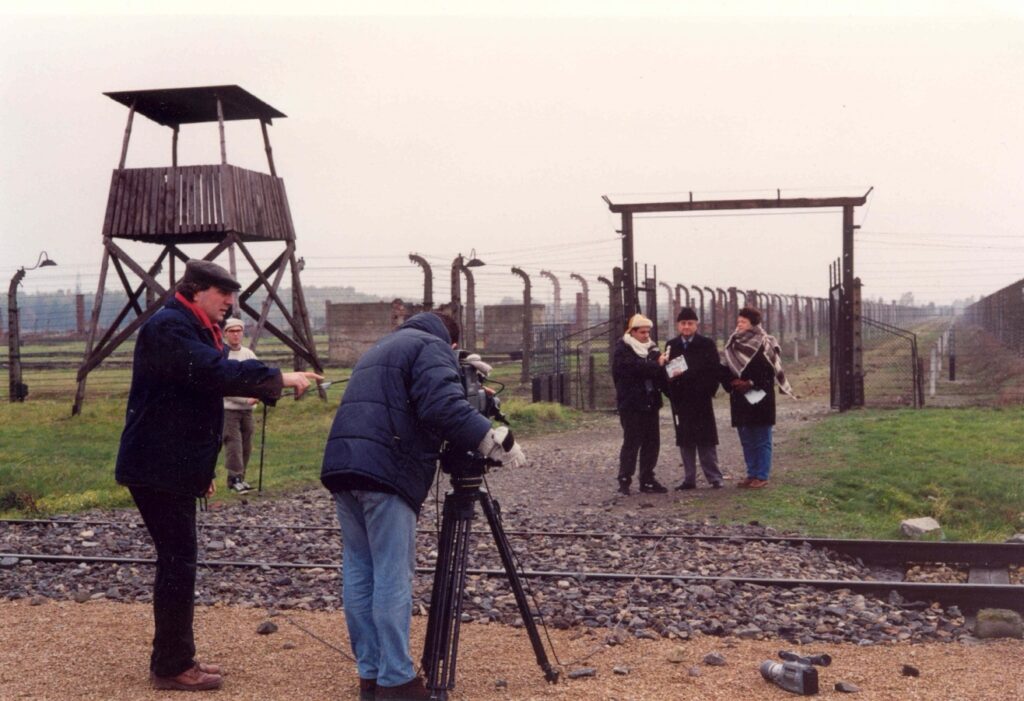
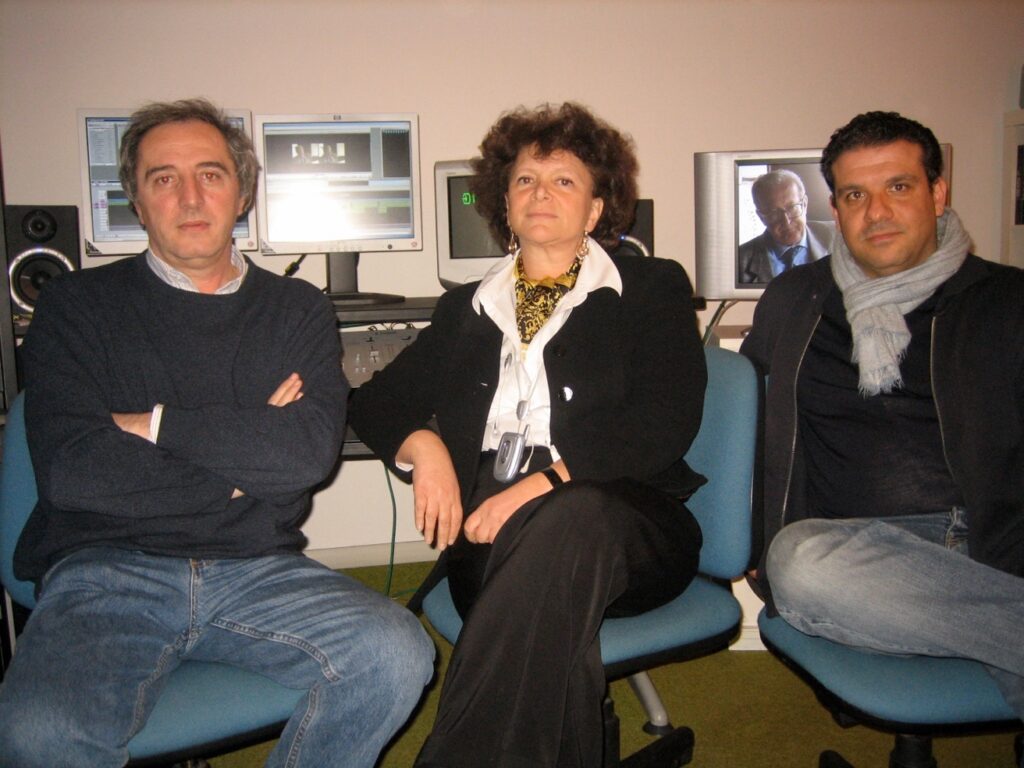
The movie3
Every Shoah has its uniqueness, and we were strongly convinced that ours had distinctive connotations and should be treated with an “all-Italian” sensitivity, starting with our cities, our Mediterranean light and our colors, our faces and accents from Milan, Venice, Turin, and Rome; this was our territory. It was important to create a film that in an hour and a half would take the observers on a narrative journey that could move them and make them understand the human story of the survivors. As previously mentioned, we focused on convincing the witnesses that it was necessary to return to the extermination sites. Many of them complied; they understood that after Primo Levi’s sudden death, they had inherited that heavy legacy. Not all of them wanted to return to the largest Jewish cemetery in the world, where the ashes of their loved ones lay. The task of convincing the witnesses was difficult and very specific, and each one reacted differently. However, in most cases, Marcello Pezzetti, with his tremendous empathy, succeeded in making them feel protected and safe.
After so many years of silence, it was difficult to talk: the whole world wanted to move on. Everyone who returned from the camps did so bearing insurmountable trauma. The guilt of having survived was immense; what they had seen and experienced, they feared, could not be believed. One of the few who managed to narrate concentration camp life was Primo Levi, whose books became a milestone for Italian culture and are still fundamental texts for understanding If This Is a Man. Our intention was to humanize the witnesses as much as possible and to bring them out of the written words of a book, giving them faces, accents, and physical movements within a story that had to be historically rigorous, yet narratively emotional. The dignity of their recounting was such that it blended with the naturalness and strength of the stories and events told.
Many of the witnesses returned in 1995, 1996, and 1997, the years when we filmed Memoria and when they realized how important it was to tell the story. Many of them also travelled to Poland to the extermination sites with their children and grandchildren. This was a choice made by numerous Roman Jews, along with Nedo Fiano, who went to Auschwitz with Emanuele Fiano and his grandson Uri Fiano.
In the camp, we built a kind of community, a family in the most terrible place that could exist: Auschwitz, which for so many families represent a place of death and has never been a place where art could be created or where the seventh art could find its own location, script, or cinematography. These elements were very much present, but were treated as if the commitment to witnessing was above all cinematic considerations. The film is a consequence of this: testimony came first and only afterward did we give space to other factors. This is why we believe Memoria aroused so much emotion on prime-time TV on Rai Due with a 16% share of the viewership (in 1997, this was equivalent to almost seven million viewers: more than one in six Italians were glued to their television sets on 26 March).
Another relevant element of that experience was the cold: Varon said that he would never feel that cold and hunger again in such a specific and pungent way. We visited Auschwitz in November and everyone in the crew was very cold, but the witnesses were not: Alessandro Kroo kept talking, and Nedo Fiano, who testified during a snowstorm, managed to keep his voice warm and vibrant as he spoke. It was they who urged us to go on and tell every last detail that needed to be told to better understand the concentration camp universe.
We can only say thank you to the ninety-seven protagonists of Memoria, because without them and their determination, these filmed documents, these cinematographic works, would not exist today. Thanks to their crucial collaboration, we managed to achieve a result we are proud of, both historically and artistically. It was hard, because “art” and “Auschwitz” are two words that I believe should never be juxtaposed. Art is esthetic communication; Auschwitz, on the other hand, is the communication of the witnesses’ memories, their pain, their relationship with death and the dehumanization of the individual. There is no possible relationship between these two communicative entities.
The Reasons behind the Film
At the beginning, the idea was to create a historical archive, like the one that Steven Spielberg was putting together in Los Angeles. Liliana Picciotto and Marcello Pezzetti were very focused on producing an archive of filmed witnesses, whereas I strongly believed that the expression of the archive could be summarized by a full-length documentary in terms of communication, in order to broaden the audience, reaching general viewers, not only academics and historians. From that moment on, I was faced with the difficult task of combining art and the Shoah within the cinematic discourse of the film, in order to build a narrative that was both rigorous and emotional.
We sometimes see artistic representations—for example, the typical image of the barbed wire with the rose—that leave one wondering: we think of Auschwitz as we know it, and there is no room for any esthetic representation that could undermine the historical and civil value of the testimony. Of course, every camera position, shot, and location represents a point of view, which, however, must be functional to the effectiveness of the story and not necessarily an esthetic/artistic choice.
However, art has always dealt with death. Let us think of the depiction of the crucified Jesus, perhaps the most narrated artistic representation in the history of art. Death and art have always coexisted; it is only in modernity that there has been a great removal where art has been relegated to something that is not seen and not talked about. Christian art carries with it the idea of a resurrection, or at any rate of a realm of the dead where true life continues. And it was precisely from Christianity that a universally recognized symbol was introduced that simultaneously shows the terrible side of death, with a suffering man nailed to a cross and dripping with blood from his tortured body on the one hand, and hope in a future life free of pain and suffering on the other. It represents the incomprehensible sense of the loss of life, simultaneously linked to the sense of hope and resurrection.
In the films we made with witnesses to the Shoah, we never thought of talking about God in relation to death. We made sure that references to God were removed from the script and testimony, which was then mediated by editing. Death had to be portrayed for what it was: the absence of life, with no transcendent or spiritual considerations; after all, hardly anyone uttered the word “God” during the interviews in Auschwitz. Perhaps they had experienced that place like Elie Wiesel, who in his book The Night wonders where God had ended up in Auschwitz: “Behind me I heard the usual man ask: Where then is God? And I heard a voice in me answer: He is hanging there, on that gallows.”
This consideration that called mankind to its responsibility was a narrative that had always struck me, but which urged me not to show even a single image of the piled-up human corpses and skeletons in our films. This choice was deliberate. Death had to be mentioned but—perhaps motivated by an all-Jewish modesty—it could not be manifested visually. Death could not be relegated to photographic or filmic images; it had to retain its profound meaning, which for us always had to be linked to life. We could not allow ourselves to turn the essence of life and the injustice of millions of murdered innocents into a mere icon. Death had to be recounted with words and not with vivid images of corpses that often succeed in anesthetizing us with respect to evil, a concept that is difficult, if not impossible, to explain at Auschwitz.
We believe that when one speaks of Auschwitz, the Shoah, or other tragedies, one must perform a work of subtraction. In this regard, the crew working with us on set almost has to disappear. With Memoria, we succeeded not only because we had a small budget and could not afford many people in the crew or more than one camera, but also because we were working in the essential, and this helped us to be lucid and to focus intensely on what really mattered within a collective story that should not, however, lose the uniqueness of each individual. We urged all of the crew members to be as respectful, discrete, and sensitive as possible.
When we film a testimony or make a documentary, we have the advantage that we can use music, images, sounds, and words. Of course, everything always starts with the word. For me, as a young student in New York, Lanzmann’s documentary Shoah was a revelation as to how to recount the Shoah, as to how you can relate something that is not fiction, but that engages you emotionally and succeeds in giving you fundamental notions of history. For me, it was and is important because filmmakers should also entertain the audience and be able to bring them into the story they are watching. The viewer should be taken and accompanied emotionally and intellectually on a narrative journey that involves all the senses.
To do this, places, topoi, become very important. It is almost as if a place becomes a character and a witness in the film. Places and witnesses must become one, a unicum that gives the viewer a natural veracity that makes the testimony absolute, unquestionable in its strength and authenticity. The place becomes testimony and the testimony becomes place. In my film on the Mafia, Io ricordo, the Sicilian landscape clashes with the harshness of the family members recalling the dead who have fallen at the Mafia’s hands. In Memoria, the place and the light are so in tune with the stories that words and places never clash; rather, one enhances the other. The places thus become narration itself, testimony.
We think there is a problem with the representation of the image because the image does not belong to Jewish culture and thought from a theological point of view. Yet look how many Jewish filmmakers there are, and how much Jewish culture in the modern era has liberated itself by producing great artists, storytellers, filmmakers, photographers, writers, and musicians. Communication and transmission remain the common denominator of a people who found an identity from the biblical narrative and who managed to reinvent art in an iconoclastic way.
We believe that Memoria remains a film, a document, a fundamental testimony for Italian culture; it gives us the story of the Shoah without filters or rhetoric, a real punch in the stomach. The credit goes to the survivors, who generously testified in a dry, sincere, and rigorous manner. There is a remarkable section in which Elisa Springer is standing in front of the window of the Zauna barracks (the place where they were stripped and matriculated). Unable to remember anything, she is confused and emotional and does not answer Liliana Picciotto’s questions. Ruggero, as a director’s note, suggests that she focus, stay in front of the window, and forget that we are shooting a film; he also tells her that she can be silent if she wants. After a few minutes, she comes to her senses and her memory flows like a river bursting its banks, and the moment of panic is replaced by one of the most touching scenes in the whole film:
It’s a strange effect. I wanted to come here, I wanted to see those places again… I’ve been holding it in my mind for fifty years, day and night. At least I've come back, while all those poor companions and others never came back. Right now, it’s difficult for me to speak, I’m trying to be strong [her voice breaks with emotion]. I see myself here naked, deprived of everything, of my dignity, of my personality, of all my human semblance… I still remember 4
The image can be adopted in different ways: for me, as a director, the image must never overpower the story. In a film of testimony, where words carry a lot of weight, one more adjective or conjunction is enough to distort the meaning of the story itself. This is why in the editing phase, the director must be certain of the true meaning that the words take on at that precise moment and in that precise space.
Documentary films are constructed above all in the editing phase, because editing is what gives you the pace; otherwise, the scaffolding of the narrative system changes. In editing, you need sensitivity and rigor, and everything has to be regulated. The essentiality lies in finding the juxtaposition between the various film sequences, like taking the various pieces of a mosaic in which each part must contribute to the final image in a precise and harmonious manner.
The director’s sensitivity is precisely this, that of interpreting individual testimony and its true meaning and then managing to insert it into a collective narrative in such a way that that individual testimony contributes to the narrative sense of the film. The editor’s skill therefore lies in selecting and composing various sequences so that one can move from one subject in one place to another in a different place without interrupting the logical thread of the narration, but on the contrary, completing it in a logical manner and with an editing rhythm consistent with the film’s story. As Godard said, “If the camera is an eye, editing is a blink of an eye.”
We often use metaphors to explain what an assembly is. That of tailoring and the made-to-measure suit that starts with the fabric, or that of the jigsaw puzzle where each piece is part of the complete picture. This need to use metaphors arises because the editing phase is probably the least known of the various aspects that make up a production. A good montage, as I said before, is a work of subtraction dedicated to making it invisible to the viewer. This work allows the viewer to better enter into the narrated facts. Historically, editing has as its milestones the European avant-gardes of the 1920s, who used editing as the main lever to create artistic-figurative symbolism, often resulting in conceptual work that for the first time highlighted the great potential of montage in cinema as a modern work of art and an alternative to what would later become the language of montage in 1930s Hollywood.
We have to wait for genius directors such as Alfred Hitchcock and Orson Welles to understand how the ungrammaticality of editing could be incorporated into the narrative of the plot of a major motion picture. Their ingenious editing also successfully gave a psychological dimension to the characters and increased our emotional and sensory response to the sequence of images. Interestingly, Hitchcock was one of the first filmmakers to be allowed to bring a camera into the Auschwitz/Birkenau death camp. To this day, his black-and-white footage of the piles of corpses and the havoc wrought by the gas chambers remains a vital document that provided visual proof of the crimes of the Third Reich during the Nuremberg Trials. His purely documentary work had no artistic ambitions in its rawness and truthfulness and is still used as archival material in various films today.
The same cannot be said of the film Night and Fog by the French director Alain Resnais, where the black-and-white images of the corpses and especially the clothing of the children and adults killed on arrival have an artistic ambition in the poetic sense of the term. Resnais, who was filming eleven years after the end of the war, tackled a historical subject that was still little dealt with at the time in an unconventional way, and with great sensitivity managed to elevate the readymades (glasses, shoes, hair, etc.) of the concentration camp universe to objects that have a soul; the editing, voiceover, and music present us with a unique document. Night and Fog is the first real attempt at an artistic operation with respect to the horror of the Shoah. Resnais gives us his idea of Auschwitz, suggesting that the subject needed intellectualistic attention to make the film and the subject palatable to the European intelligentsia of the time. In fact, the text is written in literary French and the voiceover is soft and warm. This soft voice, together with the music, is meant to contrast with the death symbolism of the images in an attempt that even today remains an example of how archive images can be used in an artistic and emotional way. I consider Night and Fog to possess an extraordinary expressive power.
1 This section is authored by Marcello Pezzetti.
2 The collection of testimonies did not end with the release of Memoria: it resumed in 2002 thanks to a contribution from the Union of Italian Jewish Communities (UCEI). In the following years, further interviews were conducted in Italy and abroad, notably in Brussels, Israel, and New York, including with survivors of the deportation of Jews from the Dodecanese islands of Rhodes and Kos. This phase also led to new documentary productions, beginning with Gli ebrei di Fossoli (The Jews of Fossoli, 2003). The testimonies collected in the Archivio della Memoria were later analyzed and published in Il libro della Shoah italiana (Turin: Einaudi, 2009), a choral account of the lives of 105 witnesses. They also formed the basis for a series of documentary films, all directed by Ruggero Gabbai, including Il viaggio più lungo (The Longest Journey, 2013), La razzia (The Raid, 2018), Kinderblock (2020), Il respiro di Shlomo (Shlomo’s Breath, 2023), and Gli ebrei di Rodi (The Jews of Rhodes, 2024).
3 The next two sections are authored by Ruggero Gabbai.
4 Elisa Springer, Memoria (1997), dir. by Ruggero Gabbai.
