


Introduction
Growing up in Milan, I passed by the San Vittore detention center countless times: driving through the circonvallazione, shopping at Papiniano weekly market, or going to my friend’s house in the nearby area of Sant’Agostino, I skirted the massive structure of the prison, often wondering what stood beyond the wall. My curiosity and the very fact that the building was inaccessible, yet so close and central to my native city, led to a strong desire to discover its inside world, to know more about its inhabitants, their stories, and their conditions and to find out what was happening just a few meters from me. To some extent, I imagined the detainees as neighbors whom I was not allowed to meet, which was a weird feeling.
I had previously visited detention centers, but never San Vittore. During my master’s degree in social work at Tel Aviv University, I completed a yearlong internship at Ofek juvenile prison, meeting regularly with the young people there and offering them one-on-one mentorship as well as group dynamics. It was a difficult, yet meaningful path, that exposed me to the reality of detention centers and one where I experienced, even if only at a preliminary level, the essential importance of engaging prison populations in all sorts of educational, interpersonal, and therapeutic activities.
This article aims at presenting and reflecting on an ongoing project entitled San Vittore: Esperienze di ieri, voci di oggi[1] (San Vittore: Yesterday’s Experiences, Today’s Voices) promoted by the CDEC Foundation and the Memoriale della Shoah as a special initiative for the detainees of San Vittore prison. This initiative represents a groundbreaking experience for the CDEC Foundation: in fact, while in the last two decades the institute has been deeply involved in educational activities and encounters with the general public, it has never engaged in activities in marginal contexts with populations who are less exposed to its work and mission. In this sense, the project has the potential to open new horizons for the use of archival material and to expand the scope of the work on testimonies toward a social impact, beyond our usual range of activity.
Analyzing a project that is still active is a sensitive endeavor, since we cannot have a comprehensive overview of its scope, achievements, and problematic aspects. We consider the workshop a pilot project, and we are fine-tuning along the way according to feedback we receive from both detainees and experienced volunteers, as well as our own perceptions of how things are unfolding. For this very reason and because of my personal involvement in the workshop as a facilitator, I have chosen to write in the first person, to convey the experience as it develops rather than providing a retrospective, more detached analysis.
The Project: Yesterday’s Experiences, Today’s Voices
The idea to organize a special workshop on San Vittore and for San Vittore’s population came during a meeting with our colleagues from the Memoriale della Shoah, who have been engaging with prison populations for several years. Specifically, they have been involved in activities with prisoners from the Bollate detention center in Milan and have been actively supporting the rights of detainees. From the CDEC’s standpoint, we were planning a program of special events to celebrate the Foundation’s seventieth anniversary, as well as the eightieth anniversary of the Liberation of Italy from the Fascist regime and the Nazi occupation. Moreover, in recent years, CDEC has been progressively opening not only to new areas of research, but also to new projects engaging with different publics that will enable us to expand our impact as well as to establish the groundwork for future horizons.
We came up with the idea of using documents preserved in the CDEC Foundation Archives—testimonies from Jews and antifascists who were incarcerated in San Vittore during World War II—in order to encourage a deeper understanding of the prison’s role during the Fascist regime and the Nazi occupation, as well as to foster the expression and transmission of today’s detainees’ experiences by promoting new ways of reading and describing their conditions.
We had a general framework in mind, though we did not know what precisely to expect, nor how the detainees would react to the documents and stories we would bring with us. For this reason, we approached the project as a pilot, keeping in mind that we would need adjustments along the way. The working group that structured and is leading the workshop is composed of Talia Bidussa and Matteo Lenuzza from the Memoriale della Shoah and Jasmine Ferrario Sardi and myself from the CDEC Foundation. Moreover, Marco Vigevani, head of the Memoriale’s cultural programs, and Laura Brazzo, deputy director and head archivist at the CDEC Foundation Archives, offered their supervision and mentorship. Laura Brazzo’s assistance was fundamental for retrieving the relevant archival material.
La Nave, an Island among Storms
Luckily, our proposal was welcomed with enthusiasm by the Amici della Nave,2 an organization of volunteers involved in the activities of San Vittore’s La Nave. Located on the top floor of the prison’s third wing, La Nave is a special department that offers advanced treatment for drug addiction in collaboration with the healthcare system through activities that keep patients occupied all day long. Rather than being locked in cells, the detainees are free to move around, from morning until evening: they start with a daily assembly and proceed with various initiatives such as reading groups, a choir, psychotherapy, and more. The name La Nave, “the boat,” is intended to symbolize a sort of ferrying toward the outside world, beyond the prison’s walls. And indeed, all the activities offered to the detainees are intended to help them undergo a personal process of change. This is to increase the feasibility of providing them with a range of tools to cope with their previous addiction at the moment of their release, as well as to challenge the high probability of relapse in the criminal world; in fact, in Italy, the recidivism rate is almost 70%.3 The physical structure of the department also resembles that of a boat: the walls are blue, there is a bow and a stern, and there are numerous references to the maritime world. Thus, La Nave is like a special island in the Italian prison system, which is generally characterized by harsh conditions and lacks rehabilitation activities.
Amici della Nave operates with two main objectives: the first is to continue to support the “outside” path of care and treatment that the prisoner-patients of La Nave undertake “inside,” especially from the point of view of culture as a rediscovery of oneself. The second is to promote an increasingly widespread sensitivity toward this type of approach by offering it as an opportunity for all citizens, in the belief that integration, participation, comparison, and exchange can foster mutual enrichment. With these goals in mind, Amici della Nave, and specifically its president, Eliana Onofrio, and vice president, Paolo Foschini, welcomed our workshop and assisted us in presenting it to the prison’s director Elisabetta Palù.
Together with them, we decided to offer the workshop not only to the participants of La Nave, but also, separately, to detainees in the women’s wing. However, the situation there was much more complex: there was no existing framework that could host us and the general conditions of the daily life of female detainees were not in any way comparable to those at La Nave. In any case, we decided to offer the workshop to any interested female detainees and to hold it within the department’s library. The framework was set so that we would visit both La Nave and the female wing once a fortnight and hold a workshop lasting around an hour and a half.
Choosing Material
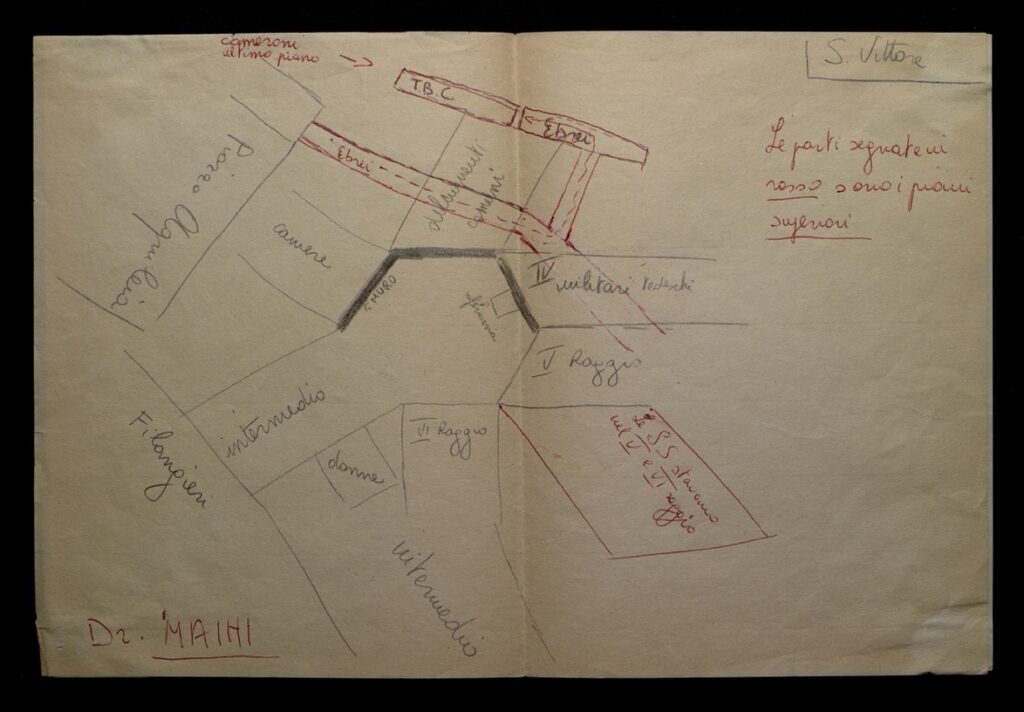
After designing the framework of the workshop, we began analyzing and selecting material from our archive. Our aim was to gather material on Jews and antifascists who were imprisoned in San Vittore during the Nazi occupation of Milan from autumn 1943 until the Liberation in April 1945. Among our collections, there is some material dedicated to camps and prisons with documents dating from 1940 to 2005 that includes a specific file focused on San Vittore with documents dating between 1945 and 1994. The file is mainly composed of wartime prison registers, from which it is possible to see how the Jewish population was listed in the prison documents. It also contains a document written by Eloisa Ravenna, the CDEC director from 1963 to 1973,4 with the testimony of Don Franco Rimoldi, a priest who helped Jews and partisans by providing information and falsifying documents and who was incarcerated in San Vittore during the spring of 1944. From that document, another testimony from Dr. Cesare Gatti, who at the time was a doctor at the Prison, and a report sent to the prefect of Milan by the Bianchi company—contractors responsible for the maintenance of Milan’s prisons—we learned about the general conditions of detained Jews during World War II. They were all housed in the fifth wing of the detention facility and were given less food than other inmates (soup once a day rather than three meals a day), and from the moment of their arrest until deportation, they were generally ignored by the SS. From the same documents, we also learned that the SS operatives in charge of San Vittore were named Klims and Franz. Finally, the San Vittore files also include drawings representing an internal and external map of the prison drawn by Dr. Maini. It is unclear in what circumstances and for what purposes the drawings were made, but it may be assumed that they were drafted during the times of trials against nazi criminals to present an idea of how the prison was structured and organized.5
All these documents served us as background material for obtaining knowledge and information on the functioning of San Vittore during our period of interest. However, beyond this data, we wanted to have first-hand testimonies and narratives from detainees. For this objective, we worked with Laura Brazzo to collect a selection of documents to use during the workshop. Our goal was to be able to tell the testifiers’ stories both during and beyond their incarceration to convey the wholeness of each person’s life, rather than reducing their identity to the mere moment of imprisonment. We managed to gather several collections and while we researched, we realized that the more we searched, the more we would find. Indeed, the CDEC Foundation Archives continue to surprise us, leaving us with the feeling that there is still a large quantity of documents that have yet been thoroughly studied. Eventually, we decided to start with four stories:
Fausto Levi, a Venetian antiquarian who was arrested in Milan, imprisoned in San Vittore, and deported to Auschwitz with the first convoy that left the city on 6 December 1944. The CDEC Foundation Archives have conserved a few letters that he sent to his girlfriend Gina Polli from San Vittore and from the convoy, several photographs, and some identification documents.
Antonio De Bortoli, a partisan and Catholic patriot who was arrested in 1943, imprisoned first in Como and later in San Vittore, and eventually deported to Fossoli. In the Archives there are transcriptions from a deposition that he left to CDEC in 1967 as part of a collection of testimonies from the Dortmund prosecution.
Renata Caminada, who was arrested and detained in San Vittore until April 26 1945. In the CDEC Foundation Archives, there is a recording of an oral testimony where she speaks about San Vittore and the Liberation.
Gaetano De Martino, an antifascist who in 1945 published a book recounting of his life first in San Vittore and later in detention camps. His writings offer very detailed descriptions of life within the prison and interactions with other inmates.
Beyond this first selection, there are other testimonies that we may consider using in the future: for example, that of Franco Momigliano, who managed to escape from San Vittore. His is an incredible story, though it may be a little too delicate to present at the workshop (although in the past months, we have observed that we can bring any kind of material if it is well introduced and if we are open to an honest and open discussion). Therefore, the testimonies mentioned above are not exhaustive, and more stories may be used for the workshop in the future.
The Porthole, Our Harbor
One of La Nave’s main projects is L’Oblò (The Porthole),6 a periodical that collects articles and reflections by the inmates that is published and distributed free of charge thanks to the support of the Feltrinelli publishing house. The project was born in 2002, a few months after the opening of La Nave, and its activities are promoted and facilitated by a group of dedicated retired journalists. It is an initiative with a well-functioning working model, and it is greatly appreciated by the inmates, who participate with enthusiasm and engagement.
It was from L’Oblò’s weekly editorial meeting that we began our encounter with the detainees: we were first invited as listeners and gradually as active participants in the discussion. There, we had the opportunity to introduce ourselves—and our project—to the group and to gain their trust. Starting with experienced volunteers and an existing framework enabled us to feel accompanied in our first steps within the prison and to learn how to properly and more confidently interact with the group. Moreover, from my perspective, participating in L’Oblò was an enriching human experience. At the first editorial meeting we joined, I was surprised and touched by the depth of the discussion: the framework enabled philosophical reflections on personal stories as well as existential themes that we rarely touch upon in our ordinary lives.
The discussion revolved around a range of themes such as the nature of human interactions, distinguishing between true relationships and those motivated by outside interests, the hardships and beauties of ordinary life and the risks of monotony (especially without drugs), time and its value, and more. The tone of the debate was frank, open, and respectful, and for the most part free of clichés and moralism. This was largely thanks to the discussion’s facilitators, Paolo Foschini, Renato Pezzini, and Fabrizio Ravelli, who managed to lead the debate in a very open and engaging manner. The level of human interaction gave me a wider sense of purpose, one I found to be shared by my peers.
Criticalities and Doubts before Beginning
After being introduced to the detainees at L’Oblò meeting and before starting our workshop, we reflected upon the criticalities and possible challenges of our project among ourselves, together with volunteers from the Amici della Nave as well as the department’s psychologists and the prison director Elisabetta Palù. We agreed that there were several issues that we would have to keep in mind and that we would have to remain flexible as to how our ideas would translate into practice. In fact, we were aware from the beginning that the reality on the ground would confront us with the fragility of bridging between past documents and the current situation of the prison.
First, we knew that many detainees would be of foreign origin, which would possibly constitute a challenge for two main reasons: their understanding and ability to express themselves in the Italian language and their limited general knowledge of Italian history. Secondly, but no less importantly, we were aware that their cultural background could represent a challenge. Indeed, amid the war in Gaza, we foresaw the possibility that we would encounter opposition and objection to discussing testimonies from the Holocaust and World War II. This is a challenge that the CDEC Foundation has faced in different contexts since October 7, though we had thought that due to the high number of detainees in San Vittore coming from the Middle East and North Africa, we would encounter a stronger sense of aversion. In any case, we followed the advice and encouragement of Paolo Foschini, who assured us that at La Nave, they often discuss topics that appear intractable in the outside world. Eventually, we agreed to be ready and open to welcoming the discussion if it would arise.
Another potential problem that we foresaw was the difficulty of conveying the historical context: even though we put past and present testimonies side by side, we did not want to convey any confusion or equalization as to the motives for incarceration. For this reason, we decided to emphasize that the authors of the testimonies from our archive were imprisoned by authoritarian regimes due to their ethnicity or political affiliation, having committed no actual crime.
Keeping in mind and in an awareness of all those factors, we decided to face these issues and potential weaknesses not only as challenges, but rather as opportunities for unexpected discussions, human encounters, and raising questions about the nature of our work.
So, It starts
After our first experience at L’Oblò’s editorial meetings and some brainstorming as to the criticalities we would possibly face, we began the workshop. This time, we would be the ones leading the conversation; volunteers from Amici della Nave would still be present, but in a more marginal role. The first workshop that we planned revolved around explaining and showing what an archive is, how it is formed, what it means to preserve, and for what purpose. We brought with us different materials (photographs, letters, minutes, etc.) with the goal of using physical elements to explain how an archive is formed. We attempted to convey that documents that may initially seem trivial and unimportant can acquire value. Hence, a letter, but also a certificate, a legal request, or other documents may reveal something about a specific place, the life of an individual, or the circumstances of the time. When discussing the role of an archive, we also mentioned that we had left a folder at La Nave and suggested that the participants use it to collect the texts and documents that they would produce in the context of our workshop.
To stress the intrinsic narrative value of objects and to help us get to know each other, we proposed an activity that focused on the presentation of oneself through a personal object, making the object speak. For instance, a tattoo could explain why its owner had it done, in which period of his life, and what it represents, or a pair of shoes could inform us about their owner’s journeys outside the prison and what they see within the detention facility. This exercise helped us to reflect on the value that an object can have when telling a story and gave participants the opportunity to choose what to present about themselves and how to go about doing so. It was a moment of generous and at times intimate sharing: some choose to speak about their tattoos, others about their glasses, and still others about the phonecard that they use to call their loved ones outside the prison.
Following this introduction and after a lecture from historian David Bidussa about the historical and sociological context of the advent of Fascism in Italy, we started to bring in testimonies from our archive. We began with the story of Fausto Levi: we showed the personal letters he sent to his girlfriend, as well as photographs from his life before the advent of racial laws, identity documents, and more. We aimed to reconstruct a story that went beyond the moment of imprisonment and deportation and did not reduce human beings to that life experience alone. Equally, our approach was to meet detainees and listen to their stories, beyond their crime, regardless of their crime. We were pleasantly surprised to see that as with L’Oblò, within our workshop, participants shared private details of their lives and openly discussed the themes that emerged. Over time we read different documents with them and noticed that the encounter with direct testimonies of various types enabled us to explore the depth of life in prison, to speak of concrete experiences as well as more abstract concepts such as indifference or solidarity. In this sense, for example, De Martino’s testimony about the condition of his cell sparked a conversation about La Nave’s spaces, how the detainees feel about them and whether they can consider them as “theirs.” On a different occasion, a gesture of solidarity toward a fellow prisoner recounted by Gaetano De Martino in his book From San Vittore Prison to the German “Lagers” opened a space for reflection on the deeper meaning of solidarity: What is it, really? How does it differ from esteem or respect? What conditions hinder or encourage it? What form does solidarity take in prison? These were some of the questions that we debated with the inmates, which confirmed to us that the testimonies offered an optimal starting point for delving into personal stories and favoring individual narration in the present time.
Meeting the Detainess: On Spiders, Gaza, and Humanty
“Have you ever seen two spiders on the same spiderweb?” a new detainee asked us, showing a spider tattoo on his elbow at the last meeting we held before the summer break. I was not entirely sure what he meant by that question/metaphor, yet I was struck by its straightforwardness. We assumed that this was a Russian saying used to express the idea that he is a solitary character who does not want people to enter his personal space. This to some extent exemplifies the type of dialogue and encounters we held with detainees: honest and straightforward conversations that enabled us to reach a deep level of interaction within a relatively short time.
From April until the beginning of July, we held around ten meetings for male detainees at La Nave,some at L’Oblò’s weekly meetings and some independently. Toward the end, we decided to hold all our meetings separately, in order not to interfere with the newspaper’s work and to draw a clearer distinction between the two projects, which had perhaps begun to overlap slightly. Throughout the months, we received a positive response, with between ten and twenty-five people joining our workshop each time. From meeting to meeting, we were happy to see many detainees coming back to our sessions and gradually becoming more and more confident and friendly. Some detainees left the detention center because they were transferred to other facilities or freed. Most participants contributed to the project by producing their own texts, whether in the form of copies of letters sent to loved ones outside, general reflections on themes such as friendship and the passing of time, lyrics from rap songs, and more.
There is a paragraph from an article by the Bulgarian author Georgi Gospodinov that was published in Robinson, the weekly magazine of the newspaper La Repubblica, which in my opinion exemplifies very well the meaning of what we managed to do with our workshop in San Vittore. This paragraph reads:
Narrating creates empathy. You can’t – if you’re a normal person – scream, insult, or chase away someone you’re facing if you’ve just heard or read their story. Simply put, propaganda seeks to strip people of their humanity, to strip them of their face and history to more easily settle scores with them. But literature does just the opposite – it restores humanity. Literature and storytelling are the natural antidote to propaganda and the desire to consciously pit people against each other. And this is an important political quality.7
Gospodinov refers to the role of literature, yet his insight can also apply to storytelling that is not literature in and of itself. Indeed, I believe that his description may be highly applicable to our workshop in San Vittore: reading firsthand testimonies produced interest and curiosity regarding the stories of the past and encouraged the narration of personal episodes from the lives of today’s detainees. Knowing the details, listening to other people’s stories as they shared their emotions paved the ground for a sincere participation in each other’s difficulties and standpoints. Under these conditions, the general atmosphere was empathetic and open to any kind of debate, and in mid-June, the topic of the situation in Gaza was also raised. We had expected it to be brought up before, and we knew that there were “rumors in the corridors” about it. From our side, we did not want it to become a taboo, and we had no resistance to speaking about it. So, when a young man originally from North Africa shared his discomfort vis-à-vis the unfolding war in Gaza and asked us what our thoughts were, we welcomed his question and did our best to foster an open discussion. From our side, we aimed to underline the individuality of each historical event, explaining the fallacies and risks of any comparison, while recognizing the importance and urgency of remaining vigilant and active as to the events of the present time. Other inmates shared their opinions, impressions, emotions, and personal connections to the situation in Israel/Palestine, and the general setting remained open and respectful even amid disagreements. Eventually, we convened that from here, away from violence and destruction, our main role is to convey and amplify voices of solidarity, humanity, and peace. On that note, we spoke about the possibility of bringing the theatrical adaptation of Colum McCann’s book Apeirogon to San Vittore,8 with the aim of having a closer encounter with the stories of Palestinians and Israelis. The episode ended up being proof of what we had been told: at La Nave,people manage to discuss topics that are usually considered intractable, around which it is easy to have heated confrontations.
A Different Context: The Female Estate
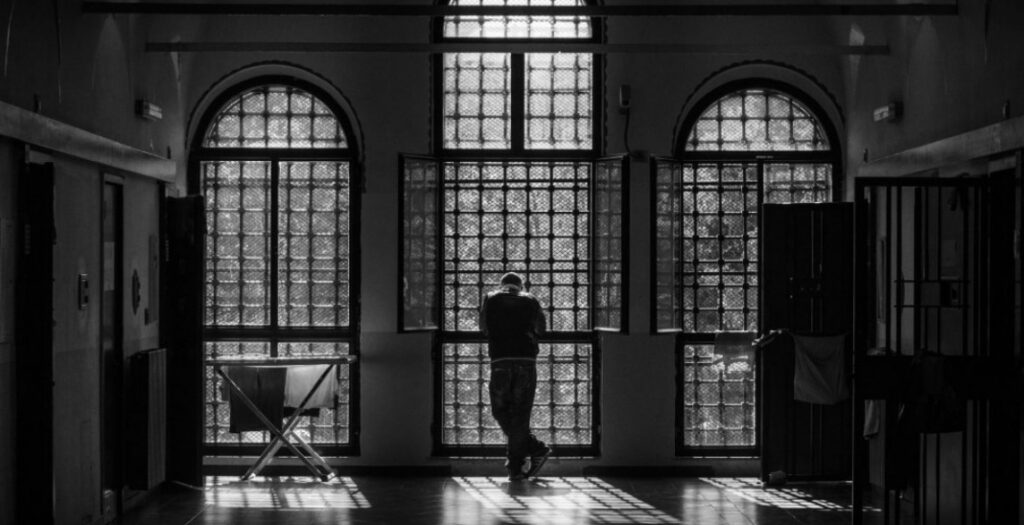
The experience in the female estate was dramatically different. From the very beginning, the setting appeared problematic: there was no member of the prison staff in charge of the project, the time dedicated to the workshop overlapped with the detainees’ working hours or even with their outside time. Moreover, the very poor conditions in the women’s division made it extremely difficult for them to focus on anything other than their impellent needs: often they did not have access to a change of clothes or the possibility to call their loved ones or lawyer. They had no pens or paper, and the general situation of the department was extremely poor. For all these reasons, there was no consistency in their participation in our workshop (each meeting was attended by new and different participants, so we could not proceed from where we had left off the previous time) and we were unable to establish a relationship of trust from which to start. My impression was that when detainees are this occupied with their basic needs, there can be no space to focus on more intellectual activities. For this reason, we tried to be sensitive to what the women brought each time, to listen to them and engage with their problems, sometimes at the cost of leaving aside the work on the archival material. After a few months, we agreed that under such circumstances, it would not make sense to continue the workshop. Moreover, the situation in the female estate made the great gap between the island of La Naveand the rest of the prison system even more evident.
Conclusions from the First Part of the Workshop
At one of the first meetings in the female estate, a sassy and active Italo-Brazilian woman in her fifties told us that behind the prison wall, they felt completely invisible to the outside world. “Anyone who passes by just a few meters away has no idea about us,” she recounted. I told her that since I was a young girl, I have thought of the people who were inside the prison every time I passed it. I saw a smile of slight relief on her face, and that for me was in and of itself a meaningful part of our workshop: to show detainees that there is interest in their stories and conditions.
While at the beginning of the workshop, during our first encounters, we sometimes felt that our path of engagement was somewhat hazy, as we proceeded, we realized that the more we anchored ourselves to the documents, the more meaning and scope we would find in what we were doing. As my colleague Jasmine Ferrario Sardi put it:
In each session, we listened to sincere and intense stories, which testified to the connection with the surrounding space, but above all, with the inner dimension that each of us cultivates within ourselves. The texts shared by the participants and the exchanges that emerged during the workshop raised questions, opened discussions on various topics, and stimulated reflections on the forms, dynamics, and meanings of the human experience; which, as the name of the department, “The Ship,” suggests, is a journey undertaken together with others.
Beyond the human exercise of being in touch with our inner world, which is in and of itself a valuable result, there are several practical lessons that we learned during the workshop and that helped us to gain a better understanding of life in prison and the different stratagems that detainees invent to have a semblance of normality where nothing seems normal. For example, they explained to us how they build portable ovens on an aluminum gas stove to bake cakes and pasta al forno, or how they assemble model boats with toothpicks and fabric that they sell outside. These are just anecdotes, and yet for us, they represent the possibility of better understanding the realm of San Vittore prison.
Similarly, the detainees have progressively come to know our work and the material in our archive, and they have produced a collection of writings that are preserved in the folder designated for the project. We still do not know what exactly we will produce with this material; there are some ideas, though nothing final. However, we already understand that they represent precious testimonies of modern life within the prison, and they are the fruit of participants’ commitment and their ability to listen and share their experiences.
General Conclusions
Each time we arrived at San Vittore, we would cross the detention center and climb four floors to arrive at La Nave department, ensuring that we did not look around too much to try and go unnoticed. However, as we walked by, the stark difference in the atmosphere with the last floor was evident: in the lower floors detainees were locked inside cells, bored and aimless, merely waiting for another day to pass. That atmosphere became much more critical as summer approached: the heatwave and the lack of cooling system within the prison immobilized detainees on their beds. So, when we passed by, I was struck by a pervasive sense of depression and alienation that made me wonder what could possibly come out of such a situation.
Unlike most detention centers, San Vittore is built as a panopticon in the very center of Milan. In terms of numbers, it is the worst prison in Italy. On paper, there are 450 spaces, but at the end of June, there were 1,113 inmates, representing 247 percent overcrowding.9 The framework of La Nave is indeed unique, and this became even more glaring when compared to the other parts of the prison: both the female and all the other male ones. There is an abyss between what happens on that last floor and what occurs on the others. And there is an abyss between the detainees’ personal journeys. This is what I keep in mind when thinking about our project: a detention center with no educational and therapeutic activities is simply a warehouse where society parks individuals involved in crime. It has no purpose, and it achieves no goals. A prison must not be merely a place of punishment.
In this sense, San Vittore: Esperienze di ieri, voci di oggi was a pioneering initiative for the CDEC Foundation in that for the first time, it allowed us to use our archival material for social purposes and to put ourselves at the service of the community with wider goals. As the first experience of this kind, it opened new horizons for our work and revealed the unexplored potential of some of our resources. For instance, our documentation reveals information and data about central places in our country, enabling us to engage with wider sections of citizens as well as marginalized populations. Finally, the workshop reinforced the importance of emphasizing the human experience behind historical or social events and brought us to reflect on and rethink the meaning of punishment and detention in our societies.
Author’s note
The present article was originally written in June and July 2025, when the first part of the workshop had been concluded and before the summer break. The workshop was expected to resume in September, with the first round concluding by December 2025. However, as of October 2025, when this article is about to be submitted for language review, the project has unfortunately been interrupted. This is because the new prison director has yet to be nominated, and this administrative void means that all external projects have been halted. We sincerely hope to be able to proceed with the second part of the workshop as soon as possible and to decide with the inmates how best to organize and valorize the testimonies of their detention that they have produced within the framework of our workshop.
1 Milan’s Shoah Memorial is located deep within the city’s central station on a sublevel below the main tracks. It was here that deportees arriving from San Vittore prison were loaded onto livestock cars. Since 2022, the CDEC Foundation’s headquarters have been located within the Shoah Memorial, further fostering the collaboration between the two institutions.
2 La Nave website, accessed December 20, 2025, https://amicidellanave.it.
3 Data published in a report by the Antigone Association, an independent Italian organization that deals with justice and human rights and monitors the Italian prison system, accessed December 20, 2025, https://www.antigone.it/upload2/uploads/docs/DOSSIER%20ANTIGONE.docx.pdf.
4 To discover more about Eloisa Ravenna: Laura Brazzo’s article “ ‘If not us, who?’ - The CDEC and the German Investigations into the Deportation of Jews from Italy: The Bosshammer Case (1963-1967)”, published in this issue.
5 Up until this date, documentation regarding the experiences of Jews in San Vittore preserved in the CDEC Archives had been used for research by historians such as Michele Sarfatti and Liliana Picciotto, but never with the aim of working on the present-day detention center.
6 “I racconti dell’Oblòg”, accessed December 20, 2025, https://amicidellanave.it/oblog/.
7 Georgi Gospondinov, “Racconta una storia e il mondo non finirà,” Robinson (June 7, 2025), translated by the author.
8 Colum McCann’s Apeirogon, accessed December 25, 2025: https://colummccann.com/apeirogon/. Published in 2020, Aperiogon is a novel recounting the story of two men, one Palestinian and one Israeli, each of whom loses a daughter during the conflict.
9 Luigi Mastrodonato, “La crisi delle carceri italiane vista da San Vittore,” Internazionale, July 22, 2025. Accessed December 20, 2025, https://www.internazionale.it/reportage/luigi-mastrodonato/2025/07/22/carcere-italia-san-vittore.
