


Introduction
During the second half of the 20th century, most Western European countries faced the challenge of managing refugee flows from the post-colonial world. The reception of these new arrivals varied significantly, impacting how public memory of these migrations evolved over time through non-linear trajectories.1 Such variations have, in turn, influenced the long-term construction of private memories in each national context.2
This study analyzes how former members of a highly dynamic minority group in modern Tunisia—the Italian-Jewish community3—have remembered and reinterpreted their past during colonial era. Settled in Tunisia between the 17th and 18th centuries as merchants,4 Livornese Jews were also known as “Grana” (an Arabic adaptation of “Livorno”) to distinguish them from local Jews, or “Twansa” (plural of “Tounsi,” Tunisian). This semantic plurality reflects a peculiar historical path and complex interactions with other communities in modern Tunisia. In 1710, in order to maintain their independence and preserve the legal protection of the Grand Duke of Tuscany, the Livornese Jews established a separate community distinct from local Jews, creating a juridical division that officially lasted until 1944.5 By the early 20th century, a large part of the Livornese Jews had formed a small but influential urban bourgeoisie of about 4,000 people. They stood apart from the local Jewish population—around 50,000,6 subjects of the Bey and part of the colonial milieu—and from the broader Italian community of 85,000,7 mostly Sicilian and Catholics, generally with a more modest social status. Due to their plural belongings, the memory production of this minority offers a valuable perspective for examining broader historical questions. The social position of Livornese Jews within the colonial system made them connectors between different groups. As Jews who had settled in Tunisia long before the French protectorate, they maintained a relatively close relationship with some parts of the local population while preserving a long-standing sense of superiority over Tunisian Jews: this sentiment was often explicitly mentioned in contemporary documents, like the local press.8 As Italian citizens, they enjoyed the legal privileges accorded to the European population by the Beys and then by the French authorities, while being excluded from the colonial administration.
Following their departure from Tunisia during the after war and the decolonization period—between 1943 and 1970, often under coercive circumstances—the reconstruction of their own past gave rise to conflicting narratives. This study aims to analyze the contested memory of colonialism, shedding light on how national and religious identities intersected and influenced each other. It is based on an analysis of all autobiographies published by Livornese Jews since their departure, mostly published in the 2000s.9 To further explore the interplay between public and private memory, this study also incorporates a corpus of approximately 30 interviews conducted between 2013 and 2022. These interviews served as a valuable tool to enrich the books’ analysis, helping to clarify the processes of selection and omission at work during the memorial elaboration of the colonial past, between written narratives and oral discourse.
Therefore, this study first analyzes the publication corpus, then explore how the migration trajectories of Livornese Jews of Tunisia affected the construction of their collective memory, and finally examines which self-perception and a view of colonial society emerges from the texts.
A small and homogeneous corpus
Previous research has identified a corpus of nine autobiographical publications written by former members of the Livornese Jewish community of Tunisia. Listed alphabetically by author, these works are:
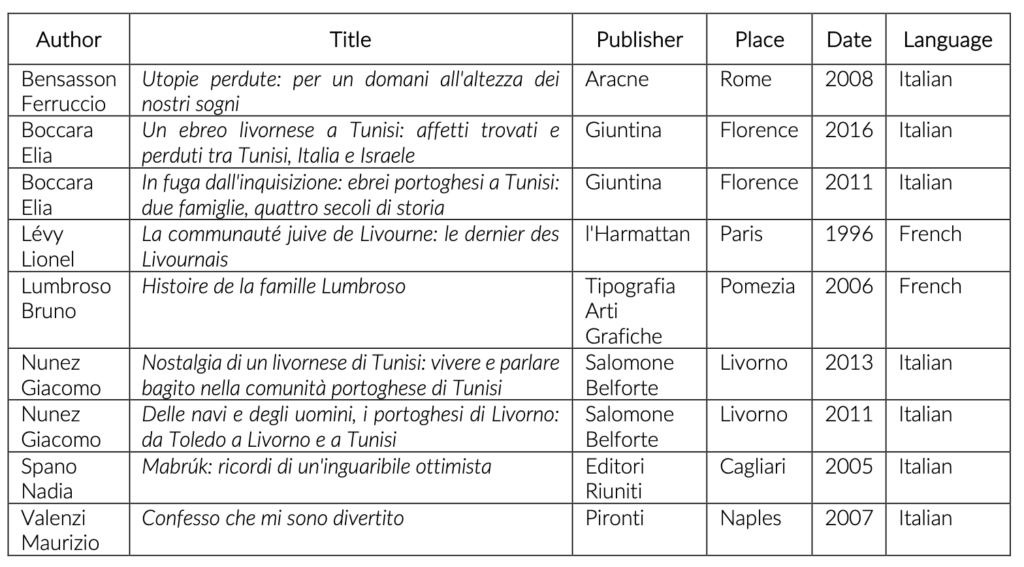
** Translated into French and published as Maurizio Valenzi, J’avoue que je me suis amusé: itinéraire de Tunis à Naples (Paris: L’Harmattan, 2014).
Despite its limited size, this production appears quite cohesive because of several common elements. The most evident is the predominance of the Italian language: Italian citizens shaped most of the public memory of the Livornese community by publishing their texts with Italian editors and addressing an Italian audience. There are, however, two exceptions. The first and most significant is Lionel Lévy’s book, considered by the author as a as part of a broader reconstruction of the Sephardic Jews’ history in Tunisia and Europe, blending autobiography with historical analysis.10 The second is the book of the Italian doctor Bruno Lumbroso. Though printed in Rome by an Italian publisher, it is written in French to reach the author’s family, most of whom had emigrated to France. Overall, this production forms therefore a small yet distinct corpus of Italian-language literature.
The predominance of Italian authors is primarily because, since 1861, most Livornese Jews in Tunisia had chosen to take the Italian citizenship. This decision seemed a natural step for a population who came from Livorno and lived under the protection of the Tuscan consuls during the 18th and 19th centuries. From a juridical point of view, the newly established nation-state appeared as the logical continuation of the previous Capitulation system,11 which guaranteed civil rights and fiscal privileges to Europeans minorities in Muslim countries. For other Jews who had joined the community later, during the mid-19th century, the connection to Italy was even stronger. In fact, most of them were political exiles involved in the Risorgimento movement, who arrived in Tunisia to promote Italian patriotism among fellow migrants and who already spoke Italian as their primary language.12 Two of them, Pompeo and Esther Sulema, even founded the first Italian school in 1831.13 Under the French Protectorate (1881-1956), the Livornese Jews were often considered the backbone of Italian presence in the country,14 because of their strong sense of patriotism and the central role played in local Italian institutions such as banks, hospitals, newspapers, the chamber of commerce, and Masonic lodges. The authors’ biographies show strong family and cultural ties to the Italian community in Tunisia, shaped by the historical and legal context. The Italo-French Treaty of 1896, known as the “Conventions,” established their legal status by applying ius sanguinis instead of ius soli: this meant that Italian citizenship was inherited from the father, regardless of birthplace. Consequently, although all the authors were born in Tunis under the French protectorate, they were Italian citizens from birth. Even Lionel Lévy, born as French citizen, grew up in an Italo-French family,15 illustrating the complex interplay of national identities in colonial Tunisia.
The authors' social background further highlights the strong cohesion that characterizes this memorial literature, since all of them were born into highly educated, middle-class families of the urban bourgeoisie of Tunis. The professions of their fathers—merchants, entrepreneurs, lawyers, doctors and surgeons—effectively illustrate this social distinction: Nadia Gallico’s parents even included Tunisia’s first female pharmacist.16 This uncommon condition was the mirror of the wealthy socio-economic profile of the local Italian Jewish community, where 90% of the active population worked in commerce, entrepreneurship, or the liberal professions. In contrast, 80% of the broader Italian population was employed in agriculture and manufacturing17 while, during the same period, an estimated 30% of Tunisian Jews barely survived thanks to precarious jobs.18 Growing up in this social environment had a profound impact on the authors' individual paths and professional trajectories. After proficient studies (often involving university studies), they all pursued successful careers as scientists, lawyers, journalists, professors, or prominent political figures.19 Eventually, this social and cultural profile shaped the memory of an entire generation.
An Italian memory, a late memory: critical aspects
Despite these common features, the linguistic homogeneity observed in the biographies appears noteworthy and somewhat unusual, for three main reasons. First, the Livornese population represented a cosmopolitan and transnational community,20 the only one, in the social mosaic of colonial Tunisia, without a distinctive language.21 Instead, multilingualism was their defining characteristic. From the time they settled in Tunisia, Livornese merchants used Spanish and Portuguese alongside Hebrew and Arabic. Speaking different languages was not only a practical skill for international trade but also a mark of intellectual and social status. Among these languages, Italian and French gain a crucial importance during the 19h century. “My father spoke Italian and French to perfection, and Arabic too, including the literary version,” recalled Giacomo Nunez: “I could at least understand French and Italian, but I also knew Sicilian dialect of Palermo, which I learned from my classmates at the school Regina Margherita.”22 Even official authorities noted this multilingualism, sometimes pointing out the preference for the French.23 The community’s ability to speak multiple languages became a status symbol, reflecting a cultural and social prominence.
Second, under the Protectorate (1881-1956), the influence of French culture steadily spread among Livornese Jews, many of whom adopted French citizenship, including some of the community leaders. This may seem counterintuitive, given the crucial role the Jewish-Italian minority played in developing of local Italian institutions. In fact, behind this public dimension, the private milieu was quite cosmopolitan: marriages between Italian and French Jews were common and many families were multilingual. Children—particularly boys—were often sent to French schools, which were seen as offering better career prospects. Numerous observers, both local and foreign, commented on this cultural permeability: in 1934, a fascist newspaper wrote that in Tunisia the Livornese Jews formed a “Jewish placenta” between French and Italian middle classes.24 This French influence extended beyond culture: during the interwar period, between 1921 and 1940, about 320 Italian Jews of Tunisia (almost 10% of the population) applied for the French citizenship.25 This shift got stronger after 1938, when the introduction of racial laws by Fascist Italy drove many Livornese Jews toward France. The younger generation was particularly touched. After Mussolini’s antisemitic turn, most of Italian-Jewish families withdrew their children from Italian schools and, between 1938 and 1939, 83% of these children transferred to the French school system, rapidly accelerating the assimilation process.26 Few years later, the colonial authorities eventually stripped the Italian population of their legal privileges and abolished the ius sanguinis principle: since June 1940, every child born from an Italian father became automatically French.
This process of cultural francization and social and legal integration into the local French population led to the third and most significant factor: postwar migration. In fact, the predominance of Italian language in the Livornese Jews’ public memory appears even more surprising when considering that only a small portion of the community chose to repatriate to Italy. Quantitative analysis on the generation born between 1918 and 1940 shows that most Livornese Jews decided to migrate to France during the postwar years and after Tunisia’s independence. Approximately 70% of Livornese Jews settled in France, 20% in Italy, and no more than 10% in other countries (including Israel). This pattern distinguishes the Livornese Jews from other Tunisian Jews, whose migration was evenly split between France and Israel, with around 50,000-60,000 people in each destination.27 Although no dedicated studies have investigated Livornese Jews’ specific path, some traces of it have emerged since the 1970s in broader research on the emigration of North African Jewish communities.28
These migration patterns make the linguistic homogeneity observed in the biographies even more peculiar: despite a strong integration into French society, the public memory remains predominantly in the hands of Italian authors. Among them, three arrived in Italy in the 1940s (Maurizio Valenzi, Nadia Gallico and Ferruccio Bensasson) and two in the 1950s (Bruno Lumbroso and Elia Boccara). Only Lionel Levy moved directly in France, while Giacomo Nunez spent a few years in Italy before relocating to Paris and, after his retirement, to United-States. The authors’ profiles reveal two others significant common points: the sex and the age. Except for Nadia Gallico, all authors are men. Additionally, all of them were born within a narrow timeframe, between 1909 and 1932, with a first cluster between 1909 and 1916 and a second between 1925 and 1932. Moreover, their publications appeared within an even shorter span, between 2006 and 2016, with the notable exception of Lionel Lévy. Interestingly, the first subgroup published their works within just four years (2005-2008).29 A simple timeline offers a clearer perspective on this distribution:
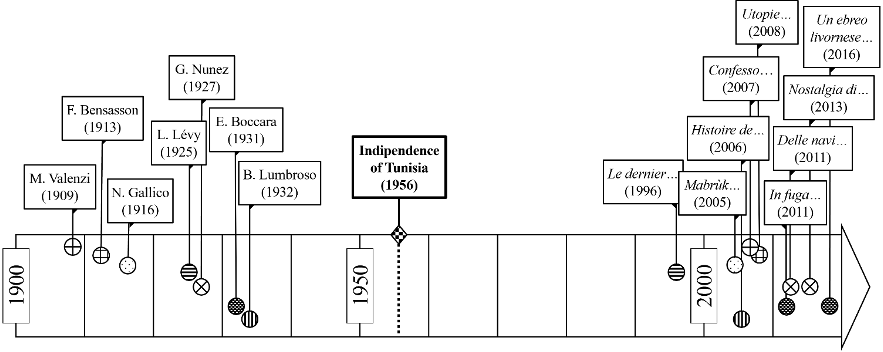
Hence, the diachronic analysis of the memorial production reveals a significantly delayed memory, shaped decades after Tunisia’s independence and the subsequent postcolonial migration. This delay is even more striking when compared to the elaboration of Tunisian Jews’ public memory, which began early, during the emigration process itself. Instead, in the case of the Livornese community, historical events and personal perspectives were fixed in their definitive form nearly half a century after the major transformations that reshaped Tunisia and its colonial society, at the end of a long process of personal and collective rethinking. A closer look at the individual trajectories supports this observation. All of them wrote their book between the ages of 70 and 90: the “youngest,” Bruno Lumbroso and Lionel Levy, were 74 and 71 years old, while the eldest, Ferruccio Bensasson and Maurizio Valenzi, were 95 and 98, respectively. What emerges is a generation of intellectuals and professionals (although none were professional historians)30 which began writing their memories at the end of their lives, to pass on their legacy after having achieved most of their personal and professional aspirations. So, in the absence of historiographical or sociological studies, the memory of the Livornese community has been transmitted mainly by its former members, through first-person accounts and autobiographical publications. This body of work, however, presents a challenge for historical research. While it provides a coherent narrative source, it also appears as a hybrid genre, blending historical facts with personal storytelling and self-representation. Shaped by an urgency to preserve a fading cultural heritage, it prioritizes safeguarding memory over rigorous selection or analysis. Consequently, this literature is more focused on documentation and transmission than on contributing to a broader, critical historiographical debate.
Between Jewish remembrance and Italian oblivion
Only a small minority of emigrants—those repatriated to Italy after World War II—produced almost all the public memory about the old community, while most of the population, who moved to France or Israel, remained largely silent. Where does this imbalance come from? The answer lies at the intersection of two dynamics linked to migration and the interpretation of the colonial past.
The first factor is the North African Jewish diaspora between the 1940s and 1960s, that followed the establishment of Israel and decolonization. During this period, the emigration of several thousand Livornese Jews from Tunisia to France joined larger waves of Jewish emigration from the Maghreb: approximately 120,000 from Algeria, 65,000 from Tunisia, and 55,000 from Morocco, totaling 240,000 people relocating to the ex-metropole.31 Some were already French citizens, while others retained their previous status, yet none came directly from Livorno or Italy. As a result, the Italian-Jewish minority was absorbed into this broader demographic shift and, from the perspective of French and Israeli historians, was incorporated into a larger Jewish historical narrative. From the late 19th century, France’s colonial expansion and the establishment of the Alliance Israélite Universelle (AIU) school network across the Mediterranean fueled growing interest in the history of North African Jews. Local intellectuals such as Abraham Cahen in Algeria, David Cazès in Tunisia, and Nahoum Slouschz in Morocco, along with AIU teachers and rabbis,32 played a key role in shaping a North African Jewish historiography, promoting a new age of studies of their communities. The “great uprooting”33 during decolonization of Arab countries did not slow this process. Instead, this process of migration and resettlement stimulated a strong demand for history among new generations seeking to reconnect with their roots. In both France and Israel, this renewed interest led to a surge of publications from the 1970s onward, often written by those who had lived through the migration themselves. The work of historians like André Chouraqui, Paul Sebag, Richard Ayoun, Doris Bensimon, Claude Tapia, Colette Zytnicki34 reshaped the knowledge of Maghrebi Jewish history. As Ewa Tartakowsky observed, North African Jews showed remarkable intellectual vitality, producing over 450 works that now form part of the French literary landscape.35 From the 1960s to the 1990s, this historiography assigned Livornese Jews in Tunisia a distinct place: as a minority within the Jewish world, their trajectory was inscribed within the broader history of Tunisian and, on a transnational scale, of Maghrebi Jews. This approach introduced a subtle teleological perspective, prioritizing religious identity over national affiliation and assuming that an Italian Jew was, above all, a Jew. It also portrayed the establishment of the Portuguese Israelite Community in 1710 as an “unnatural” division, attributing tensions between Grana and Twansa to some “typical” traits of Livornese psychology, like the sense of honor, the arrogance, and “an air of superiority”36 towards local Jews. From this perspective, assimilation to France through education and language was seen as a natural process, leading both groups to merge into French society: the 1944 dissolution of the Portuguese Israelite Community—imposed by colonial authorities to cut Italian influence—appeared as the natural outcome of this fusion. The convergent migration path to France and subsequent integration into the same environment further reinforced the idea of an inevitable socio-cultural unification. In essence, Livornese memory was absorbed into the broader memory of Tunisian Jews in France: nowadays, it is recalled in conferences, ceremonies, and collective works organized by Jewish associations often linked to the former Tunisian community, such as the Société d’Histoire des Juifs de Tunisie (SHJT) and the Cercle de Généalogie Juif (CGJ).37
The second dynamic affecting the memory process was the repatriation of Italians from Africa during and after World War II, which involved settlers from the Italian empire (Libya, Somalia, Eritrea, Ethiopia), but also civilians from territories under the control of another colonial power (like Egypt, Tunisia, and Morocco). Repatriations began during the war after the fall of Italian East Africa (AOI), with about 30,00038 people returning to Italy, and continued after the war as Libya's independence disrupt the presence of some 108,000 Italians living there. The decolonization of North Africa dismantled all the remained Italian communities (about 180,000 people in 1940),39 often established in foreign colonies. Consequently, Livornese Jews of Tunisia found themselves involved (and confused) in this chaotic return, which the new Italian republic struggle to manage due to logistical and political reasons.40 The ambiguous legal status of Italians arriving from Tunisia—neither military refugees nor prisoners of war, nor settlers from Italian colonies—left them in a juridical limbo.41 Throughout the 1950s, they fought to obtain the same economic support and professional reintegration measures provided to other categories. Many spent years in refugee camps, enduring conditions of overcrowding and isolation. Family losses, separations, material hardship, and the struggle to rebuild their lives in their new homeland linked these repatriations to other classic postcolonial experiences, such as the return of the “pieds noirs” from French Algeria.42 This traumatic return was soon complicated by the fact that, in Italy more than in France, refugees from Africa faced isolation and the indifference of public institutions, society, and the academic community. Post-war Italian society was marked by the loss of colonies imposed by peace treaties, which hindered the development of a critical awareness regarding imperialism and colonial violence in Italy’s former dominions.43 While other colonial nations like Britain and France faced hard decolonization processes that challenged both institutions and national identities, Italy largely bypassed this historical turn, keeping old colonial paradigm and clichés, such as the notion of the “good Italian” dedicated to civilizing colonial populations.44 Due to this reluctance to confront the colonial past, historiographical reflection on Italian imperialism developed slowly and late. In this process, Italian communities in foreign colonies suffered a double marginalization: they were reminders of a colonial past to forget and, at the same time, “leftovers” from non-Italian colonies. With few notable exceptions,45 such as Romain Rainero’s research,46 the Italians of Tunisia remained largely absent from colonial historiography until the 1990s. Only after this decade they did become a historical subject, stimulating new studies47 and various memorial projects.48
Consequently, unlike other nationals who emigrated to France, Livornese Jews from Tunisia who fled to Italy between 1943 and 1970 were placed in a memorial “twilight zone,” lacking official recognition from either the state or society. As their collective bonds gradually weakened, their identities became unclear: were they Italians from Tunisia, Italians like others, Italian Jews, or Italian Jews from Tunisia? Unlike North African Jews who migrated to France, the Italians repatriated from Tunisia did not develop a strong collective sense of belonging based on shared origins or diasporic awareness. This was evident in a 2000 study involving 100 individuals who arrived in Italy from Tunisia in the after war.[49] The survey revealed that most of them struggled to define their identities after the repatriation. Moreover, many tended to claim a “pure” Italian identity and to obscure their past, as if their Tunisian origin were a source of shame.50 Despite having lived in Tunisia for over 20 years (51% of those surveyed) and having parents born there (around 35%), almost none of the migrants identified himself as “Italian-Tunisian.”
Lack of a strong identity, historiographic void, and social oblivion left Livornese Jews repatriated to Italy seeking memory through autobiographical literature. The authors often present their works in this context, emphasizing the need to pass on their memories to future generations and to counter the silence surrounding their history. “This book is like a bottle in the sea,” Elia Boccara states at the end of his book, “in the hope that some of the sons, nephews or grandchildren who descend from our families will become aware of a page of our past often ignored.”51 Similarly, Giacomo Nunez proudly evoke the history of his family, inviting his descendants to carry on their legacy: “It’s been a magnificent adventure, despite the price we've had to pay, and it will remain fundamental for at least a part of us. This feeling is destined to carry on in the future, if some of our sons and grandsons, aware of this history, claim it with pride.”52 Bruno Lumbroso explicitly dedicates his efforts to his grandchildren: “I’m writing our family history for Léa, Diane, Philippe and Ilan, and the others who will come. They will read it when they are 12-14.”53 This migration and memorial path offer insights into the peculiar patterns observed in the corpus of publications. It highlights the imbalance between Italy and France and explains the considerable delay between events occurred in Tunisia and the emergence of autobiographies. While Tunisian Jews in France have engaged in a vibrant historical and intellectual reflection on their past since the 1960s, with key figures like Albert Memmi and Paul Sebag,54 Livornese Jews missed this turn with both the Italian and Jewish historiography. The genesis of their memorial production illuminates its content and style, shaped by the authors' social profiles, their positions within colonial society, and their need to assert a solid identity and distinctive trajectory, both in relation to Tunisian Jews and other Italian immigrants.
Describing the colonial time: family, community, and society
At first glance, this literary corpus seems to present two very different approaches to memorializing the past: family memories and political memories. The first type is predominant in the books, but also among the other minor texts produced by the same authors, such as papers, articles, reviews, internet posts helping circulate memory in the public space. Family memory focuses on retracing a collective history, blending 55 This genealogical focus aims to legitimize the Livornese community's existence and position it as an independent actor of the history of Tunisian Judaism. Tracing history back to the late Middle Ages serves two purposes: it establishes a “noble” heritage, as Spanish Jews were often prominent figures in royal courts, and presents a coherent historical path that had been way more complex and sometimes contradictory. It also identifies a founding moment in the persecutions initiated by the Catholic Kings in 1492, which led to forced conversions, trials, and expulsions in collaboration with the Spanish Inquisition. This persecution caused a diaspora across the Mediterranean, yet the autobiographies frequently insist on the transmission of a common Iberian heritage. Elia Boccara, for example, referred to “the Portuguese community, symbol of the ancient history of essence of old families who had escaped the Inquisitions of Spain and Portugal, who still morally carried the [honor], that nobility that had never left them inside, source of much misunderstanding.”56Many narratives also emphasize the arrival of Sephardic Jews in Livorno and their successful integration into the city, providing a strong identity and an honored place. At the end of the 16th century, Livorno attracted many Spanish and Portuguese Jews due to the policies of the Grand Dukes of Tuscany, who granted Jewish merchants unprecedented economic and legal privileges. This topic subtly tends to the Livornese community, presenting it as an unchanging historical entity. Giacomo Nunez remarked on his ancestors’ remarkable ability to endure: “The most astounding thing is without a doubt their ability to survive, to remain the same, stubbornly, despite the dangers met anywhere.” 57 The perceived continuity between Al-Andalus and colonial Tunisia creates a sense of stability. As Cherry notes, communities often attribute qualities to their origins, such as social homogeneity and consensual relations among members. This perception leads to an implicit positive evaluation of the community as natural and meaningful, thus “self-legitimized.”58 In reality, however, very few families could genuinely claim Iberian descent by the early 20th century; many had migrated to Tunisia more recently from Italy or other European nations.
Other than a common origin, the memorial literature portrays the Livornese Jewish community as a dynamic social actor, well distinguished from local Jews as well as other Italian immigrations. “The adjective 'Livornese' placed you,” said Elia Boccara:
First and foremost, in relation to other Italians, who were generally Sicilians, Calabrians or Sardinians, and in any case Catholics. [...] Secondly, it distinguished us from the indigenous Jews: we, the Livornese, were not Tunisian Jews. It was very important, then: from the moment I was born, I heard “us” referred to as “us the Livornese,” because that was the most important thing.59
If the authors frequently emphasize their Italian identity,60 they insist above all on their connection to the European world, which underscores their distance from the local population. This perspective often implies a pattern of prejudices inherited from the colonial era, echoing in oral interview too.61 All the attention is focused on colonial society, on its spaces, its codes, its routine, its sociability: the social background of the urban bourgeoisie of Tunis. Recent research indicates that most Italian Jews lived in the European district, centered around Avenue Jules Ferry and Avenue de Paris,62 and the memorial geography in the autobiographies confirms this spatial distribution.63 Another area often mentioned in autobiographical literature is the seaside district extending from northern Tunis to the Sidi Bou Said promontory, encompassing towns like La Goulette, Carthage, Le Kram, and La Marsa. Many European bourgeois families had holiday homes here, and residing in this area became a status symbol and a marker of affiliation with colonial society. Authors who spent their childhoods between Tunis and its nearby beaches depict this region as a maritime Eden, almost exclusively inhabited by Livornese Jews, resembling a utopian, family-oriented community. One author recalls that “at Le Kram, the whole neighborhood was ours, it was like the Finzi-Contini garden. Every summer we lived there with our families: there were only our cousins, beautiful villas, we went to everyone’s house, we breathed an atmosphere of conviviality.”64
An invisible world?
In stark contrast to the meticulous description of their social milieu, the world of the colonized, which comprised 90% of Tunisia's population, is portrayed as a shadowy, distant reality, colored by colonial stereotypes. Interactions with Tunisians, referred to as “Arabs” (a term used by colonial authorities to deny their national identity) are often described as friendly, but are framed within a context of structural inequality described as normal or even obvious. For example, one author notes: “our relations with the Arab population of Le Kram were cordial: actually, they worked for us.”65 While some memoirs criticize discrimination, most present an apologetic view of colonialism as a peaceful existence. The separation between colonizers and the colonized appears unproblematic and natural. Authors use phrases like “the Arabs were like wallpaper,” “Tunisians were part of a distant background,” or “were part of the landscape, like dates or prickly pears.”66 The Tunisians feel almost invisibles, as one author notes: “The Arabs: one might wonder where and who they were. In the European district, we did not see them much.”67 Interviews suggested that this vision was shared among Livornese Jews’ community:
We really were at home! It was our home, it was our town, it was our street... it was very small, Tunis: we crossed the street, there was a café, and then “salut” [hello], “bonjour” [good morning], “c'est la cousine de machin...” [she’s his cousin], “c’est le frère de truc...” [he is his brother]. It was just us! The others [the Arabs] were in the Arab district.68
This perspective aligns with the “moral economy of domination”69 established by colonizers. Participation in colonial mechanisms appears in descriptions of workplaces, where authors often recall the employ of Arab workers in a subordinate relationship.70 Similarly, in the family sphere, descriptions of domestic staff reveal a clear hierarchy based on ethnicity and religion: typically, Italian (or even Tuscan) nannies held the highest status, while Arab or Jewish-Tunisian servants and housemaids occupied the lowest levels, as illustrated by Lionel Levy.
In my childhood, and up until the war, many servants shared our lives. Their hierarchy followed the subtle division of the country into opposing nations and religions. I mentioned the faithful Isola, an unalterable piece of Tuscany in a barbarian land [...]. There was Rahmin, a Tunisian Jew still wearing the traditional baggy pants, the sarwal, and the fez, whose only language was Judeo-Arabic and whom I understood only through his smiles and gestures of affection. An irreplaceable factotum, he had served my father's grandparents, whom he had witnessed being born. I’m told that, as was customary for servants in the great Tunisian houses, he slept on a mattress outside his masters’ door.71
The contradictions of colonialism became evident only at the end of the Protectorate, as Tunisian protests grew, and independence approached. However, this realization often triggered surprise rather than embarrassment: “we had to wait until the Liberation and the demonstrations organized by the nationalists to find out that they [Tunisians] were quite numerous. When I saw them parading after 1945, clapping their hands vigorously, I realized that we were not at home. They were so many, and they were so determined.”72 This late awareness, evoked also by Marinette Pendola it in its works on Italian of Tunisia,73 created a deep sense of displacement. One interviewee recalled:
One day, we were at the beach: well, the beach was full of people, and they were all Tunisians. That day, I knew it was over. That’s it. I used to say “this is my beach” or “this is my town.” And then comes a moment when things suddenly turn around: and you’re no longer at home.74
This euro-centric perspective may seem self-evident: after all, it can be founded in the public memory of the most part of ancient settlers, like the “pieds noirs” in Algeria and the Italians of Libya. The myth of the colonial society as a pacific and cosmopolitan world is also a common topic in the collective memory of many minorities, such as the Italians of Egypt75 or the Jews of Libya.76 Yet, when comparing autobiographical books from the 2000s with opinions expressed by Livornese Jews in the aftermath of Tunisia’s independence,77 we realized that this position was not so widespread at the time.
In fact, many of them openly criticized colonial society, describing it as superficial, racist, and, particularly from women’s perspectives, misogynistic. They also condemned the social marginalization of Tunisians:
It was a very closed environment, and I didn't realize it at the time, because for me that was all my world, we all lived inside it, the rest didn't exist [...]. What I regret now, from that period, is that total break with the Arabs, essentially, because we lived in an Arab country after all, but without participating in anything, neither in their way of life, nor in their way of thinking, nor in their philosophy, nor in their culture, nothing.78
Thus, it appears that the colonizers' perspective was neither the only viewpoint nor a neutral or “natural” opinion. Its hegemony did not emerge instantly but developed gradually, through a historical trajectory between the 1950s and the 2000s. Analysis of written and oral sources suggests that this process of memory building began after the social contestation of the 1950s and the disillusionment with Habib Bourguiba’s nationalist policies in the aftermath of independence. The Arabization of society promoted by the new governments and the gradual marginalization of the European population—culminating in the mass exodus of Italians, French, and Tunisian Jews—caused deep traumas, leaning to a more indulgent perception of the past. Several interviewees recalled the loss of their homes, the abrupt liquidation of their possessions, and their sudden departure with only a few belongings. Others mentioned cases of depression or even total amnesia which persisted for years. The urge to forget was particularly evident in the account of one witness, whose mother decided to tear up all her photographs before leaving home.79 Over time, a process of selective memory took place, crystallizing, many decades later, a more peaceful image of the Livornese community and the colonial past. This reinterpretation was also influenced by the singular position occupied by Italian immigrants within the colonial hierarchy under the French protectorate, between colonizers and colonized. This condition of “non-dominant allogenous”80 was quite problematic, as Italian emigrants were viewed as a threat by the colonial authorities. However, after independence, this ambiguous status helped Italians redefining themselves as victims of the colonial regime. This narrative was particularly compelling for the Grana, who suffered from dual Italian and Jewish identities: they faced Mussolini's racial laws in 1938, antisemitic persecution by Vichy during the war, Nazi threats during the Axis occupation, and, after 1943, expulsions by the French as enemies. These experiences left deep marks on public memory, also because all the authors lived the persecutions and the war as children. They vividly recall the impact of racial laws, the imprisonment of parents, and the hostility of both Vichy and German authorities. This focus on victimhood overshadowed their involvement in the colonial system and neglected the fact that some of these refugees had been also agents (and not only the victims) of conflicting nationalisms.
An Alternative Memory, between Politics and Anticolonialism
Within the corpus of memorial text analyzed, a second subset offers a very different vision of the colonial past. The books of Ferruccio Bensasson, Nadia Gallico and Maurizio Valenzi are characterized by an even greater uniformity than the family memories: they are published in a very short span of four years (2005-2008), they result from a life spent in political action, and their authors are tied together by deep familial and ideological connections.
The common denominator of the authors is their active participation in the anti-fascist and anti-colonial movements since the 1930s, in the ranks of the Tunisian Communist Party (PCT). The aim of these autobiographical accounts is to transmit a political legacy through personal narratives that highlight an exemplary path. This intent shapes their style and themes, setting aside topics common in other memoirs, such as the Livornese community, Sephardic identity, ancestral roots, and family ties. Instead, identity centers on the party, defined by political rather than religious or national affiliations. This kind of public memory challenges the tendency to essentialize the Livornese community and to idealize its coherence, because the authors often emphasize internal conflicts cracking the unity of their religious or national cluster: personal rivalries, social hierarchies, political divides, and family tensions between children and parents. The antifascists are at the same time the witnesses and the catalysts of these disputes because their political choice clashed with family values and the social norm of the colonial system. For instance, when Ferruccio Bensasson lead a strike in Tunis, he became a sort of pariah among the European middle class:
The news of my presence at the head of two thousand tram drivers immediately made the rounds of bourgeois houses, deformed and magnified as it passed from mouth to mouth. All the doors were slammed in my face. Even the Bessis, who said: “You’ll understand! Putting at the head of a gang of strikers! It is a challenge against society! We cannot run the risk of being compromised by its head blows!” Above all, Maurizio became the black beast, the instigator of that hybrid group of spoiled children lent to the Bolshevik revolution.81
The anti-colonialist perspective of militant memories valorizes inter-community sociability and crossed solidarities. Despite personal and familial ties among Italian Jewish militants, relationships with Muslim Tunisians, Tunisian Jews, and other workers were forged without regard to race, class, or nationality. Political involvement in the PCT helped bridge the gap between colonizers and colonized, as illustrated in a chapter from Maurizio Valenzi’s book.
At the first PCT meeting I met my cousin Silvano Bensasson and Michelino Rossi. [...] We met Arab comrades from the port, Italian tram drivers, and French teachers. The language used in the debate is Arabic, and when we couldn’t make ourselves understood, we asked for translations. The atmosphere of solidarity and equality thrill us, it’s unlike anything else.82
This new awareness of the importance of the Tunisian world also impacted social dynamics at home. For example, Nadia Gallico and her parents build a strong relationship of mutual respect with the factotum Ad bel Kader, who became almost a family member and provides a crucial help during the war period, when he refuses to collaborate with the Vichy authorities in their hunt against Jews and anti-fascists.83 The new sociability also affected the choice of spouse, which became more flexible: many militants marrying fellow activists, including Tunisian Jews or even non-Jews, breaking a social taboo within the Livornese community.
In the political corpus of memorial texts, colonial domination is depicted not as a natural or a neutral background, but as a violent and oppressive system. In this perspective, the anti-colonialist fight is assumed with pride: instead of highlighting differences with other Jews in Tunisia, authors prefer to emphasize the social and political divisions among Italians and the colonial system in general. The struggle against local representatives of the Fascist regime during the interwar period is a key theme in these memoirs. Even the militants’ early departure for Italy during the war, another central topic in their autobiographies, was driven by political commitment and the desire to continuing the anti-fascist fight during the war after Tunis's liberation in May 1943.
Conclusions
The Livornese Jews’ relation with the memory of the colonial past in Tunisia is part of a broader European issue: the reassessment of colonial history in European societies. In both France and Italy, immigrants from former empires embody the legacy of a defeat: the collapse of colonial system and the failure of European nations to maintain a presence in independent countries as agents of modernization. Witnesses and symbols of this uncomfortable memory, they experienced varying degrees of invisibility, mistrust, and oblivion. In Italy, as reminded by Labanca,84 even historiography ignored their experience for a long time, neglecting the fact that Italy’s ultimate imperial goal was demographic colonialism, with settlers as its main actors. This lack of public memory, however, stimulated the parallel emergence of private narratives, which developed in a non-linear way, influenced by politics and by the historical events that occurred in the decades following the decolonization process.
For those who experienced this exodus, individual and collective memories often diverged from historical narratives. Examining the evolution of private memory among Livornese Jews highlights how the colonial past has been shaped and transmitted over time by its protagonists. At the same, it warns about the risks of excessive generalization in the study of colonial societies. Under the same label of “colonizers” (or even Italians or Jews) existed a heterogeneous population, established in the country at different times and through different waves, with countless geographical origin, complex social backgrounds, fluid national identities. The relation with the colonial power was never the same: the case study of Livornese Jews shows that a minority could be at the same time part of the colonial system and a victim of its contradictions, inside its logics and outside its benefits. Despite the significant uniformity of its authors, the memorial production discloses a wide range of sensibilities, perceptions, and choices toward the question of the colonial past and the collective identity. Under the common need to transmit a legacy to the new generations, emerge a multifaceted memory where religious, national and politic belonging combines in an original way.
Finally, the crossed analysis of autobiographical books and oral interviews reveals their mutual influences in shaping a collective narrative of the past. The publications reworked individual and collective knowledge and opinions that were already present and had become “common sense” among many former members of the Livornese community of Tunisia. On the other hand, these written memories spread memorial topics to a wider audience, contributing not only to preserving them, but also to consolidate common views and old clichés. This study, therefore, invites us to ponder the importance of memory stratification resulting from a never-ending crisscrossing of personal experience, social context, and historical contingencies, often marked by abrupt changes, upheavals, identity crises, and conflicts.
[1] Jean-Louis Miège and Colette Dubois, eds., L’Europe retrouvée: les migrations de la décolonisation (Paris: L’Harmattan, 1995); Andrea Smith, Europe’s Invisible Migrants (Amsterdam: Amsterdam University Press, 2003); Patrizia Audenino, La casa perduta: la memoria dei profughi nell’Europa del Novecento (Rome: Carocci, 2015); Pamela Ballinger, The World Refugees Made: Decolonization and the Foundation of Postwar Italy (Ithaca: Cornell University Press, 2020); Alessandra Vigo, "Dealing with ‘Returns’: African Decolonization and Repatriation to Italy, 1947-70," Journal of Contemporary History 57, no. 3 (2022): 751-774.
[2] Andrea L. Smith, Colonial Memory and Postcolonial Europe: Maltese Settlers in Algeria and France, New Anthropologies of Europe (Bloomington, IN: Indiana University Press, 2006); Dennis Walder, Postcolonial Nostalgias (New York-London: Routledge, 2010); Dirk Göttsche, ed., Memory and Postcolonial Studies: Synergies and New Directions, Cultural Memories (Oxford: Peter Lang, 2019).
[3] Also known as the “Livornese community” due to its origins in the Jewish community of Livorno, and officially called “Portuguese Israelite Community” since XIX century, to underscore the common Sephardic heritage of its members.
[4] Richard Ayoun, "Les Juifs livournais en Afrique du Nord," La Rassegna Mensile di Israel 50, no. 9-12 (1984): 650-688; Paul Sebag, Histoire des Juifs de Tunisie : des origines à nos jours (Paris: L’Harmattan, 1991).
[5] Martino Oppizzi, Les Juifs italiens de Tunisie pendant le fascisme. Une communauté à l’épreuve (1921-1943) (Rennes: Presses Universitaires de Rennes, 2022).
[6] Direction Générale de l’Agriculture, du Commerce et de la Colonisation, Statistique générale de la Tunisie. Année 1922 (Tunis: Imprimerie Générale J. Barlier, 1924), 3.
[7] According to the official numbers. Based on the rate of natural increase of Italian population, Juliette Bessis has estimated a range between 99,000 and 143,000 people. Juliette Bessis, La Méditerranée fasciste: l’Italie mussolinienne et la Tunisie (Paris: Éditions Karthala, 1981), 17.
[8] For example, in 1931, the official journal of the Alliance Israélite Universelle described the Livornese as an “aristocratic caste” and blamed their “superior attitude and a strong attachment to their language and traditions,” which unsettled local Jews (“Grana et Twansa,” Paix et Droit, April 1, 1931). Some years before, an anonymous observer wrote that “The Tounsi sees the Gorni as a spoiled rich kid, a degenerate aristocrat, and a vain ignoramus” (“Pour la fusion,” La Justice, April 8, 1927).
[9] The selection only included works that were published and explicitly intended to preserve the memory of the past in Tunisia. As a result, certain categories were excluded, such as unpublished manuscripts (e.g., Souvenirs livournais by Victor Koskas), autobiographical works not centered on the colonial period (e.g., Racines by Claudia Giami or Ricostruzione di un'anima by Elia Boccara), and non-memorial publications (e.g., the political pamphlet Ebrei italiani contro il razzismo by Maurizio Valenzi, published in Tunis in 1938).
[10] Lionel Lévy, La nation juive portugaise. Livourne, Amsterdam, Tunis: 1591-1951 (Paris: L’Harmattan, 1999).
[11] The capitulations were commercial treaties to regulate the presence of non-Muslims in the territories of the Ottoman empire, since the 16th century. This system allowed Christian or Jewish subjects (often merchants from European countries) the right to work and move, exempting them from some taxes. Moreover, capitulations protected non-Muslim subjects from the local justice as long as the crimes committed were not against other Muslims. Anh Nga Longva and Anne Sofie Roald, eds., Religious Minorities in the Middle East: Domination, Self-Empowerment, Accommodation, Social, Economic, and Political Studies of the Middle East and Asia (Leiden: Brill, 2012), 52-54.
[12] Ersilio Michel, Esuli italiani in Tunisia (1815-1861) (Milan: Istituto per gli studi di politica internazionale, 1941); Leila El Houssi, "The Qrāna Italian Jewish Community of Tunisia between XVIII-XIX Century: An Example of Transnational Dimension," Studi Emigrazione/ Migration Studies 49, no. 186 (2012): 361-369.
[13] Filippo Petrucci, "Una comunità nella comunità: gli ebrei italiani a Tunisi," AltreItalie: international journal of studies on the peoples of Italian origin in the world 36-37 (2008): 173-188, 176.
[14] Gaston Loth, Le peuplement italien en Algérie et en Tunisie (Paris: Librairie Armand Colin, 1905), 315.
[15] Lionel Lévy, La communauté juive de Livourne: le dernier des Livournais (Paris: L’Harmattan, 1996), 35-37.
[16] Nadia Spano, Mabrúk: ricordi di un’inguaribile ottimista (Cagliari: Editori Riuniti, 2005), 83.
[17] Oppizzi, Les Juifs italiens de Tunisie pendant le fascisme, 42-43.
[18] “Le paupérisme juif à Tunis,” La Justice, April 6, 1923.
[19] Maurizio Valenzi was a senator and mayor of Naples in the 1980s, while Nadia Gallico Spano was one of the first women to be elected to the Constituent Assembly in 1946, helping to draw up the Constitution of the Italian Republic.
[20] El Houssi, "The Qrāna Italian Jewish Community of Tunisia between XVIII-XIX Century."
[21] In fact, there was a dialect imported from Livorno, called Bagito or Bagitto, but its use was restricted to the private sphere and its public utility was severely limited. Furthermore, no interview shows a trace of this dialect among the generation born between the 1920’ and the 1950’, and no witness remembered hearing it in their family, not even by grandparents. Giacomo Nunez, Nostalgia di un livornese di Tunisi: vivere e parlare bagito nella comunità portoghese di Tunisi (Livorno: Salomone Belforte Editore, 2013), 27.
[22] Giacomo Nunez, Delle navi e degli uomini, i portoghesi di Livorno: da Toledo a Livorno e a Tunisi (Livorno: Salomone Belforte Editore, 2011), 57.
[23] For example, in June 1938, the director of Italian schools, Ruggero Roghi, complained that the Jewish students spoke better French than Italian. Archivio Storico Diplomatico del Ministero degli Affari Esteri (ASDMAE), Archivio Scuole - I Versamento (1936-1945), f. 128, report of June 24, 1938.
[24] “Aberrazioni,” La Stampa, May 5, 1934.
[25] Oppizzi, Les Juifs italiens de Tunisie pendant le fascisme, 115-118.
[26] From this point of view, it’s significant that all the authors, except Lionel Lévy, began or even completed their schooling before the proclamation of racial laws, in an Italian institute.
[27] Sebag, Histoire des Juifs de Tunisie, 305; Jacques Taïeb, "Immigrés d’Afrique du Nord : Combien ? Quand ? Pourquoi ?," in Terre d’exil, terre d’asile : migrations juives en France aux XIXe et XXe siècles, ed. Colette Zytnicki (Paris: Éditions de l’Éclat, 2010), 148-154, 151.
[28] In her quantitative investigation about Jewish immigration from North Africa, Doris Bensimon found that Italian was spoken by 56% of adults from Tunisia and by 44% of younger (among the immigrants from Algeria the proportion was of 14% and 19%, adults and younger respectively; among the Moroccans immigrants the proportion was of 20% and 11%, adults and younger respectively). Doris Bensimon, L’Intégration des Juifs nord-africains en France (La Haye: Mouton, 1972), 24.
[29] No single political, social, or cultural reason fully explains this rise in publications. One possible catalyst is the 2000-2016 book series on the history and memory of Italians in Tunisia, produced through a partnership between the Italian embassy in Tunis and local editor Finzi. This initiative may have helped to trigger a new wave of memorial writing. http://www.ilcorriereditunisi.it/default.asp?id=41&mnu=41, Accessed February 2, 2025.
[30] Lionel Levy is maybe the only exception, although he began studying history after his retirement in 1991, earning a doctorate at the Ecole Pratique des Hautes Etudes in Paris in his late years.
[31] Taïeb, "Immigrés d’Afrique du Nord: Combien? Quand? Pourquoi?", 149-151.
[32] Colette Zytnicki, Les Juifs du Maghreb: naissance d’une historiographie coloniale (Paris: PUPS, 2011), 344.
[33] Georges Bensoussan, Juifs en pays arabes: le grand déracinement, 1850-1975 (Paris: Tallandier, 2012).
[34] I cite as examples, in a chronological order: Paul Sebag and Robert Attal, La hara de Tunis: l’évolution d’un ghetto nord-africain (Paris: Presses Univ. de France, 1959); André Chouraqui, La saga des Juifs en Afrique du Nord (Paris: Hachette, 1972); Bensimon, L’Intégration des Juifs nord-africains en France; Michel Abitbol, Judaisme d’Afrique du Nord aux XIXe-XXe siècles: histoire, société et culture (Jerusalem: Ben-Zvi Institute, 1980); Richard Ayoun, Bernard Cohen, and Gérard Nahon, Les Juifs d’Algérie, deux mille ans d’histoire (Paris: J.C. Lattès, 1982); Robert Attal, Bibliographie annotée sur les Juifs d’Afrique du Nord. 1974-1979 (Jerusalem: Ben-Zvi Institute, 1983); Ayoun, "Les Juifs livournais en Afrique du Nord"; Claude Tapia, Les Juifs sépharades en France (1965-1985): études psychosociologiques et historiques (Paris: L’Harmattan, 1986); Sergio Della Pergola and Doris Bensimon, "Structures socio-démographiques de la population juive originaire d’Afrique du Nord," in Les Juifs du Maghreb: diasporas contemporaines, eds. Jean-Claude Lasry and Claude Tapia (Paris; Montréal: L’Harmattan ; Presses de l’Université de Montréal, 1989); Jean-Claude Lasry e Claude Tapia, Les Juifs du Maghreb: diasporas contemporaines (Paris; Montréal: L’Harmattan; Presses de l’Université de Montréal, 1989); Sebag, Histoire des Juifs de Tunisie; Michael Menachem Laskier, North African Jewry in the Twentieth Century: The Jews of Morocco, Tunisia, and Algeria (New York: New York University Press, 1994); Patrick Simon and Claude Tapia, Le Belleville des Juifs tunisiens (Paris: Éditions Autrement, 1998); Denis Cohen-Tannoudji, Entre Orient et Occident: Juifs et Musulmans en Tunisie (Paris: Éditions de l’Éclat, 2007); Colette Zytnicki, Les Juifs du Maghreb: naissance d’une historiographie coloniale (Presses de l’Université Paris-Sorbonne, 2011); Colette Zytnicki, Terre d’exil, terre d’asile: migrations juives en France aux XIXe et XXe siècles (Paris: Éditions de l’Éclat, 2010); Benjamin Stora, Les trois exils: Juifs d’Algérie (Paris: Pluriel, 2011); Bensoussan, Juifs en pays arabes; Albert-Armand Maarek and Michel Abitbol, Les juifs de Tunisie entre 1857 et 1958. Histoire d’une émancipation (Paris: Éditions Glyphe, 2014).
[35] Ewa Tartakowsky, Les Juifs et le Maghreb . Fonctions sociales d’une littérature d’exil (Tours: Presses universitaires François Rabelais, 2016).
[36] “Grana et Twansa,” Paix et Droit, April 1, 1931.
[37] For example, in 2016 a remarkable work of transcription and organization of all the marriage records of the Portuguese Israelite Community has been accomplished by the “Tunisian” section of the Cercle de Généalogie Juive (CGJ), a Jewish genealogy group located in France. The official purpose was “to perpetuate the memory of a community”: Gilles Boulu and Alain Nedjar, La communauté juive portugaise de Tunis dite livournaise ou Grana: Registres matrimoniaux (Cercle de généalogie juive, 2016).
[38] Romain Rainero, "Rapatriés et réfugiés italiens: un grand problème historique méconnu," in L’Europe retrouvée: les migrations de la décolonisation, eds. Jean-Louis Miège and Colette Dubois (Paris: L’Harmattan, 1995), 30.
[39] Miège and Dubois, L’Europe retrouvée, 15.
[40] Alessandra Vigo, Rimpatriati d’Africa: assistenza, associazioni e reintegro tra storia e memoria (1939-1952) (Padova: Scripta, 2016); Giacomo Canepa, Riabilitare gli italiani. Politiche dell’assistenza post-bellica e costruzione della cittadinanza (Milan: Viella, 2024).
[41] Pamela Ballinger defined it “a twilight zone between colonial subjects and citizens.” Ballinger, The World Refugees Made, 3.
[42] Michèle Baussant, Pieds noirs, mémoires d’exil (Paris: Stock, 2002).
[43] Christopher Seton-Watson, "Italy’s Imperial Hangover," Journal of Contemporary History 15, no. 1 (1980): 169-179.
[44] Audenino, La casa perduta, 117-118.
[45] Nullo Pasotti, Italiani e Italia in Tunisia: dalle origini al 1970 (Milan: Finzi, 1970); Janice Alberti Russel, "The Italian community in Tunisia, 1861-1961. A viable minority" (PhD diss., Columbia University, 1977); Juliette Bessis, La Méditerranée fasciste.
[46] Romain Rainero, La rivendicazione fascista sulla Tunisia (Milan: Marzorati, 1978); Romain Rainero, "Presenza culturale e scuole italiane in Tunisia negli anni ’30," in Il vincolo culturale tra Italia e Francia negli anni Trenta e Quaranta, eds. Jean Baptiste Duroselle and Enrico Serra (Milan: Angeli, 1986), 220-233.
[47] Michele Brondino, La stampa italiana in Tunisia: storia e società, 1838-1956 (Milan: Jaca Book, 1998); Giovanna Gianturco and Claudia Zaccai, Italiani in Tunisia: passato e presente di un’emigrazione (Milan: Guerini scientifica, 2004); Mark Irvan Choate, "Identity Politics and Political Perception in the European Settlement of Tunisia: The French Colony versus the Italian Colony," French Colonial History 8, no. 1 (2007): 97-109; Daniela Melfa, Migrando a sud: coloni italiani in Tunisia (1881-1939) (Rome: Aracne, 2008).
[48] Notably, a project has been launched in 2000 by the Italian embassy of Tunis with the Dante Alighieri society, which has resulted in seven collective volumes published between 2000 and 2016, covering various aspects of the former Italian community.
[49] Marinette Pendola, “Fra memoria e oblio. Inchiesta sugli Italo-tunisini residenti in Italia,” Il Corriere di Tunisi (Corriere Eurafrica), April 20, 2000, 5.
[50] In the report, 54% of witnesses claimed to have married a native Italian, and only 38% an Italian of Tunisia. Pendola.
[51] Boccara, La saga des séfarades portugais, 490.
[52] Nunez, Delle navi e degli uomini, i portoghesi di Livorno, 25.
[53] Bruno Lumbroso, Histoire de la famille Lumbroso (Pomezia: Tipografia Arti Grafiche, 2006), 5.
[54] Sebag and Attal, La hara de Tunis; Sebag, Histoire des Juifs de Tunisie; Paul Sebag, Les noms des juifs de Tunisie: origines et significations (Paris: l’Harmattan, 2002); Albert Memmi, Portrait du colonisé (Paris: Buchet/Chastel, 1957); Albert Memmi, Portrait d’un Juif (Paris: Gallimard, 1962); Albert Memmi, La statue de sel, Éd. rev. et corr (Paris: Gallimard, 1966).
[55] Interview with Giacomo Nunez, by the author, October 25, 2014.
[56] Elia Boccara, In fuga dall’inquisizione: ebrei portoghesi a Tunisi : due famiglie, quattro secoli di storia (Florence: Giuntina, 2011), 368.
[57] Nunez, Delle navi e degli uomini, i portoghesi di Livorno, 23.
[58] Cherry Schrecker, La communauté: histoire critique d’un concept dans la sociologie anglo-saxonne (Paris: L’Harmattan, 2006), 14.
[59] Interview with Elia Boccara, by the aauthor, December 27, 2013.
[60] Elia Boccara, Un ebreo livornese a Tunisi: affetti trovati e perduti tra Tunisi, Italia e Israele (Florence: Giuntina, 2016), 9.
[61] Like during the interview with Renato Pariente, by the author, July 13, 2018:
Interviewer: You said you were part of the Jewish world in postwar Tunisia…
Respondent: Not just "Jewish," okay? We had nothing to do with Tunisian Jews. Don’t call us “the Jews”… but Italian Jews.
[62] Oppizzi, Les Juifs italiens de Tunisie pendant le fascisme, 86.
[63] Nunez, Delle navi e degli uomini, i portoghesi di Livorno, 123.
[64] Interview with Bruno Lumbroso, by the author, February 15, 2016.
[65] Nunez, Delle navi e degli uomini, i portoghesi di Livorno, 161.
[66] Boccara, Un ebreo livornese a Tunisi, 20.
[67] Nunez, Delle navi e degli uomini, i portoghesi di Livorno, 131.
[68] Interview with Pierre Fiorentino, by the author, October 19, 2017.
[69] Didier Fassin, "Moral Economies Revisited," Annales. Histoire, Sciences Sociales 64, no. 6 (2009): 1237-1266.
[70] Nunez, Nostalgia di un livornese di Tunisi, 65-66.
[71] Lévy, La communauté juive de Livourne, 65.
[72] Nunez, Delle navi e degli uomini, i portoghesi di Livorno, 131.
[73] Marinette Pendola, La riva lontana (Palermo: Sellerio, 2000), 17-18.
[74] Interview with Pierre Fiorentino, by the author, October 19, 2017.
[75] Marta Petricioli, Oltre il mito. L’Egitto degli italiani (1917-1947) (Milan: Bruno Mondadori, 2007).
[76] Piera Rossetto, Juifs de Libye: constellations de mémoires (Arcidosso: Effigi, 2023).
[77] The result of a field study by anthropologist Michèle Salmona (1931-2019), whose transcriptions were kindly donated by Mr. Mario Bensasson.
[78] Interview with Pierre Lumbroso, by Michèle Salmona, 1963.
[79] Interview with Aldo Sitbon, by the author, February 19, 2020.
[80] Miège and Dubois, L’Europe retrouvée, 14.
[81] Ferruccio Bensasson, Utopie perdute: per un domani all’altezza dei nostri sogni (Rome: Aracne, 2008), 107.
[82] Maurizio Valenzi, Confesso che mi sono divertito (Naples: Pironti, 2007), 26.
[83] Spano, Mabrúk, 104.
[84] Nicola Labanca, Posti al sole: diari e memorie di vita e di lavoro dalle colonie d’Africa, Memorie (Rovereto: Museo storico italiano della guerra, 2001).
