


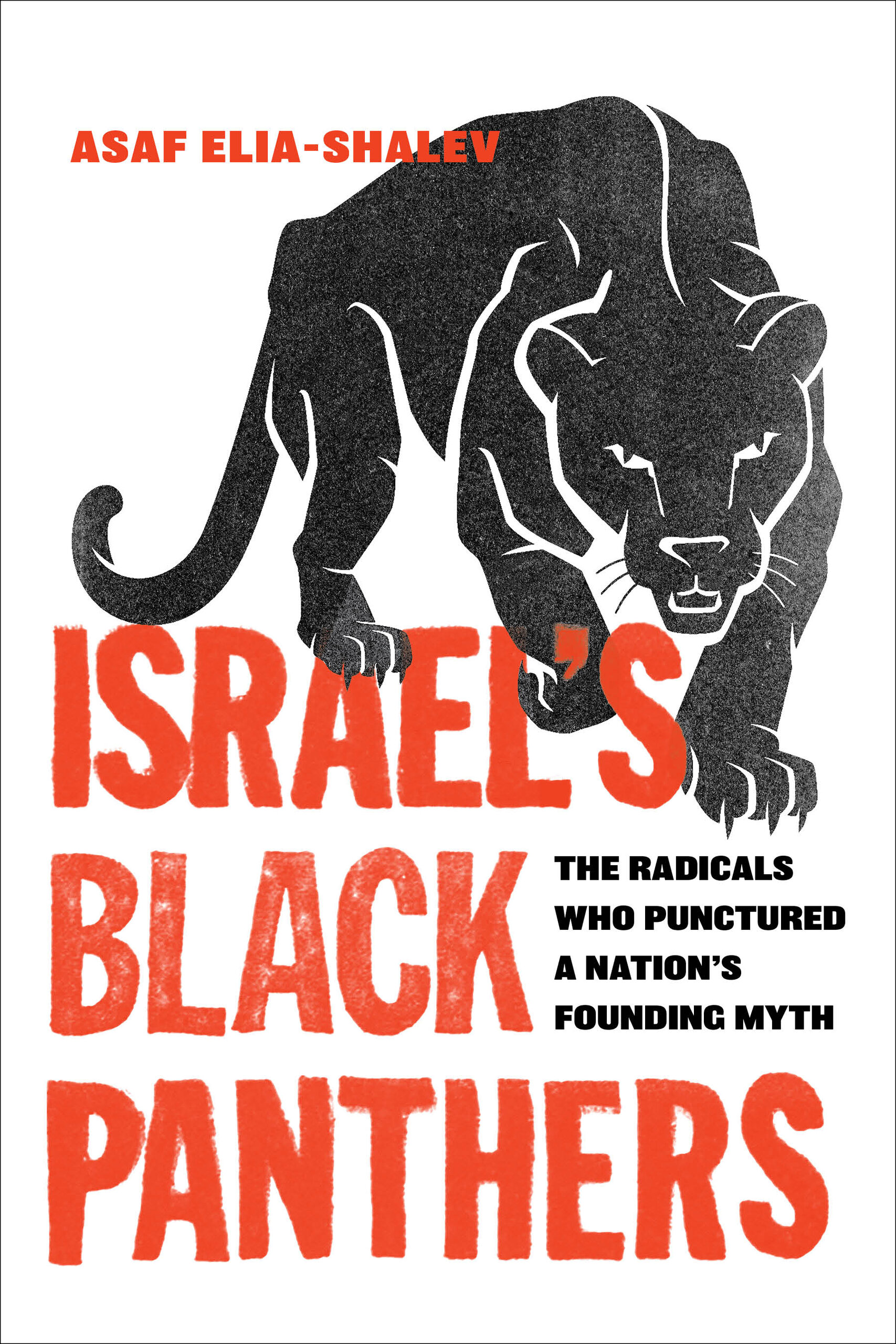
Ha-panterim ha-shehorim (Hebrew: “The Black Panthers”) have been one of the most significant Israeli social and political movements of the second half of the twentieth century. Nevertheless, their history, success and rapid decline made them–in the eyes of many–an epitome of the limits of Israeli radicalism and of this country’s Left more generally: a scarce degree of unity, an Israel- and Jewish-centered perspective that focuses on the cleavages between Ashkenazim and Mizrahim, while ignoring the Palestinians. The impact of the Black Panthers on Israeli politics and society has been assessed in contrasting ways, underlining the rapid dissolution of the movement and how some of its leaders took very different, in some cases divergent, political paths. But even though the legacy of the Black Panthers is indeed ambivalent and not always easy to historicize, the importance of this movement not only for the Mizrahim themselves, but for Israel as a whole is undeniable. This is why Asaf Elia-Shalev’s Israel’s Black Panthers constitutes a significant addition to Mizrahi Studies, as well as to the social and political history of Israel–even more so when thinking of the limited knowledge about the Black Panthers outside of Israel.
Israel’s Black Panthers is divided into twenty short chapters that follow–in a chronological manner–the history of the Black Panthers, from the years that preceded the founding of the movement in 1971 up to its decline and gradual dissolution starting in the second half of the 1970s. Even though this might appear as a rather short time span, it actually encompasses some of the most relevant events in Israeli history: from the Yom Kippur War (1973), to the historic victory of Menahem Begin’s Likud in the 1977 elections and the peace treaty with Egypt (1979). The author Asaf Elia-Shalev, who is a journalist by training, writes in a narrative style that allows us to read the history of the Black Panthers almost as a documentary fiction. The book is based on thorough archival research, which includes previously undisclosed police records, and on interviews that he conducted with some of the Black Panthers’ leaders–especially Reuven Abergel–and with others. Despite the richness of its primary and secondary sources, Israel’s Black Panthers does not have footnotes or endnotes, but a lengthy final section entitled “Notes on Sources,” in which the author refers to sentences from each chapter and describes the sources on which he based himself. If the non-academic public might appreciate the choice of not burdening readers with footnotes, from a scholarly perspective this makes referencing Elia-Shalev’s sources extremely difficult to follow.
As said, the chapters follow the history of the Black Panthers chronologically. Thus, we start from Reuven Abergel’s upbringing in 1950s Musrara–the Jerusalem popular neighborhood near the 1948 armistice line where the founders of the Black Panthers grew up–to the impact of the 1967 War, passing through his Moroccan origin and the 1959 revolt of Wadi Salib, Haifa, which is considered one of the first cases of Mizrahi political activism in Israeli history. The book then retraces the origins of the Black Panthers and the debut of other important members, such as Saadia Marciano and Haim Biton, as well as the impact of (Ashkenazi) social workers, activists and journalists on these young sons of mainly North African immigrants in the context of 1960s Israel. The 1970s protests and manifestations are described in great detail, up to the much-cited meeting with Prime Minister Golda Meir in April 1971 after which she famously described the Black Panthers as lo’ nehmadim (Hebrew: “not nice”).
Elia-Shalev also presents the struggles of the movement, especially in relation to aspects such as the dialogue with the Palestinians, and the discussions between its leaders on how to advance their ideals of social justice and equality in the context of 1970s Israel. In this, the author is supported by the seminal study of the renowned Israeli sociologist Deborah Bernstein, author of a doctoral dissertation on the Black Panthers already in 1979, and by the more recent works of Sami Shalom-Chetrit and Bryan K. Roby among others. The last chapters continue to follow the trajectory of the Black Panthers before and after the 1977 elections and the so-called ma’apakh (Hebrew, lit. “reversal”) caused by Likud’s victory. It was in those years that the Black Panthers finally entered parliamentary politics, something which also led to divisions within the movement and the final dispersion in different directions that would later include the Israeli radical Left, as well as the Sephardi ultra-Orthodox party Shas. In the last pages, the legacy of the Black Panthers is assessed by going forward to the 2000s and to Abergel’s final return to Morocco for a visit to his childhood home in Rabat and his participation in a New York University seminar three years later, in which he reflected on his trajectory in terms of a personal and political struggle: “I am here today to tell you how I and an entire generation became Black Panthers. […] regardless of whether a struggle succeeds or not, the most profound changes happen inside those people who fight for their rights and their dignity” (p. 277). The book also hints at the global dimension of the movement–a topic that still remains quite understudied–and how the Black Panthers connected not only to Israeli politics and society, but to 1960s and 1970s Third-Worldism, as well as to radical leftist and youth movements. In addition to the American Black Panthers, which are of course evoked already in the name, the Israeli Black Panthers for example had contacts with Italian leftist and extra-parliamentary groups such as Potere Operaio and Lotta Continua.
As said, it is difficult to evaluate the impact and legacy of the Black Panthers in a definitive manner. However, Elia-Shalev’s book makes clear how they were able to identify problems that are, in many respects, still at the core of any Israeli social agenda: the cleavage–surely less evident nowadays than it was in the 1970s, but still present in fields such as education and job opportunities–between Ashkenazim and Mizrahim, between center and periphery; the relations with the Palestinians—Haim Biton was among the first Israelis to meet officially the PLO leader Yasser Arafat in a 1980 conference in Bulgaria—and the possibility of working with them in a shared struggle for social justice and equality; the meanings of Zionism and its promise of Jewish liberation and emancipation in the face of intra-Jewish conflict and discrimination in Israel.
Elia-Shalev’s book then shows the profound significance of the Black Panthers and how their history has perhaps not entirely come to an end, as it can still provide us with useful cues for looking at contemporary Israeli society and politics.
