


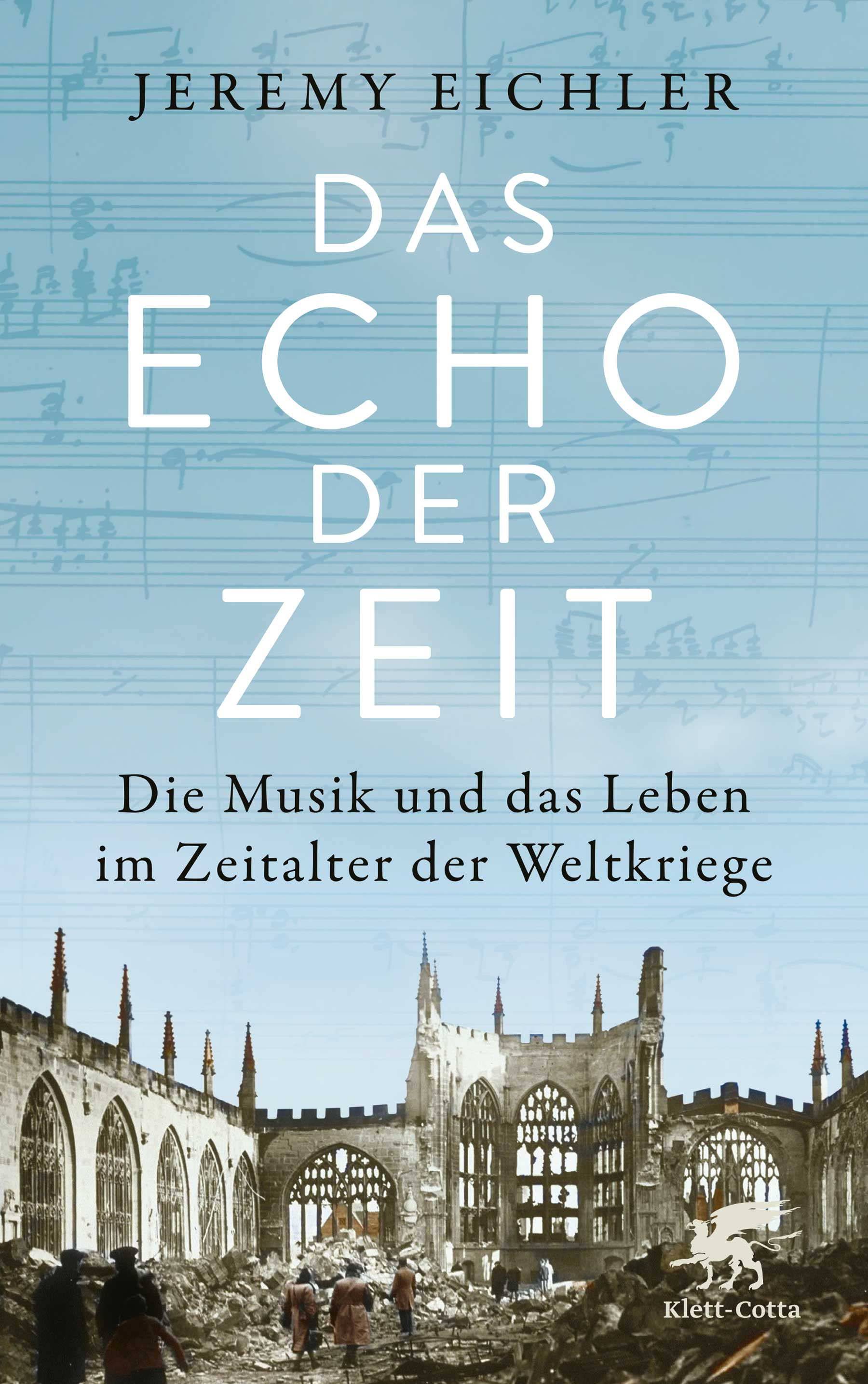
In contrast to the 2023 American original edition, the subtitle of the German edition of Jeremy Eichler’s already award-winning work of non-fiction omits two central themes: the Holocaust and the “music of remembrance.” This omission is disconcerting. The diluted formulation that the book presents a broad cultural history of “music” and “life” in the “age of the world wars” neither does justice to the common focus of the study—the before, during, and after of the singular civilizational rupture of the Holocaust—nor to the author’s intention to elucidate, from multiple perspectives, the forms and potentials of a musical (and music-historical) culture of remembrance and to make contemporary readers and listeners aware of its ongoing relevance.
The prominent compositions “of remembrance” by Richard Strauss, Arnold Schoenberg, Dmitri Shostakovich, and Benjamin Britten, which Eichler approaches with sensitivity and nuance, emerge as “echoes of their times”: of the era in which they were composed and of the historical moments to which they directly and indirectly bear witness—for example, Strauss’s Metamorphosen (1945), Schoenberg’s A Survivor from Warsaw (1947), Britten’s War Requiem (1962), and Shostakovich’s Symphony No. 13, Op. 113, “Babi Yar.” The book’s contemporary resonance becomes unmistakable when Eichler observes that this symphony—through the poetry of Yevgeny Yevtushenko, which denounces Soviet-era antisemitism—was able to “express the problem of conscience in music” (p. 335),1 and further notes that at the time he completed his manuscript it had not yet been performed by the Vienna Philharmonic (p. 350). The study thus becomes an echo of the present and will endure insofar as it confronts every future present anew with the question of how to engage with “musical monuments.”
The suppression of this principal theme in the German subtitle is therefore as incomprehensible as it is counterproductive. This is all the more striking given that, in the final chapter, Eichler advances the compelling thesis that music—especially music composed as a memorial to unimaginable human suffering—possesses a distinctive relationship to memory. In listening, we are actively prompted to become conscious of past pain and trauma in all their historical entanglements, a process that may render us more critical and attentive to injustices in the present (p. 382). Eichler’s book not only advocates “deep listening” at its beginning and end (p. 28); it offers nothing less than a guide to its practice. In short, whether read by academic specialists or interested laypersons, this study enriches its audience through an impressive synthesis of microhistory and histoire croisée, effectively fostering a more profound mode of listening. Conceptually, Eichler productively adapts the method of histoire croisée to the genre of narrative non-fiction and skillfully integrates a layer of personal experience. Across chapters, this experiential dimension establishes fixed points of orientation by mapping a topography of sites of memory that serve as points of departure for reflections on historicity, processes of overwriting, and the disturbing coexistence of high culture and barbarism.
The interwoven travel narratives lead readers to the stump of the Goethe Oak, felled in 1937 by prisoners during the construction of the Buchenwald concentration camp on the slopes of the Ettersberg near Weimar. The fragility of the seemingly permanent, and the shocking visibility with which the National Socialists openly enacted iconoclastic antisemitism, are further illustrated by the example of the Mendelssohn monument in Leipzig. Erected in 1892 before the Gewandhaus, it was completely destroyed by the Nazis in 1936 despite international protests and rescue efforts, and reconstructed as an exact replica in 2008. Such reconstruction, Eichler argues, risks leveling the “contextualization of the sins of the past” (p. 386). Re-erection in the form of a copy appears to annul history itself, potentially erasing even the scars left by crime. Unlike mutable—and manipulable—sites of memory, music can function as a “missing plaque” (ibid.), speaking more clearly and proving resilient and “untouchable” (p. 355) in the face of attempts to frame, control, instrumentalize, or even obliterate material monuments in accordance with prevailing cultural-political narratives.
Eichler’s most compelling account of a site visit appears in his description of the execution site at Babyn Yar, a ravine near Kyiv that became one of the principal sites of the “Holocaust by bullets.” Concealed and physically altered by the Soviet regime—whose infamous handling of the terrain led, as Eichler learned on site, to there being “no ravine left”—the area came to embody a “permanent wedge” (p. 352) driven between landscape and memory in the postwar period. Today the site has been transformed into a recreational park dotted with individual memorials to various victim groups, situated amid urban infrastructure and the “green lung” of a modern metropolis once again scarred by war. Despite the assistance of a knowledgeable guide, Eichler was unable to identify the precise location of the massacre. In contrast to the mutability of physical places, music remains a “home of conscience” (p. 355)—in this instance, Shostakovich’s Symphony No. 13. As a musical monument, it is neither alterable nor corruptible. More than that, such music becomes a site-independent and timeless testimony to concealed atrocity and a personal confession by its author, whose own conflicts—inscribed into the composition under totalitarian conditions—are thereby made communicable.
Eichler’s detailed reconstructions of the lives of composers and musicians (including the deeply moving account of the Viennese Rosé family) and his contextualization of the motivations underlying these memorial compositions converge on this central claim regarding the singular value of musical monuments. This becomes evident, for instance, in his discussion of Schoenberg’s “combination of premonition and passion in political matters” (p. 87), which, upon his expulsion in 1921 from the holiday resort of Mattsee, made him acutely aware of the impending catastrophe—a trajectory Eichler traces to the periphery of music history in Albuquerque, New Mexico, where A Survivor from Warsaw was premiered in November 1948 by an amateur ensemble. It is equally apparent in Strauss’s premiere of Metamorphosen in Zurich two years earlier, which Eichler characterizes as a “uniquely ‘open’ memorial” (p. 162), enigmatically binding together “sincerity and inscrutability” (ibid.) amid the morally encumbered idyll of Garmisch-Partenkirchen, where, for example, the grave of the conductor Hermann Levi lay neglected for decades and only since 2010 has a modest memorial commemorated regional victims of National Socialism. Through these narratives, Eichler consistently renders accessible and experientially tangible to contemporary audiences the complex mnemonic space in which these compositions unfold.
The book is neither an introductory listening guide nor a specialized work of musicology. Eichler writes from the firm footing of a cultural historian who, through meticulous research and—judging from the acknowledgments—sustained dialogue with numerous interlocutors, reconstructs the historical constellations of musical monuments and thereby enables readers to grasp the unimaginable catastrophes to which these works fundamentally refer. Implicitly, readers are invited to extend this inquiry by examining other relevant compositions and their authors from this era with regard to the biographical ruptures wrought by fascism and their relationship to the memory of the victims of the Holocaust.
Even if many historical details may already be familiar to expert readers, the clearly structured and never cumbersome histoire croisée guarantees an intellectually rewarding reading experience for specialists as well. The German translation by Dieter Fuchs likewise deserves high praise. One may hope that many readers, through Eichler’s reflections on musical remembrance, will also recognize that this topic has recently received growing attention within musicology. Melanie Unseld’s 2025 study Musik und Erinnerung, grounded in interdisciplinary memory studies, classifies and discusses diverse forms of souvenir and memorial compositions. In the same year, Erik Battaglia and Claudio Voghera published a compendium of recent commemorative compositions dedicated specifically to the victims of the Shoah, written for events marking Italy’s Giorno della Memoria under the title Musica per la Shoah. Concerti per il Giorno della Memoria al Conservatorio “G. Verdi” di Torino. The musical echo of this era—if one is willing to hear and see it—continues, with hope, to resonate ever more widely.
[1] Page numbers refer to the German edition reviewed here.
