


Antisemitism Reconsidered
In the eyes of many observers, the Hamas attack on Israel on 7 October 2023, the ensuing war in Gaza and the US-Israel war with Iran have become nothing less than a watershed, generational moment for Jews across Europe, North America, Israel and other centers. While vocal anti-Israel protests on campuses and city squares from Berkeley to Berlin and from London to Lisbon have made many Jews and Israelis feel uncomfortable, violent assaults (and, at times even acts of murder) against Jews and Jewish institutions in Manchester, Sydney, Toronto and Washington, DC, have forced Jews in a range of locations to think hard about what it means to be a Jew today, in the twenty-first century. Are Jews, indeed, full and equal citizens in different European, North American and other societies? Or, was the enlightenment dream regarding the ability to be both a Jew and something else—a Pole, a Canadian, an American—an illusory moment whose time has come to a sudden and deafening closure?
In North America and elsewhere, Jewish communities and local universities have responded to this acute moment in modern Jewish history by creating an array of new research centers and initiatives dedicated to the academic study of antisemitism at leading institutions such as Brandeis University, New York University, the University of Michigan, the University of Pennsylvania, the University of Toronto and others. The underlying principle behind this wave of research centers is clear: If we could only understand the social illness we collectively refer to as “antisemitism,” then we would surely be able to combat, contain and even eliminate it, just as scholars and scientists were able to do with other deadly contagion that threatened modern society, from polio to AIDS to Covid. Although surprised and, for some even traumatized, by the events of the past three years, the vast majority of Jews and Jewish institutions remain fundamentally Whiggish regarding the very path of modernity and its fundamental promise regarding the construction of a just, ethical, and inherently better world in which one can be both a Jew and an equal member of the surrounding community.
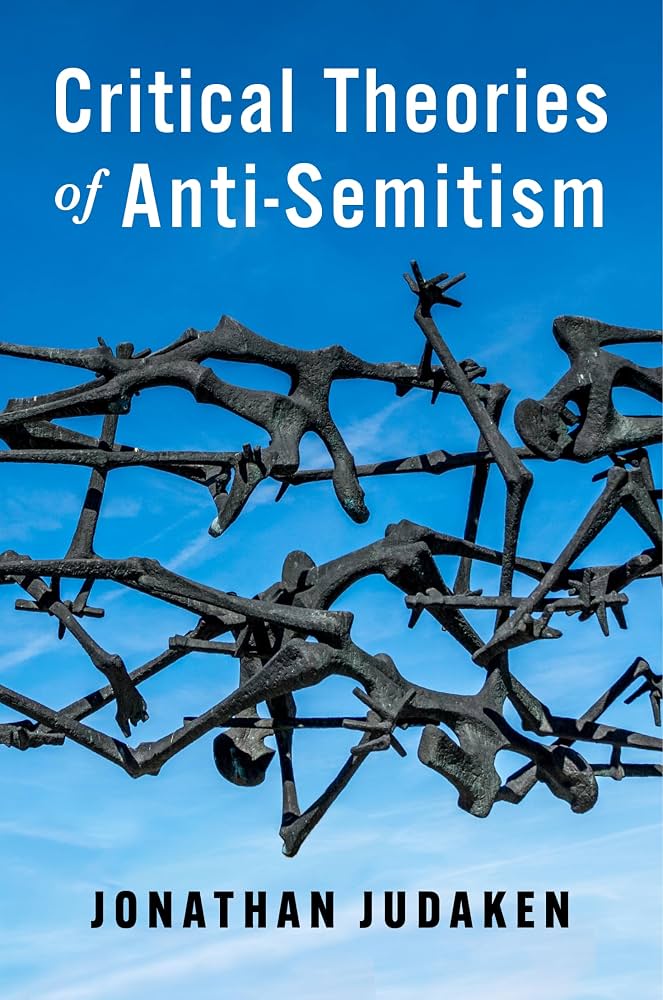
However, as Jonathan Judaken convincingly demonstrates in his illuminating, learned and provocative study Critical Theories of Anti-Semitism, many of these same questions pre-occupied a range of leading intellectuals from Sartre to Arendt to Mosse, and their conclusions regarding the nature and history of antisemitism and the future of “the Jews” are as varied (and as fascinating) as the writings and lives of these, primarily Jewish, thinkers themselves. Rather than despair at the multiplicity of approaches and potential answers to these questions, Judaken is inspired by these works and his path-breaking study is designed to encourage readers to follow their footsteps, embrace their intellectual challenges, and to take the study of antisemitism seriously as both authors and readers revisit, probe and rethink some of the fundamental postulates regarding hostility and prejudice towards members of the Jewish community (antisemitism) that are very often accepted in Jewish society and also among scholars of Jewish studies and leaders of Jewish communal life.
For the past two decades, Judaken has been one of the more prominent voices advocating for the need to reconsider the very nature, history and potential resolution of antisemitism as well as the different ways that scholars study and discuss the phenomenon, and Critical Theories of Anti-Semitism expands upon and continues his bold intervention.1 Noting how academic and public discussions of antisemitism often degenerate to a discursive “battlefield” and the extent to which they frequently serve as surrogates for heated debates regarding the “Israeli-Palestinian question,” Judaken calls on readers and scholars to turn to works by key twentieth-century thinkers like Jean-Paul Sartre, members of the Frankfurt School, Hannah Arendt and Jean-François Lyotard, as well as sociologists like Talcott Parsons and Zygmunt Bauman and historians like Léon Poliakov and George Mosse (pp. 3 and 1, respectively). Close readings of studies by these scholars, allows Judaken “to write a history of the major theories and theorists of anti-Semitism” which aims to bring “critical theories of anti-Semitism into dialogue with critical race theorizing” and, in the process, to advance his larger goal of revitalizing the academic study of antisemitism (p. 15).
Delineating his methodological goals and the book’s scholarly intervention in the Introduction, Judaken presents his position clearly. “I maintain that writing about Judeophobia today demands greater interrogation of our terms, methods, narratives and epistemologies. It requires that we appreciate the connections between anti-Semitism and colonialism, immigration, and xenophobia; the links between gender and Jewishness, and between Jews and Muslims and other ‘Others’; and the ties between the postcolonial condition shaped by slavery and imperialism, and the experiences of other genocides and the Holocaust. In short, I argue against exceptionalism, eternalism, teleology, apologetics and theoretical naïveté” (p. 3).
Although many of their earlier works consciously avoided Jewish topics and the study of antisemitism, leading members of the Frankfurt School like Max Horkheimer and Theodor Adorno turned increasingly to these topics after their exile from Nazi Germany and arrival to the US as German-Jewish refugees in Southern California in 1941 (pp. 49 and 51). Their research on antisemitism was advanced by a major funding initiative from the American Jewish Committee which supported and published the groundbreaking Studies in Prejudice series that Horkheimer directed (p. 46). Leading to such definitive studies as The Authoritarian Personality (1950), Rehearsal for Destruction: A Study of Political Anti-Semitism in Imperial Germany (1949), and Prophets of Deceit: A Study of the Techniques of the American Agitator (1949), the five books published as part of the Studies in Prejudice series shaped the way that generations of scholars and other observers would understand the nature of antisemitism and its critical place in both the Nazi’s rise to power and the implementation of the Final Solution. Nor is Judaken shy in noting how relevant questions like those regarding the charisma of the authoritarian figure, the allure of political rhetoric, and the impact of racial antisemitism are for understanding today’s political discourse. According to Judaken, these books can be read as a “secret playbook” regarding the “contemporary right-wing populist authoritarian discourse” in the United States and other locations (p. 59).
Horkheimer and Adorno also collaborated on Dialectic of Enlightenment which looked at “anti-Semitism within the development of Western civilization, instrumental rationality, and the administered society of modernity” (p. 65). While the works published under the auspices of the American Jewish Committee’s Studies in Prejudice series were widely read and incredibly influential, Dialectic of Enlightenment would speak to a different, more academic audience, and the book continues to serve as a central part of the Frankfurt School’s Critical Theory to this day (p. 65).
Horkheimer, Adorno and other members of the Frankfurt School were part of a generation of post-war émigré scholars who attempted to comprehend the searing black hole that World War II and the Holocaust created in the very middle of Europe in the very middle of the twentieth century. Hannah Arendt similarly set out to understand these and related developments in her sweeping study The Origins of Totalitarianism (1951). After her arrest and imprisonment by the Gestapo in the summer of 1933, Arendt and her mother fled Germany to Paris where she was later interned as an “enemy alien” in 1940 before escaping and fleeing, first to Lisbon and then to the United States. Settling in New York, she began writing for a number of central Jewish journals like The Menorah Journal and Jewish Social Studies, where she published pieces that would lay the foundations for her masterwork, The Origins of Totalitarianism (p. 75). Antisemitism was key to Arendt’s study, taking up the first third of the tome as she repeatedly called for the phenomenon’s “historicization” (p. 73). As part of her efforts to challenge how many understood and studied antisemitism at the time, Arendt criticized “eternalist narratives that postulate that Jews are transhistorically hated and abused,” and was “also critical of apologetics, casual teleology, and exceptionalist narratives” (p. 73, see also pp. 88 and 99). After her analysis of antisemitism, Arendt turned to imperialism, by focusing on the example of Cecil Rhodes and other imperial financiers (some of whom were Jewish) active in colonial South Africa, thus allowing her to forge a connection between “the histories of anti-Semitism, racism, imperialism, Nazism, and genocide” (pp. 95 and 77).
Forceful and enticing, The Origins of Totalitarianism “instantly became a key reference in debates about totalitarianism during the Cold War and in postwar discussions of anti-Semitism and the Holocaust.” Arendt’s 1963 study Eichmann in Jerusalem: A Report on the Banality of Evil, on the other hand,“was far more controversial and helped ignite key debates in the emerging field of Holocaust studies” (pp. 75-76). The renowned German-Israeli scholar of kabbalah from the Hebrew University, Gershom Scholem, for example, accused Arendt in a private letter of lacking a “love of the Jewish people” (ahavat Yisrael),2 as fierce debates among Jews surrounding Arendt’s study of Eichmann foreshadowed many of the arguments and divides that plague the study of antisemitism today as the field repeatedly attempts to strike a balance between scholarly research and Jewish communal interests.3
The Polish-born sociologist Zygmunt Bauman similarly turned to the study of antisemitism and the Holocaust in exile after being forced out of Poland in wake of the 1968 anti-Zionist campaign. After a few, apparently unhappy, years at Tel Aviv University, Bauman continued on to Canada and the United States before finding an academic home at the University of Leeds’ Department of Sociology in 1971 (p. 106). There, Bauman turned his attention to the Holocaust and “the Jewish question” with such provocative works as Modernity and the Holocaust (1989), Modernity and Ambivalence (1991) and Life in Fragments: Essays in Postmodern Morality (1995). Embracing the Frankfurt School’s intellectual legacy and Arendt’s iconoclastic temperament, Bauman brushed up against the burgeoning field of Holocaust studies just as it was developing a scholarly consensus in major academic centers in Israel and the United States.
Turning to the long-overlooked Polish literary scholar of Jewish descent Artur Sandaeur, Bauman embraces the term allosemitism to highlight the different ways “that Jews and Judaism are treated as the quintessence of difference, often embodying how all forms of alterity” threaten the socio-political reality (p. 124).4 Focusing on allosemitism also allowsBauman to emphasize the extent to which antisemitism should be “treated as a case of heterophobia - the resentment of differences that provoke anxiety,” since “Judeophobes […] fear the anxiety produced by the Jews because they blur borderlines” (pp. 124 and 125). In this and other ways, Bauman’s analysis substantiates one of Judaken’s main points regarding the many connections between antisemitism and other forms of group hatred.
While Bauman viewed allosemitism, ambivalence and modernity as key forces underpinning antisemitism and the Holocaust, Léon Poliakov pointed to the longue durée of antisemitism and its central role in the Nazis’ rise to power and the implementation of the Final Solution. Judaken’s chapter on Poliakov is very much an historiographical rehabilitation of the French Jewish historian as he sheds light on “Poliakov’s often-unacknowledged contributions to the establishment of Holocaust studies” (p. 158; also see, p. 164). According to Judaken, Poliakov’s work served as nothing less than “a palimpsest that sketched key aspects of the Shoah that were developed and treated by others, but rarely with credit to their origins in his work” (p. 159).
Poliakov’s approach to the topic was laid out in his study Bréviaire de la haine (Harvest of Hate) which was published in 1951, the same year that Arendt produced The Origins of Totalitarianism and a year after the publication of The Authoritarian Personality by Adorno and others. Unlike these works, however, Poliakov was, according to Judaken’s frank assessment, “no theorist” (p. 158). At the same time, Poliakov’s study, which “was the first all-encompassing survey of the genocide of European Jewry in any language,” helped lay the foundations for how generations of scholars would understand and define the Holocaust by highlighting the Christian roots of antisemitism, the view that Nazism was, essentially, a new religion, and the centrality of modern racism to both antisemitism and the Holocaust (pp. 164 and 167-168). These and other points were also central to Poliakov’s four-volume study on The History of Anti-Semitism, a seminal work that claimed that anti-Judaism lay at “the core of Western civilization.” “To write the history of anti-Semitism,” Poliakov believed “is to write the history of a persecution that, in the bosom of Western society, was linked with the highest values of this society” (p. 177). Unlike Arendt and Bauman’s emphasis on the path of modernity, Poliakov believed that “Christian anti-Judaism was the scaffolding for modern racism” (p. 188). Here, in particular, Poliakov’s work helped lay the foundations for prevailing analyses of antisemitism as well as its central place in the study of the Holocaust.5 While the twinning of antisemitism and the Holocaust may seem self-evident to many observers today, Judaken demonstrates the different interpretations of the relationship between racism, antisemitism, World War II and the Holocaust that a range of twentieth-century thinkers adopted and the far-reaching ramifications of these authorial and methodological strategies, both then and now.
The study of antisemitism is a heavily presentist field and while Judaken is determined to challenge this approach, the concluding chapter turns to today’s world by pointing to the various ways that the different thinkers he discusses can help us unpack and understand pressing contemporary issues. Bauman’s emphasis on the ambivalence inherent in allosemitism as well as his use of the concept of heterophobia helps demonstrate “how Judeophobia in the present is entangled in anti-Muslim, anti-black, and xenophobic racisms” in contemporary American society where “the outcasts are a rolling list of targets: Muslims, immigrants, liberals and socialists, and Jews” (pp. 221 and 228). At the same time, works by members of the Frankfurt School and other scholars (like the historian George Mosse) can help people decipher contemporary examples of the Authoritarian Personality and various Prophets of Deceit in the United States, Hungary and other countries where many Jews live. Similarly, Poliakov, who was “the key forerunner of ‘the new anti-Semitism’ theoritsts,” can help us understand “the shifts in the discourse of the Left following the Six-Day War in 1967” (p. 228), and Arendt, who “was labeled as a ‘self-hating,’ anti-Semitic, ‘enemy of Israel,’” serves as a stark reminder regarding the angry debates today surrounding the State of Israel and many of its policies in which “Jews who are vociferous critics of Israel” are often derided and delegitimized as “self-hating” members of a Jewish fifth column (pp. 233 and 237).6
Judaken’s wide-ranging, learned analysis raises a litany of questions that readers and scholars will ponder throughout his provocative study. I, for one, repeatedly found myself thinking about the potential impact that larger catastrophes like the Holocaust and the very experience of exile may have had upon a particular thinker’s decision to study antisemitism and the Holocaust. The vast majority of the authors that Judaken discusses are Jews (in one way or another) whose lives were violently disrupted by the Nazi’s rise to power. Whether it was Adorno and Horkheimer in Southern California, Arendt in New York, Poliakov in Paris, Bauman in Tel Aviv and later in Leeds, or George Mosse in Iowa and then in Wisconsin, most of them turned to the study of antisemitism only after their seemingly idyllic European lives were torn asunder and they attempted to comprehend the Nazis’ rise to power and repair, somehow, the shattered remains of their pre-war lives. While these points are raised periodically throughout Judaken’s book, the potential link between the very personal experience of exile and loss, on the one hand, and the turn to larger historical questions, on the other, might prove to be a productive line of thought for future studies.
As refugee scholars, many of these thinkers and their research projects were also dependent upon the goodwill and support of Jewish communal institutions and their associated leaders. The American Jewish Committee’s backing was critical to the publication of the Studies in Prejudice series undertaken by Horkheimer and other members of the Frankfurt school and Poliakov’s early forays into the field began through his activities at the postwar Contemporary Jewish Documentation Center and his subsequent role as an expert in the French delegation to the Nuremburg trials (pp. 162-3). Some two decades later, Arendt was pilloried for her book on the Eichmann trial by an array of prominent Jewish communal figures, including Scholem and also Jacob Robinson who was the founding director of the Institute of Jewish Affairs in New York, the research arm of the World Jewish Congress and the American Jewish Congress.7 Nor does this confluence of interests end with the lives and works discussed in Judaken’s book. To the best of my knowledge, all of the centers for the study of antisemitism currently active today—academic and communal—are supported by private or, in the case of the largest center in Europe at the Technical University in Berlin, by public funding, and even the esteemed forum sponsoring this scholarly discussion of Judaken’s book is published with the support of the Fondazione Centro di Documentazione Ebraica Contemporanea (CDEC, Center for Contemporary Jewish Documentation). While the maintenance and development of a range of academic fields depend upon support from either private or government sources, the study of antisemitism has a long history of Jewish communal backing and involvement and I wonder about the extent to which this ongoing, albeit diffuse, dependence on communal support has shaped the very study and development of the field, and what this, in turn, can tell us about the way that scholars, students and community members think, teach, study and understand antisemitism.
Digressions aside, Jonathan Judaken’s book is one of the most important studies of antisemitism to have been written in this fragile century of ours and it is nothing less than a must read for any student, scholar or community member interested in learning and thinking about antisemitism, its history and the heated debates that continue regarding its potential resolution or unfortunate endurance. The range of works analyzed by Judaken is staggering and his readings are clear and thought-provoking. Critical Theories of Anti-Semitism adroitly delineates the different approaches that a range of key thinkers implemented in their attempts to understand, explain and perhaps even resolve antisemitism and, in doing so, allows students and scholars to gain a much deeper understanding of the different ways that the phenomenon has been studied, presented and discussed.
While Judaken’s study may be a bit too detailed at times for undergraduate survey courses, it will prove essential for graduate student seminars and accompanying reading groups on the topic and will also be of great use in courses on European intellectual history and modern Jewish thought as students and their instructors dive deep into the works, minds and lives of central thinkers like Sartre, Adorno and Arendt as well as sociologists like Talcott Parsons and Bauman, and historians like Poliakov and Mosse. Interested community members as well a wide range of Jewish and non-Jewish educators, practitioners and communal leaders will also gain much from Judaken’s spirited call that we all take this very moment in our fragmented, frenetic lives on the precipice of a post-human era to pause and think about a range of basic assumptions that have long been accepted as fundamental truths regarding “the Jews,” their history and their fate.
Whether or not Jewish studies scholars and students as well as community members and other interested readers will be able to hear and embrace Judaken’s intellectual, political and existential intervention remains, at the end of the day, an open question.
1 Jonathan Judaken, “So What’s New? Rethinking the ‘New Antisemitism’ in a Global Age,” Patterns of Prejudice 42, nos. 4-5 (2008): 531-560; David Feldman and Marc Volovici, eds., Antisemitism, Islamophobia and the Politics of Definition (London: Palgrave Macmillan, 2023); David Nirenberg, Anti-Judaism: The Western Tradition (New York: W.W. Norton and Co., 2014); Scott Ury and Guy Miron, eds., Antisemitism and the Politics of History (Waltham, MA: Brandeis University Press, 2024).
2 Gershom Scholem to Hannah Arendt, Jerusalem, July 23, 1963, in Hannah Arendt, The Jew as Pariah: Jewish Identity and Politics in the Modern Age, ed. Ron H. Feldman (New York: Grove Press, 1978), 241-242.
3 Scott Ury and Guy Miron, “Antisemitism: On the Meanings and Uses of a Contested Term,” in Antisemitism and the Politics of History, 1-21.
4 Artur Sandauer, On the Situation of the Polish Writer of Jewish Descent in the Twentieth Century: It Is Not I Who Should Have Written This Study…, trans. Abe Shenitzer and Sarah Shenitzer (Jerusalem: Magnes Press, 2005).
5 See, Shmuel Almog, ed., Antisemitism through the Ages (New York: Pergamon Press, 1988); Robert S. Wistrich, A Lethal Obsession: Antisemitism from Antiquity to the Global Jihad (New York: Random House, 2010).
6 Sander L. Gilman, Jewish Self-Hatred: Antisemitism and the Hidden Language of the Jews (Baltimore: Johns Hopkins University Press, 1990); Sol Goldberg, “Jewish Self-Hatred,” in Key Concepts in the Study of Antisemitism, eds. Sol Goldberg, Scott Ury, and Kalman Weiser (Cham, Switzerland: Palgrave Macmillan, 2021), 147-160.
7 Jacob Robinson, And the Crooked Shall Be Made Straight: The Eichmann Trial, the Jewish Catastrophe and Hannah Arendt’s Narrative (New York: The Macmillan Company, 1965).
