

Introduction
Following the fall of Saigon on 30 April 1975, around 140,000 South Vietnamese associated with the former government were evacuated to the United States. At the same time, smaller numbers fled by sea to neighboring countries: approximately 5,000 reached Thailand, 4,000 Hong Kong, 1,800 Singapore, and 1,250 the Philippines. These refugees, who escaped aboard often makeshift vessels, soon became known in Western public opinion as “the boat people.” After the proclamation of the Socialist Republic of Vietnam on 2 July 1976, the communist government's nationalization policies, which particularly affected the ethnic Chinese Hoa minority, triggered a sharp increase in emigration. The number of refugees rose from about 15,000 in 1977 to more than 62,000 in 1978, around 70 per cent of whom were Hoa. Following Vietnam's invasion of Cambodia in December 1978 and China's retaliatory attack in early 1979, the exodus accelerated further. By 1979, Malaysia had received 124, 103 Vietnamese boat people, Hong Kong nearly 80,000, and Thailand just over 25,000.1
In recent years, the topic has been addressed only in scattered contributions and mainly within the broader scholarship on the history of migration and humanitarianism during the Cold War.2 From 2016 onwards, Michael Vossing's study of the reception of the boat peoplein West German public discourse3 inaugurated a wave of scholarship devoted to individual national case studies, often adopting a comparative perspective.4 In 2019, Andrea Possieri was the first to offer a detailed reconstruction of the debate that unfolded in the Italian press.5
Compared with these studies, my aim is to reconstruct the origins and functioning of the analogies drawn in Italy between the boat people and the Shoah, focusing on the first three years of John Paul II’s pontificate (1978-1980), which coincided with the emergence of the Indochinese refugee issue on the international stage. This contribution seeks to explore the specific Catholic elaboration of the Shoah in Italy, considering collective memories not as isolated and competing realities, but as dynamic processes shaped by mutual influence and “multidirectional” interaction.6 Robert S. C. Gordon’s pioneering work offered the first comprehensive reconstruction of Italian cultural responses to the Jewish genocide between 1945 and 2010 but did not examine the specific role of Catholic culture. The limited attention given to the Holy See’s use of the term Shoah and to debates over Pius XII’s silence appears insufficient, given the lasting influence of Catholic culture on Italian society.7 The topic has so far been addressed only in scattered and generally framed contributions. In 2005, Manuela Consonni opened this new field of research by offering a preliminary, albeit partial, investigation into the ways in which the ecclesiastical hierarchy engaged with the memory of the Shoah in the early years of the post-war period.8
In the article were identified three main symbolic-rhetorical constructions characterized the catholic press in Italy. At the first level, an anti-totalitarian rhetoric emerged, centered on the analogy between Nazi regime and the new perpetrator, identified with the Government of the Socialist Republic of Vietnam. A second level of comparison revolved around the parallel between the boat people and the Jews. The third level rested on a parallel between the silences of the Western powers in the face of the Shoah and the attitude adopted by those same countries towards the tragedy of the Vietnamese refugees.
Catholic anti-totalitarianism and the analogy of the persecutor
The first reports concerning Vietnamese refugees reached Italy in January 1977, thereby opening what came to be known as the “caso Vietnam” (Vietnam controversy).9 Italian public opinion addressed the issue of Vietnamese refugees later than the international debate, which had already developed in countries such as the United States and France. The French press had begun covering their plight immediately after the fall of Saigon in 1975. In the context of the Cold War, a sense of responsibility toward the colonial and imperialist past, combined with the tendency to identify the boat people with anti-communists, contributed to an early acceptance of refugees.10 Nevertheless, the issue did not immediately achieve full visibility even in 1977 within Italian public opinion. References to the crisis in Vietnam remained sporadic and fragmented until November 1978, while even more limited attention was devoted to the refugees themselves.11 Despite limited media coverage, the issue nevertheless came to the attention of the Italian government.
The United States delegation to the North Atlantic Treaty Organization (NATO) urged allied countries to accept even a modest number of Indochinese refugees, alongside the implementation of its own resettlement program. Following an interministerial meeting convened on 10 February 1978, the Italian government decided not to comply with the American request. The political debate focused on two main sets of issues. On the one hand, legal concerns emerged, stemming from the non-applicability of the 1951 Geneva Convention Relating to the Status of Refugees to non-European citizens. On the other hand, doubts arose regarding the social, employment, and public order implications associated with the potential reception of foreign immigrants. 12
In December 1978, newspapers around the world gave extensive coverage to Malaysia's decision to refuse permission for the merchant vessel Hai Hong, carrying approximately 2,500 refugees, to dock.13 These events attracted the attention of Italian public opinion, also beyond Catholic circles. André Glucksmann, one of the leading figures of the nouveaux philosophes movement, published in the moderate Italian daily newspaper Corriere della Sera a series of articles on the Vietnamese refugees as part of the third instalment of “Reportages di idee,” which had previously featured contributions by Michel Foucault and Alain Finkielkraut. As a proponent of a liberal-progressive and anti-communist political outlook,14 he undertook a journey to investigate the underlying causes of the exodus.On that occasion, he reflected on the mechanisms of persecution. “Why do they leave? The reasons are many.” Dr. Don, one of the Vietnamese refugees, recounted his experience of the “concentration camps” in North Vietnam.[15] He went on to draw a detailed comparison between the “vast industrial enterprise” of “the German camps,” the Chinese, the Soviets, and the “Vietnam newcomers, by contrast, drew upon the methods of their predecessors.”16 This idea spread primarily through the pages of the illustrated Italian magazine Gente. On 6 January 1979, the weekly published a lengthy interview with survivors of the “Vietnamese lager”: “Harrowing testimonies on “re-education” carried out by the Communists: as in Auschwitz and Dachau.”17 “Perpetrators, or Analogy as Denunciation,” was the first type of analogy to emerge. As the Italian historian Guri Schwarz writes, “the central feature of this kind of exercise is the condemnation of a political adversary, a new perpetrator who is degraded through association with Nazism.” The core of this comparison therefore lies in the focus placed on the perpetrator’s intentions and responsibility.18
The Italian context was shaped by the reverberations of a debate that, at the time, was particularly intense across the Alps.Glucksmann promoted in France an initiative that gained broad public attention: Un bateau pour le Vietnam (A Boat for Vietnam). At the end of 1978, the project of chartering a vessel to rescue Vietnamese boat people received the support of prominent intellectuals from different political backgrounds, including Raymond Aron and Jean-Paul Sartre, as well as Cardinal François Marty.19 Sartre, a former Marxist, represented a generation of intellectuals increasingly critical of justifying present suffering in the name of future benefits. This position reflected the gradual decline of grand historical narratives and overarching interpretive frameworks.20 In the 1970s, the resulting vacuum was gradually filled by the emergence of human rights as a new universalist “utopia,” grounded in the protection of individual rights regardless of political affiliation.21 In 1974, the publication of the Italian and French translations of Aleksandr Solzhenitsyn’s The Gulag Archipelago provided an opportunity for numerous anti-communist intellectuals, including Glucksmann, to challenge Marxist doctrine by drawing comparisons with Nazism.22 This anti-totalitarian reflection also included a strong critique of American imperialism and European colonialism.23
This interpretation had a significant impact in Italy, especially within debates among left-wing forces, contributing to the political divide between the positions of the Italian Socialist Party (PSI) and those of the Italian Communist Party (PCI). The PCI rejected the view that the Vietnamese regime’s dictatorial nature lay among the causes of the exodus, it directed its criticism primarily towards the historical legacy of French colonialism.24 On January 12, several PSI senators submitted parliamentary inquiries against the government, accusing it of failing to undertake any rescue initiatives.25 A few days later, Paolo Flores D’Arcais addressed the issue in the PSI newspaper, Avanti!, accusing his generation of having supported a just anti-imperialist struggle without considering its consequences: the rise of a new “totalitarianism.”26 Around the same time, Arturo Viola pushed this rhetoric even further, observing that the “Vietnamese are fleeing their country” to escape the “concentration camp” and the “hell of the lager.”27 The condemnation of Vietnam, through a comparison with Nazism, was accompanied during those months by a broader and more complex reflection. On March 4, Avanti! interviewed the French philosopher, who was engaged in identifying the elements “of rot and commonality among totalitarianisms.” On this occasion, the comparison focused on the “identity of methods” and the “identity of weapons” among Vietnam, the United States, and Nazism, noting that “currently, the communist Vietnamese have taken up American weapons again,” and “the consequences are essentially the same”: “political prisons,” “concentration camps […] that were those of the Nazis.”28 It is a comparison that “places ‘democratic’ countries alongside totalitarian countries.”29 As in France, the Italian left interpreted the boat people phenomenon through a humanitarian and apolitical discourse, grounded in the promotion of human rights as a means of moving beyond ideological confrontations. This raises the question of how the Italian Catholic world interpreted and responded to the crisis.
The Catholic Church had in fact been concerned for some time with the fate of the populations of Southeast Asia, at least since the Paris Peace Accords between the United States and Vietnam on 27 January 1973.30 On 3 December 1978, the newly elected Polish pontiff Pope John Paul II stirred Catholic public opinion by issuing an appeal to pray “for those Vietnamese who, having left their land, are suffering because they do not find anyone to welcome them.”31 Thereafter, the Holy See’s daily newspaper, L’Osservatore Romano, had reported on the front page the specific details of the tragedy of the Hai Hong vessel, without, however, questioning the deeper causes of the exodus.32 It called upon public opinion and governments to make a “gesture of humanity,”33 recalling that “thousands of Jews had wandered from one port to another across the Mediterranean without any country being willing to accept them.”34 As the Archbishop of Singapore reiterated in an interview with the newspaper: “Our understanding is not based on politics, race, or religion, but rather on understanding in the deepest sense of human values.”35 At the same time, La Civiltà Cattolica, the Jesuit fortnightly widely regarded as the Pope’s “semi-official voice,” condemned the “totalitarian” climate of Vietnamese regime, and the “creation of numerous concentration camps to which […] people were sent who, because of their social position and their political and religious beliefs.”36 Unlike the PSI, the Holy See did not, during this period, extend the category of totalitarianism to include either the United States or French colonialism. Instead, it claimed to stand above ideological divisions, without this implying any renunciation of a political interpretation of events. Since the end of the Second World War, Catholic humanitarianism had shaped its discourse within the context of the Cold War, adapting its relief programs to a particular conception of the geopolitical order.37 As Daniele Menozzi has observed, Pius XII invoked the category of “totalitarianism” “to emphasize that the ‘subordination to the nation, race, or class’ was incompatible with Catholic doctrine.”[38] Even at that time, however, the Pope did not confine this condemnation to totalitarian regimes in the strict sense but regarded it as potentially applicable to any political order, including democracy, should it cease to be firmly anchored in Christian principles.39 The roots of this decline were traced back to the principles of the French Revolution, identified as the moment when humanity had abandoned its sense of God. 40 From this perspective, the denunciation of totalitarianism served a clearly political purpose: to restore Catholicism as the foundation of the identity of individual states. John Paul II situated himself within this tradition, reinterpreting anti-totalitarianism as part of a broader political project of the re-Christianization of Europe.41 The aim was to reaffirm the Catholic Church's role as the guardian of human rights.42 The Holy See's position on the boat people cannot therefore be reduced to an apolitical explanation and differed also from the interpretations advanced by the various currents of Italian Catholicism.
During the first months of 1978, the plight of the Vietnamese refugees began to receive increasing attention in the missionary press. These publications continued to represent one of the principal channels through which Italian Catholics encountered humanitarian crises affecting non-Western countries.43 At this early stage, a pivotal role was played by Piero Gheddo, a PIME missionary and editor of Mondo e Missione,44 who rapidly established himself as one of the most authoritative and influential voices within Italian Catholic public opinion. Gheddo joined the PIME in 1945. In the following years, he worked as a journalist for L’Osservatore Romano, and, in 1962, was appointed by Pope John XXIII as an expert advisor for the conciliar decree Ad Gentes.45 In 1967, the missionary undertook an extended journey to Vietnam at the invitation of the Archbishop of Saigon. On that occasion, he regarded the Vietnamese struggle for national independence as fully legitimate and acknowledged the active role played by Catholics, who participated in it with enthusiasm and even initially supported Ho Chi Minh’s leadership.46 His position reflected that of a generation of Italian Catholics who, during the Vietnam War, had joined anti-imperialist and anti-colonialist movements, especially in the early months of 1965. However, the first policies of the new communist government generated growing disillusionment, leading to a significant shift in outlook.47
As early as 15 July 1978, Mondo e Missione published a review of Bishop Paul Seitz's Le temps des chiens muets, the Bishop of the Diocese of Kontum exiled in 1975, who had spent thirty-eight years as a missionary in Vietnam. The book openly denounced the international community's silence regarding the Christian persecution unfolding in Vietnam: “Vietnamese bishops, missionaries, and priests are closely monitored and constantly harassed through repeated demands and searches.”[48] Piero Gheddo highlighted the principal allegations: “Ideological dictatorship: the indoctrination of the population through every means available to a totalitarian state,” and the “forced labour and extermination camps.”49 This portrayal of Vietnam evoked the specter of Nazism, implicitly establishing a parallel between the modern communist persecution of Christians and that suffered by Jews.
In December 1979, the tragedy of the Vietnamese refugees truly entered the horizon of mass Catholic culture, providing a specific response to this humanitarian crisis. Although, from the beginning of 1978, the Catholic weekly Famiglia Cristiana50 had avoided addressing the issue, it underwent a significant shift in those weeks. In its 17 December 1978 issue, the magazine announced on its front cover an “exclusive report” [Fig. 4] on the journey undertaken by the French journalist and photographer Alan Dejean to document the “hell” endured by the refugees aboard the Hai Hong.51 In a boxed feature accompanying the article, Piero Gheddo asked: “Why are they fleeing? The answer is beyond doubt: because they no longer wish to live under a totalitarian and oppressive regime that denies every freedom.”52 A few weeks later, Renzo Carnevali likewise condemned the “crimes against humanity” committed by the country, attributing full responsibility for the “odyssey of the refugees from the camps of Vietnam” to communist ideology.[53] At the same time, he expressed “regret for the former rulers” of the “colonial era” and argued that, even during the Vietnam War, “the imperialists were not the Americans but the North Vietnamese.”54 Piero Gheddo articulated his interpretation more clearly in the pages ofIl Sabato, a weekly magazine associated with circles of Catholic conservatism. “Implacable Totalitarian Regimes” is the subtitle chosen. The “communists’ seizure of power in Vietnam […] brought a new and implacable oppression, marked by the elimination of political opponents and the establishment of ‘re-education camps,’ which increasingly proved to be concentration and extermination camps.”[55] Indochina is still at war, but, once again, “not because of colonialist and imperialist powers.”56 A significant segment of Italian Catholicism shared the Holy See’s anti-totalitarian stance but distinguished itself through a more pronounced alignment with the Western bloc in the context of the Cold War.
Avvenire, the daily newspaper of the Italian Episcopal Conference (CEI), reiterated its condemnation of the persecution of Christians.57 The newspaper devoted its front page to the press conference of Bishop Paul Seitz, who attracted widespread public attention only during those weeks. In December 1978, he was hosted by the PIME in Milan, where he met with the Archbishop of Milan to prepare a document to be sent to the President of the Republic.58 On that occasion, he denounced the “situation of the Catholic Church in Vietnam, describing it as ‘deeply rooted, heroic, resilient’ despite the persecution to which it is subjected.”59 This narrative remerged particularly in Seitz’s interview with Piero Gheddo, published in the weekly Gente. After denouncing the murder of “catechists,” “systematically eliminated,” the bishop recounted the testimony of the “survivors, who seemed to have come out of a Nazi Lager.”60 Monsignor Seitz drew a further parallel between the persecution of the Chinese minority in Vietnam and the Holocaust. “The phenomenon resembles that of the Nazi period, when gold was confiscated from the Jews in exchange for promises to spare their lives.”61 In this media context, Italian Catholics provided their own representation of the present, contributing to the resurgence of a specific interpretation of the crisis. Traces of this same imagery can also be found in PIME's missionary discourse. On 1 May 1979, Mondo e Missione published a special feature on Father Fernando Galbiati's journey to South-East Asia. In attempting to decipher the root causes of the ongoing repression, the article raised a fundamental question—“What were the reasons for these measures?”—and immediately pointed to both “racial considerations” and a “religious motive: the Vietnamese were Buddhists or Catholics.”62 Beyond these ethnic and religious dimensions, the report argued that the persecution was heavily driven by economic interests. To illustrate this state-sponsored expropriation, the author drew a direct comparison to Nazi Germany, writing that “Much like the Jews in Germany during Hitler’s era, who controlled 80 per cent of the country’s finances, in Vietnam too the anti-Chinese campaign was rooted in a solid motive: to transfer to the state the businesses and wealth of this industrious minority.”63
The comparison between the Chinese minority in Vietnam and the Jews, constructed through an antisemitic rhetoric centered on the alleged control of finance and industry, thus came to provide a justification for the government's policy towards the refugees. The Vietnamese refugees offered the Catholic world an opportunity to project a specific representation of the past onto the present. The political condemnation of the new Vietnamese perpetrator, assimilated to Nazism, was articulated through a dual analogy: the violation of Christians’ religious freedom and the rejection of biological racism. Italian Catholic publications developed, on the one hand, a victim-centered interpretation of the Catholic Church and, on the other, explicitly acknowledged the Jewish genocide. The former interpretation was not an original formulation of John Paul II but rather had its roots in the pontificate of Pius XII and in a reading of contemporary history centered on the suffering endured by the Church and its clergy.64 La Civiltà Cattolica continued, at least until the 1960s, to avoid directly addressing the issue of the Shoah, following a tendency shared by Italian society as a whole, and instead promoted a celebration of Pius XII’s charitable actions.65 By the late 1970s, the memory of the Shoah had acquired a new centrality within Catholic discourse, also because of the post-conciliar climate and the role of John Paul II, having grown up in close contact with the Jewish community of Wadowice.66 However, considering the analogies that emerged during the boat people crisis, this recognition still tended to place the persecution of Jews on the same level as the suffering endured by Catholic cardinals and priests, thereby reproducing certain antisemitic stereotypes. In this way, while acknowledging the specificity of Jewish persecution, Catholic discourse risked diminishing its distinctiveness by once again incorporating it into a victim-centered framework focused on the history and identity of the Church.
Indifference and the myth of good Italian
From June 1979 onwards, Catholic mass discourse accorded unprecedented prominence to a dual parallelism: between the boat people and the Jews and the bystanders of the past and those of the present. Attention to the victims was the result of long-term cultural dynamics. The traditional conception of war as an opportunity for individual and collective redemption gradually gave way to a sense of repulsion, which contributed to placing the victims of oppression at the center of public attention.67 This trend was further strengthened in the early 1980s by the spread of a new pacifist sensibility. A series of events triggered an intense public reaction, which occurred only a few days apart: the broadcast on Italian television of the NBC American miniseries Holocaust: The Story of the Family Weiss and John Paul II’s pilgrimage to Auschwitz-Birkenau, the first historic visit by a pope to a concentration camp. Holocaust was first broadcast in the United States in April 1978, reaching about 120 million viewers within a few days. It was the first widely distributed television portrayal centered on the specifically Jewish dimension of the Shoah. In West Germany, the series caused a profound shock and opened a broad national debate about the country’s collective responsibilities. In Italy, however, the reaction was different. After it aired on Rete 1 between May 20 and June 19, no significant discussion emerged about Italy’s role in the persecution and extermination of the Jews. Alongside the broader tendency to preserve Italy’s self-image as a nation of victims, those weeks were marked by a notable reluctance to comment on the miniseries’ references to the Christian persecution of the Jews.68
Not coincidentally, these were the central themes of the gestures and speeches delivered by John Paul II at Auschwitz on 7 June 1979. Wojtyła regarded his visit to the camp as a central moment of his first pilgrimage to Poland. The visit was marked by gestures of great symbolic significance, within a process that was nonetheless accompanied by tensions and misunderstandings. Among the most innovative elements was, during the liturgy at Birkenau, the prayer before the inscription in Hebrew, an explicit recognition of the Shoah that represented a significant gesture of reconciliation. The decision to place a large wooden cross on the railway ramp where Jews were selected for extermination, however, provoked debate. This element superimposed Christian symbolism onto a site already charged with other meanings.69 In John Paul II’s discourse, Auschwitz thus acquired the meaning of a universal warning of peace and fraternity. The camp became a symbol of the denial of the “rights of nations: to existence, to freedom, to independence.”70 There were, therefore, two elements common to the Catholic reception and, more broadly, to the Italian one: the tendency to universalize the meaning of Auschwitz and the failure to come to terms with one’s own historical responsibilities. While John Paul II avoided, on that occasion, any reference to antisemitism and to the responsibilities of the Church, Italian society similarly failed to undertake a reflection on its own involvement in the persecution of Jews. Both aspects contributed not only to creating a cultural environment favorable to comparisons, but also to fostering a specific rhetorical framework: the guilt of present-day indifference was contrasted with the silence of the past, justified by the presumed lack of awareness of the scope of the Shoah.
On 19 June 1979, Corriere della Sera, declared on its front page: “Basta con l’olocausto dei profughi del Vietnam” (Stop the Holocaust of the Vietnamese refugees).71 André Glucksmann was particularly struck “by the screening of Holocaust and by the photographs of a Pope celebrating Mass in a former death camp.”[72] The coincidence of these two events led him to shift his attention to denouncing the Pope’s alleged silence regarding the boat people. The French philosopher published a forceful denunciation of “His Holiness Pope John Paul II,” urging him “not to remain in the silence of Pius XII at the time of Auschwitz.”73 The debate over the attitude of the Holy See and of Pius XII toward the Shoah had already emerged during the Second World War,74 only to intensify in the 1960s with the opening of Pacelli’s cause for beatification and, above all, with the staging in Berlin, in 1963, of Rolf Hochhuth’s The Deputy. Translated into around twenty languages, the play helped disseminate internationally a deeply negative image of Pius XII, based on accusations of pro-Nazi sympathies, indifference, and cowardice.75 The references in the miniseries Holocaust to the role of the Catholic Church during the persecution of the Jews contributed to inviting comparisons with Pope John Paul II.76
Alongside this analogy, Glucksmann also invoked the parallel between Europe’s silences. Although “Europe did not know,” it was nevertheless held responsible for the “crime of having allowed the Jews to be gassed”; for this reason, “today’s indifferent,” namely the “relatively wealthy countries—France, Germany, Italy,” were called upon to prevent “the China Sea” from becoming “a liquid Auschwitz.”77 This latter comparison gained much greater traction in public discourse.
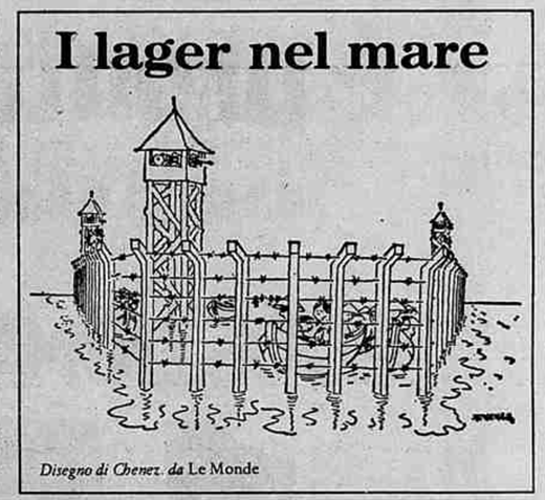
“I saw Holocaust on television. That is what Vietnam is like today,”78 commented Giuseppina Cosimo, a refugee who had escaped a refugee camp. “The conscience of humanity is once again confronted with the horror of genocide,”79 “comparable only to Hitler’s persecution of the Jews.”80 The Turin-based daily also sought to mobilize Italian public opinion by evoking the image of the “Lager at sea,”81 [Fig. 1] accusing the Hanoi government of using “the South China Sea as Hitler used the gas chambers.”82
At the same time, the weekly magazine Gente published an article entitled: “1979: The Holocaust Continues. Vietnam: The Charge Is Genocide,” written by the Catholic journalist Piero Gheddo. The appeal was directed even more explicitly not only at governments, but also at the indifference of civil society. “I wonder whether the ‘holocaust’ of the Vietnamese refugees […] might not also be partly our fault—our fault as Italians although we are so moved when we see it on TV.”83 Forty years later, public opinion had been informed “of the crimes committed by the Nazis throughout Europe.” Why, then, should we wait “another forty years to be informed of the atrocities taking place before our eyes?” For Gheddo, if Italians had not been fully aware in the past, in the present, once informed, they were called upon to act. From this perspective, the “comparison with Hitler’s time” appeared “spontaneous”: “there, the Jews; here, the Chinese; there, the crematoria; here, the mass expulsion.”84 On 28 June 1979, Ugo Intini, editor-in-chief of the Italian Socialist Party (PSI) newspaper Avanti!, published a front-page article entitled “ ‘Holocaust’ in Vietnam.” In it, he asked: “If Vietnam has its own ‘Holocaust,’ why is there hesitation, beyond expressions of solidarity with the refugees, to identify the Nazis of the day—that is, Hanoi’s ruling class?”[85] Intini issued his appeal “to spark, above all within the Left, a debate,”86 resorting to “even those provocative stimuli,” such as analogies with the Shoah.
This line of reflection also extended to the left-leaning press that was not affiliated with any political party, such as L’Espresso. On 1 July, the weekly magazine devoted part of its cover to the issue under the headline: “Olocausto ’79. I dannati del Vietnam” (Holocaust ’79. The Damned of Vietnam). While, on the one hand, PCI member and Italian Senator Umberto Terracini condemned Vietnam and its “Lager,”87 Noam Chomsky expressed a radically different position. The American linguist and philosopher condemned “the abuse of the term,” “Stalinism and totalitarianism,”88 while defending the legitimacy of Vietnam’s economic policy. Moreover, there was no consensus even within the pages of the PSI newspaper. The central question concerned the actual usefulness of such analogies: “Simply talking about Vietnam, perhaps in the style of ‘Holocaust 1979,’ would be a waste of time or a distraction. It would solve neither the refugees’ problems nor the many problems of our own country, which exist regardless of Vietnam.”89 The existence of this debate confirms both the effectiveness and the evocative power of this analogy.
At this point, it is necessary to examine the response of Catholic culture. Faced with renewed accusations against Pius XII, Raimondo Manzini defended the conduct of the papacy on the pages of Avvenire. At a time when “some news of the horrors of the concentration camps had already begun to emerge,” the Holy See is said to have provided “silent assistance” “to help Jews leave the country.”90 According to the CEI newspaper, the Catholic Church had already done everything that could and ought to have been done. The silence to be denounced was instead that of governments and public opinion, which became central to the Catholic interpretation of the boat people crisis. On 20 June 1979, Il Popolo, the newspaper of the ruling party, the Christian Democracy (DC), described the Vietnamese exodus as “a different new Holocaust,” involving mainly refugees of Chinese origin who had been “driven out of their workplaces (like the Jews, indeed).”[91] The aim was to encourage Italians to abandon their own “indifferent cynicism.”92 A few days earlier, Avvenire published on its front page an evocative article by Piero Gheddo titled “L’olocausto dei profughi vietnamiti” (The Holocaust of the Vietnamese Refugees).93 Drawing on these tragic episodes, Piero Gheddo denounced:
Italian television is showing us these days another “Holocaust,” that of the Jews in Nazi Germany and Europe forty years ago—but it is absurd that it remains silent, that it does not adequately portray this other Holocaust happening before our eyes. […] We are all responsible for the Vietnam Holocaust 1979, even if we pretend not to see or hear the anguished pleas coming from Southeast Asia. Future generations will accuse us of having done nothing (or almost nothing) to stop the massacre; yet we feel our conscience is clear because we watch, with indignation, the televised portrayal of Nazi crimes from forty years ago. Comfortably seated in our armchairs.94
This initiative did references to the Jewish persecution reach the readers of Famiglia Cristiana. On July 8, 1979, Piero Gheddo clearly warned of the advent of a “new holocaust.”[95] Numerous testimonies about the escape from “concentration and extermination camps” were accompanied by an effective iconographic representation, constructed through cartoons and photographs.96
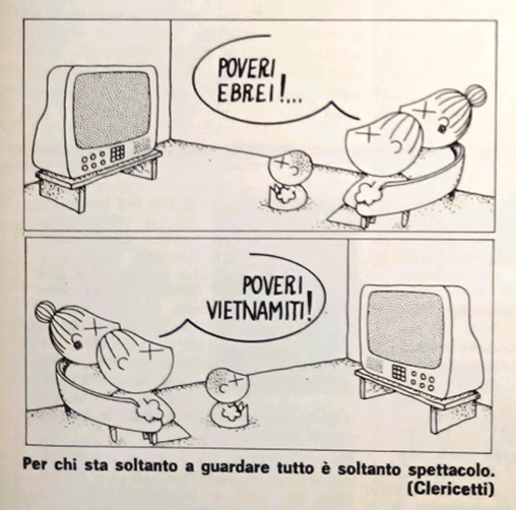
In the same article, a cartoon was published [Fig. 2]. The cartoon features a family sitting in front of the television, watching two different tragedies. In the first scene, they watch the American Miniseries Holocaust and exclaim, “Poor Jews!”; in the second, they witness the tragedy of the boat people with the same passivity, as if it were “just a show.”97 The cartoon shifts the responsibility to the present: while ignorance could be pleaded back then, today's indifference is no longer justifiable, because awareness of the Shoah demands action. On July 8, 1979, Avvenire published, within a section titled “Che dice la gente su Olocausto ‘79” a series of letters sent by some readers. Among these, Giovanni Lodi, from Genoa, wrote: “Dear Editor, the TV film Holocaust has ended, raising outrage and horror for its portrayal of a horrifying campaign of mass murder that took place, under conditions of calculated secrecy.”[98] In this perspective, the silence of the past was once again explained by the presumed impossibility of knowing, whereas “the Holocaust of the Vietnamese refugees” was unfolding “before an insensitive world.” 99 The Holy See’s press offered a substantially similar interpretation.
On June 20, 1979, John Paul II spoke again on the matter at the end of the general audience in St. Peter’s Square: “I appeal to the conscience of humanity, that all should take their share of responsibility, both the peoples and those who govern them, in the name of a solidarity that goes beyond frontiers, races and ideologies.”100 Just four days after the papal speech, the Holy See’s weekly illustrated magazine, L’Osservatore della Domenica, denounced the “racial aspects” of the Malaysian government’s policies101 while also condemning public indifference.
The Holocaust of the Jews cries out to heaven, and everyone has asked, “How could this have happened?” But at that time, the world did not know—or did not know to what extent; the war set up insurmountable barriers. But today we know; today we have time; today we can prevent disgrace from happening again.102
La Civiltà Cattolica had, moreover, already reiterated: “This is a terrible drama, before which human and Christian conscience cannot remain indifferent.”103 This condemnation would soon be replaced by an opposing narrative, based on a constant celebration not only of the Italian humanitarian spirit, but more specifically of its Catholic roots. On June 25, the Italian government established a “Committee for the Coordination of Public and Private Activities in Support of Southeast Asian Refugees.” During the first meeting at the Prime Minister’s office, the goal was set to organize a humanitarian mission to Southeast Asia. On July 4, the cruisers Vittorio Veneto and Andrea Doria, and the supply ship Stromboli departed from La Spezia and Taranto.104
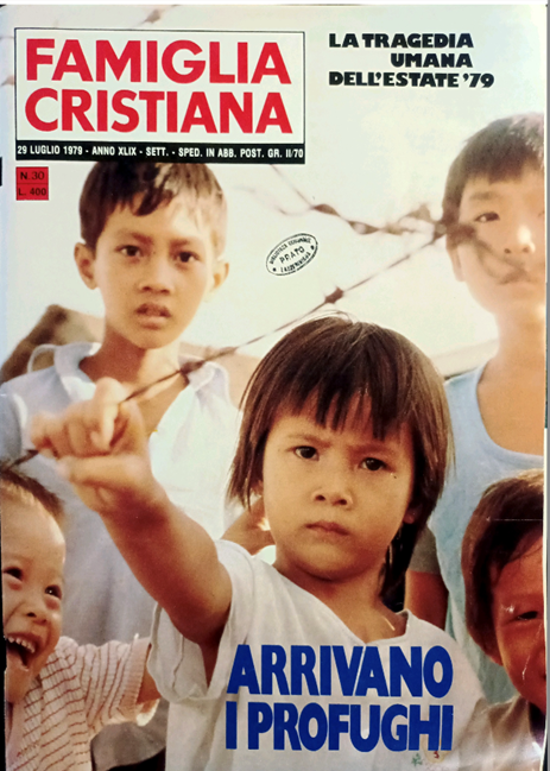
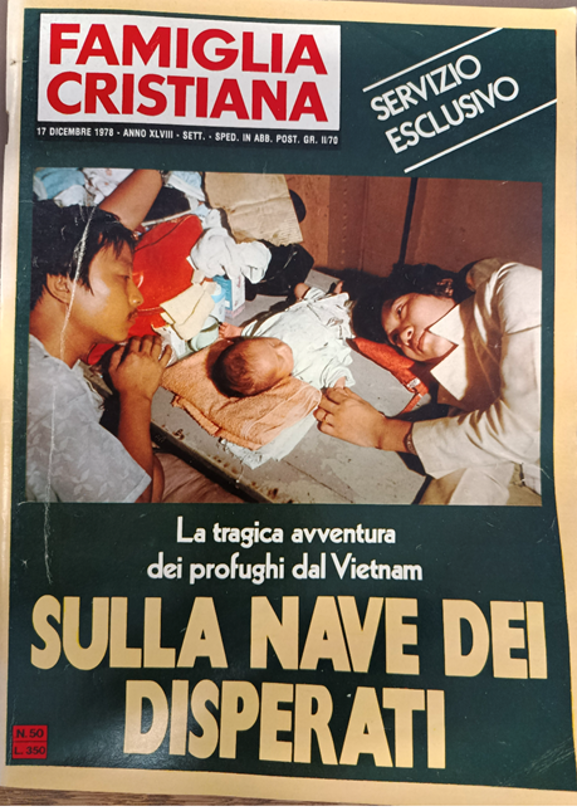
On July 29, 1979, Famiglia Cristiana featured on its cover the announcement of the arrival in Italy of the first refugees. Italy, “of the poor, of the humble,” was ready to “give meaning to the lives of these wretched people, who had escaped, through a thousand sufferings, that immense genocide.” The first to aid were the members of Caritas Italy, “to which all Catholic organizations” active in those days reported, tasked with “arranging for the first arrivals to be placed with families and institutions.”105 Starting with the magazine's cover, a substantial change occurred in the iconographic representation of Indochinese refugees. The central element of the image was no longer the family, as in the December 17, 1978,106 [Fig. 4] issue, but rather the children, depicted looking directly at the reader with a stern gaze and a hand gripping the barbed wire [Fig. 3]. Although it has not been possible to determine the name of the photographer or the production context of the image, it is possible to focus on the iconographic level of description. The barbed wire evoked the fences of a concentration camp. In that discursive context, the symbol generated a comparison with the Shoah, visually reproducing those discursive elements that had, until then, been part of journalistic language: indifference and the rhetoric of “never again.” Ultimately, this general mobilization against indifference, the rhetoric of “never again,” and the analogy with the Shoah led-especially within the Catholic world-to numerous initiatives to adopt refugee children left orphaned.107
The arrival of the Vietnamese refugees had helped fuel a national debate on reception policies, provoking complaints from some journalists about the lack of oversight and the complete disorganization.108 Corriere della Sera questioned the regularization of immigrants, while condemning “racism, but also demagoguery.”109 Meanwhile, an unemployed woman from Milan wrote to the moderate weekly Oggi, arguing that Vietnamese refugees “aspired to privileged positions,” while “millions of Italians” were forced to wait “for years at employment offices.”110
Nevertheless, L’Osservatore Romano devoted an entire page to a detailed account of the reception given to the refugees, making no reference to the issue of racism. The Holy See’s daily, on the other hand, offered the portrayal of a nation of priests and Christians who “with simplicity and affection seek to make their integration into the new life easier.”[111] To reinforce this narrative of Italian hospitality, the article highlighted the gratitude of the newcomers themselves, reporting that “they [the refugees] say they already love Italy: a country they did not know, but that immediately made them feel at home.”112 On 3 February 1980, Maria Grazia Bevilacqua praised, in the pages of Famiglia Cristiana, the “generous and spontaneous” willingness of Italian families to adopt a refugee child, seeing in it the “awakening […] of a Christian conscience.”113 During those same weeks, an image of Italy as a country that had returned to Catholicism spread, above all through the Catholic press, reinforced by the words of the refugees, “who said they were happy to come to Italy precisely because they knew they were coming to the country that hosts the Pope.” 114 “What a fortunate country Italy is: it has the Pope and no communists,” 115 proclaimed Gente. The pro-government Mondadori weekly Epoca, by contrast, published an evocative photograph of a child left “silently gazing at the magical domes of the churches of Venice.” 116 As early as 1 October 1979, Piero Gheddo, one of the leading figures in this campaign, had published his concluding reflections: “First, it must be said that the response of the Italian people has been unexpected, wonderful.”[117] Framing this public outpouring of solidarity as a spiritual turning point, he went on to assert: “This is the Christian sign that our society needs.” 118 Almost a year after the arrival of Vietnamese refugees in Italy, on April 6, 1980, Renzo Giacomelli asked on Famiglia Cristiana the question: “How are we doing on racism in Italy?” The article began with an interview with the Vietnamese refugee Agnese Nguyen Thi Ngoc Hieu, owner of a restaurant in Rome. The answer was clear: “Racist Italians? Absolutely not. I feel good in Italy, and the Italians are all very kind and friendly.”119
Conclusions
The word “indifference,” invoked in the Catholic press, has become one of the central references of Italian Holocaust memory. As Guri Schwarz has observed, this moral category had its roots in the late 1980s, when it was used both to interpret the persecutions of the 1930s and 1940s and to reflect on the dilemmas of the present.120 This interpretive framework, however, does not fully apply to the Catholic reception of the boat people, which was instead characterized by the justification of the silences of Italian and European society, attributed to a lack of information. In this context, the “myth of the good Italian,” a foundation of anti-fascist national identity since the establishment of the Italian Republic,121 continued to exert a strong influence on public discourse, limiting a full assumption of responsibility for the past. While acknowledging the Jewish genocide, the Italian Catholic world used the tragedy of the Vietnamese refugees to construct a predominantly victim-centered narrative,122 focused on the suffering of the Church itself and, in some cases, still connected to persistent antisemitic stereotypes. The victim-centered imagery employed in the analogy between theboat peopleand Jews in fact reflected an ancient anti-Jewish stereotype: that of the “witness people.” Beginning in the 1980s, the emergence of the renewed interest in Jewish identity and culture in Italy, contributed to the formation of a positive repertoire of images of Jews that was, at times, “dangerously close to negative representations.”123 A stereotypical and victim-centered image of “the Jews” thus spread in Italy, connected to the idea, rooted in the Christian anti-Judaic tradition, of a people punished by God and condemned to an endless dispersion until the end of time.124 “They call them the ‘people of the boats’. Without a homeland, without geography.”125 This was the definition that Monsignor Ersilio Tonini attributed to the Vietnamese refugees in the pages ofAvvenire.
However, the reference to “indifference” was employed to encourage public opinion to transform the new historical awareness, also shaped by the viewing of a television miniseries, into concrete action. The silence of the past, even without an explicit attribution of guilt, was thus interpreted as a moral responsibility requiring redemption. With the arrival of the first Vietnamese refugees in Italy, Catholic narratives interpreted humanitarian operations as evidence of the nation’s return to its Christian spirit and to its spiritual guide: the Pope. For this reason, Catholic anti-totalitarianism in those years cannot be considered exclusively humanitarian and apolitical, unlike the form promoted by the Italian Left. The condemnation of the new totalitarian regimes and the reference to the Shoah were therefore also part of a broader political project: the reaffirmation of a Catholic Italy.126
[1] For a detailed reconstruction of these events, see Becky Taylor, Karen Akoka, Marcel Berlinghoff, and Shira Havkin, “Introduction,” in When Boat People Were Resettled, 1975-1983. A Comparative History of European and Israeli Responses to the Southeast Asian Refugee Crisis, eds. Becky Taylor, Karen Akoka, Marcel Berlinghoff, and Shira Havkin (Cham: Palgrave MacMillan, 2021), 47-77.
[2] Michele Colucci, Storia dell’immigrazione straniera in Italia (Rome: Carocci 2018), 63-64; Silvia Salvatici, A history of humanitarianism, 1755-1989. In the name of others (Manchester: Manchester University Press, 2019), 197-235.
[3] Michael Vossing, “Competition over Aid? The German Red Cross, the Committee Cap Anamur, and the Rescue of Boat People in South-East Asia, 1979-1982,” in Dilemmas of Humanitarian Aid in the Twentieth Century, eds. Johannes Paulmann (Oxford: Oxford University Press, 2016), 345-368.
[4] See note 1.
[5] Andrea Possieri, Rifugiati. La vicenda storica dei profughi indocinesi in Italia (1978-1979) (Perugia: Morlacchi editore, 2019).
[6] Michael Rothberg, Multidirectional Memory. Remembering the Holocaust in the age of decolonization (Stanford: Stanford University Press, 2009).
[7] Robert S. C. Gordon, The Holocaust in Italian culture, 1944-2010 (Stanford: Stanford University Press, 2012), 90-95 and 179-180.
[8] Manuela Consonni, “The Church and the Memory of the Shoah: The Catholic Press in Italy, 1945–1947,” in Jews, Catholics and the Burdens of History, ed. Eli Lederhendler (Oxford: Oxford University Press, 2005), 21-34.
[9] Possieri, Rifugiati, 31.
[10] Karen Akoka, “France: Boat People Brought by Plane,” in When Boat People Were Resettled, 47-77.
[11] Possieri, Rifugiati, 68-69.
[12] Ibid., 104-106.
[13] Ibid., 38-39.
[14] Akoka, “France: Boat People Brought by Plane,” 64.
[15] André Gluckmann, “I ‘nipoti dello zio Ho Chi Min’,” Corriere della Sera, February 11, 1979. From this point onwards, all translations of articles are my own, unless otherwise indicated.
[16] Ibid.
[17] M. Thérèse de Brosses, “Così torturano uomini, donne e bambini nei lager del Vietnam,” Gente, January 6, 1979.
[18] Guri Schwarz, “Un antirazzismo commemorativo. La Shoah, i migranti e i demoni dell’analogia,” Italia contemporanea 297 (2021): 145-179, 166.
[19] Akoka, “France: Boat People Brought by Plane,” 64.
[20] Tony Judt, Postwar. A history of Europe since 1945 (New York: The Penguin Press, 2005), 559-584.
[21] Samuel Moyn, The Last Utopia. Human Rights in History (Cambridge-London: Harvard University Press, 2010).
[22] Enzo Traverso, Totalitarismo. Storia di un dibattito (Verona: Ombre corte, 2015), 103-108.
[23] Akoka, “France: Boat People Brought by Plane,” 66-69.
[24] Possieri, Rifugiati, 71.
[25] Ibid., 68.
[26] Paolo Flores d’Arcais, “È stato criminale non chiedersi per cosa ci si batteva,” Avanti!, January 16, 1979.
[27] Arturo Viola, “Una nave per il Vietnam,” Avanti!, February 17, 1979, 1.
[28] Arturo Viola, “Sto dalla parte degli uccisi,” Avanti!, March 4, 1979, VI.
[29] Viola, “Una nave per il Vietnam,” 1.
[30] Possieri, Rifugiati, 45.
[31] John Paul II, “Angelus. Sunday, 3 December 1978,” The Holy See, accessed March 12, 2026, https://www.vatican.va/content/john-paul-ii/en/angelus/1978/documents/hf_jp-ii_ang_19781203.html.
[32]For example, see “La tragedia dei profughi dal Vietnam,” L’Osservatore Romano, December 6, 1978, 1.
[33] “I cinquemila profughi vietnamiti in attesa di un gesto di umanità,” L’Osservatore Romano, December 31, 1978, 1.
[34] “Israele potrebbe accogliere parte dei profughi vietnamiti,” L’Osservatore Romano, January 5, 1979, 1.
[35] Gianfranco Grieco, “Il dramma dei profughi dell’Indocina,” L’Osservatore Romano, April 7, 1979.
[36] Giuseppe De Rosa, “La coscienza cristiana di fronte alla tragedia dei profughi vietnamiti,” La Civiltà Cattolica 1, (1979): 259-260.
[37] Elena Serina, “ ‘A Great Work of International Charity’: Catholic Humanitarianism, Displaced Persons and the Making of Post-War Europe (1945–1947),” Contemporary European History 35 (2026): 1-19.
[38] The quotation is taken from the address delivered by Pius XII on October 2, 1945, before the Tribunal of the Sacred Roman Rota. Daniele Menozzi, “Chiesa e totalitarismo: una difficoltà per la ‘Resistenza’ cattolica,” in Storia della Resistenza in Toscana, ed. Marco Palla (Pisa: Carocci, 2009), 10.
[39] Ibid, 9-34.
[40] Daniele Menozzi, Giovanni Paolo II. Una transizione incompiuta? (Brescia: Morcelliana, 2006).
[41] Giuliana Chamedes, A Twentieth-Century Crusade. The Vatican’s Battle to Remake Christian Europe (Cambridge-London: Harvard University Press, 2019).
[42] Daniele Menozzi, Chiesa e diritti umani (Bologna: il Mulino, 2012).
[43] During the 1950s and 1960s, it had long played an almost hegemonic role in this field, reaching a circulation of approximately 800,000 copies per month. Mauro Forno, La cultura degli altri. Il mondo delle missioni e della decolonizzazione (Rome: Carocci, 2017), 25-26.
[44] The PIME journal, Le Missioni cattoliche was founded in 1872. Piero Gheddo served as editor from 1959 to 1994, renaming the journal Mondo e Missione while maintaining a circulation of approximately 45,000 copies. Valentina Ciciliot, “Il laboratorio missionario del Pontificio istituto missionario estere (PIME): la rivista ‘Le Missioni Cattoliche’ (1972-1968),” in Laboratorio della fede. Religione e cultura popolare in Italia dall’Unità al miracolo economico, ed. Giovanni Vian (Rome: Carocci, 2026), 89-108.
[45] “Biografia,” GHEDDO PIERO sito ufficiale, accessed July 9, 2026, https://www.gheddopiero.it/it/biografia/; Piero Gheddo, PIME. 1850-2000. 150 anni di missione (Bologna: EMI, 2000).
[46] Piero Gheddo, The Cross and the Bo-Tree. Catholics and Buddhists in Vietnam (New York: Sheed and Ward, 1979), 25-27.
[47] Francesca Ghezzi, “Cattolici di Francia e d’Italia dinanzi alla guerra in Vietnam: verso la rottura del ‘fronte filoatlantico’ (1963-1965),” Chrétiens et sociétés 26 (2019): 1-18.
[48] Piero Gheddo, “Il tempo dei cani muti,” Mondo e Missione, June 15, 1978, 405-406.
[49] Ibid.
[50] According to government records from 1963, the magazine had an average of 6.9 million readers. Famiglia Cristiana was the most widely circulated weekly magazine in Italy, the third most widely circulated in Europe, and the Catholic weekly with the largest readership worldwide. Mauro Forno, “La battaglia dei costumi. ‘Famiglia Cristiana’ e morale cattolica in un ventennio tempestoso (1960-1980),” Memoria e Ricerca 81, no.1 (2026): 150-180.
[51] Alan Dejean Sygma, “Ho fotografato l’inferno. Sulla nave dei vietnamiti che nessuno vuole,” Famiglia Cristiana, December 17, 1978, 34-40.
[52] Piero Gheddo, “Perché fuggono dal Vietnam?”, Famiglia Cristiana, December 17, 1978, 39.
[53] Renzo Carnevali, “La parabola ‘rossa’ ” orchestrata dal’URSS. Che cosa c’è dietro la ‘guerra comunista’ tra Vietnam e Cambogia,” Famiglia Cristiana, January 21, 1979, 18.
[54] Ibid.
[55] Piero Gheddo, “Le zanne del Vietnam. Le radici antiche della guerra contro la Cambogia,” Il Sabato, January 13, 1979, 10.
[56] Ibid.
[57] Piero Gheddo devoted an entire article to the “discrimination, deprivation, and slander” to which the Church in Vietnam was subjected: Piero Gheddo, “Essere cristiani in Vietnam,” Avvenire, April 13, 1979, 3.
[58] Possieri, Rifugiati, 56.
[59] Arrigo Bongiorno, “Perché fuggono dal Vietnam?”, Avvenire, December 17, 1978, 1.
[60] Piero Gheddo, “Italiani, non chiudete gli occhi davanti a questa tragedia,” Gente, January 6, 1979.
[61] Arrigo Bongiorno, “Perché fuggono in massa dal Vietnam?”, Avvenire, November 17, 1978, 1.
[62] Fernando Galbiati, “Un viaggio tra i profughi del Vietnam,” Mondo e Missione, May 1, 1979, 321.
[63] Ibid., 323.
[64] Andrea Riccardi, La guerra del silenzio. Pio XII, il nazismo, gli ebrei (Bari-Rome: Laterza, 2022), 288-291; Consonni, “The Church and the Memory of the Shoah,” 21-34.
[65] Elena Mazzini, L’antiebraismo cattolico dopo la Shoah. Tradizioni e culture nell’Italia del secondo dopoguerra (1945-1974) (Rome: Viella, 2012), 61-63.
[66] Renato Moro, “L’elaborazione cattolica della Shoah in Italia,” in Memoria della Shoah. Dopo i testimoni, ed. Saul Meghnagi (Rome: Donzelli, 2007), 30-34.
[67] James J. Sheehan, L’età post-eroica. Guerra e pace nell’Europa contemporanea (Bari-Rome: Laterza, 2009).
[68] Emiliano Perra, Conflicts of Memory. The Reception of Holocaust Films and TV Programmes in Italy, 1945 to the Present (Bern: Peter Lang, 2010), 117-147.
[69] Massimiliano Signifredi, Giovanni Paolo II e la fine del comunismo. La transizione in Polonia (1978-1989) (Milan: Guerini e Associati, 2013), 113-116; On the international reception of that media event, see the work of Jonathan Huener, Auschwitz, Poland, and the Politics of Commemoration, 1945-1979 (Athens: Ohio University Press, 2003), 207-225.
[70] “Vittoria della fede e dell’amore sull’odio. 7 giugno: al campo di concentramento di Brzezinka,” L’Osservatore Romano, June 9, 1979.
[71] “Basta con l’olocausto dei profughi del Vietnam,” Corriere della Sera, June 19, 1979, 1.
[72] André Glucksmann, “Li hanno scaraventati in un mare senza sponde,” Corriere della Sera, June 19, 1979, 1.
[73] Ibid.
[74] Giovanni Miccoli, I dilemmi e i silenzi di Pio XII. Vaticano, Seconda guerra mondiale e Shoah (Milan: Rizzoli, 2000), 1.
[75] Alessandro Angelo Persico, Il caso Pio XII. Mezzo secolo di dibattito su Eugenio Pacelli (Milan: Guerini e Associati, 2008), IX-X.
[76] Perra, Conflicts of Memory, 131.
[77] Gluksmann, “Li hanno scaraventati in un mare senza sponde,” 1.
[78] Giuseppe Baiocchi, “Come hanno potuto riprendere a vivere i primi profughi approdati dal Vietnam,” Corriere della Sera, June 21, 1979, 23.
[79] Giovanni Testori, “Vietnamiti: la nostra coscienza davanti all’orrore del genocidio,” Corriere della Sera, June 20, 1979.
[80] “Le macerie del Vietnam,” Corriere d’Informazione, June 21, 1979, 2.
[81] “I lager nel mare,” La Stampa, June 28, 1979, 3.
[82] Mimmo Candito, “Una barca che va all’inferno. La tragedia dei profughi in fuga dal Vietnam,” La Stampa, June 25, 1979, 3.
[83] Piero Gheddo, “1979: l’olocausto continua. Vietnam: l’accusa è genocidio,” Gente, June 29, 1979, 74.
[84] Ibid.
[85] Ugo Intini, “ ‘Olocausto’ in Vietnam. La sinistra non può eludere il dibattito,” Avanti!, June 28, 1979, 1.
[86] Ibid.
[87] Umberto Terraccini, “Olocausto ‘79,” L’Espresso, July 1, 1979, 7.
[88] Guido Moltedo, “Ma che piagnoni questi europei. Intervista a Noam Chomsky,” L’Espresso, July 1, 1979, 8-9.
[89] Marcella Andreoli, “Una prima porta aperta per i Vietnamiti,” Avanti!, June 20, 1979, 1.
[90] Raimondo Manzini, “Quella resistenza eroica e silenziosa,” Avvenire, May 20, 1979, 3.
[91] Paolo Giuntella, “Una tragedia anche nostra. Il terribile dramma dei profughi indocinesi,” Il Popolo, June 20, 1979, 1.
[92] Ibid.
[93] Piero Gheddo, “L’olocausto dei profughi vietnamiti,” Avvenire, June 17, 1979, 1.
[94] Ibid.
[95] Giuntella, “Una tragedia anche nostra. Il terribile dramma dei profughi indocinesi,” 1.
[96] Piero Gheddo, “A quei profughi le parole non servono. Nessuno può tirarsi indietro di fronte alla tragedia dei profughi indocinesi,” Famiglia Cristiana, July 8, 1979, 16.
[97] Ibid.
[98] “Che dice la gente su Olocausto ‘79,” Avvenire, July 5, 1979, 3.
[99] Ibid.
[100] John Paul II, “General Audience, 20 June 1979,” The Holy See, accessed March 15, 2026. https://www.vatican.va/content/john-paul-ii/en/audiences/1979/documents/hf_jp-ii_aud_19790620.html.
[101] The member countries of ANSEA—Philippines, Indonesia, Malaysia, Singapore, and Thailand—had, in fact, decided to push Indochinese refugees back out to sea, towing them into international waters with police boats. Possieri, Rifugiati, 82.
[102] Raimondo Manzini, “Due interrogative,” L’Osservatore della Domenica, June 24, 1979, 3.
[103] De Rosa, “La coscienza Cristiana,” 259-260.
[104] Possieri, Rifugiati, 90-95.
[105] “Nuova vita per i profughi. Sono arrivate in Italia le prime famiglie di esiliati dal Vietnam,” Famiglia Cristiana, July 29, 1979, 16-17.
[106] Cover of “Sulla nave dei disperati. La tragica avventura dei profughi dal Vietnam,” Famiglia Cristiana, December 17, 1978.
[107] Andrea Possieri, “Un ruolo di supplenza. L’associazionismo cattolico e l’accoglienza degli immigrati stranieri in Italia (1979-1986),” in Disuguaglianza e generazioni in Italia (1914-2008), eds. Stefano Cavazza, Emanuele Costantini, and Emanuela Scarpellini (Bologna: Alma Mater Studiorum Università di Bologna, 2026), 57-80.
[108] Possieri, Rifugiati, 62.
[109] Renato Ferraro and Milo Vignolo, “ ‘Né razzismo, né demagogia’. Che cosa si può fare per regolarizzare la posizione degli immigrati,” Corriere della Sera, August 6, 1979, 3.
[110] “I vietnamiti e noi italiani,” Oggi, September 29, 1979.
[111] Sergio Trasatti, “Accolti con amore, primi gruppi di rifugiati indocinesi a Roma e a Grottaferrata,” L’Osservatore Romano, July 29, 1979, 2.
[112] Ibid.
[113] Maria Grazia Bevilacqua, “ ‘Aiutateci ad avere un bambino cambogiano’ ,” Famiglia Cristiana, February 3, 1980, 58.
[114] “Italia: il Paese del Papa,” Avvenire, September 9, 1979, 8.
[115] Francobaldo Chiocci, “Che paese fortunato l’Italia: c’è il Papa, non ci sono i comunisti,” Gente, August 24, 1979, 32-38.
[116] “Svanisce l’incubo: appare Venezia,” Epoca, September 1, 1979, 16-19.
[117] Piero Gheddo, “Il centro missionario P.I.M.E. per i profughi del Vietnam,” Mondo e Missione, October 1, 1979, 554-558.
[118] Ibid.
[119] Renzo Giacomelli, “Come stiamo a razzismo in Italia?”, Famiglia Cristiana, April 6, 1980, 61.
[120] Schwarz, “Un antirazzismo commemorativo,” 165-171.
[121] I mention only the main works, see David Bidussa, Il mito del bravo italiano (Milan: Il Saggiatore, 1994); On the role of the Italian Jewish leadership see Guri Schwarz, “On Myth Making and Nation Building: The Genesis of the ‘Myth of Good Italian’,” Yad Vashem Studies 1 (2008): 111-143; For the intertwined representations of the “bad German” and the “good Italian” Filippo Focardi, Il cattivo tedesco e il bravo italiano (Bari-Rome: Laterza, 2013).
[122] Consonni, “The Church and the Memory of the Shoah,” 21-34.
[123] Simon Levis Sullam, L’archivio antiebraico. Il linguaggio dell’antisemitismo moderno (Bari-Rome: Laterza, 2008), 82-86.
[124] Piero Stefani, L’antigiudaismo. Storia di un’idea (Bari-Rome: Laterza, 2004).
[125] Ersilio Tonini, “Quel campo di concentramento è nei mari del Vietnam,” Avvenire, July 8, 1979, 2.
[126] On the origin of Catholic Nationalism see Guido Formigoni, L’Italia dei cattolici. Dal Risorgimento a oggi (Bologna: il Mulino, 2010).
