


Antisemitism Reconsidered
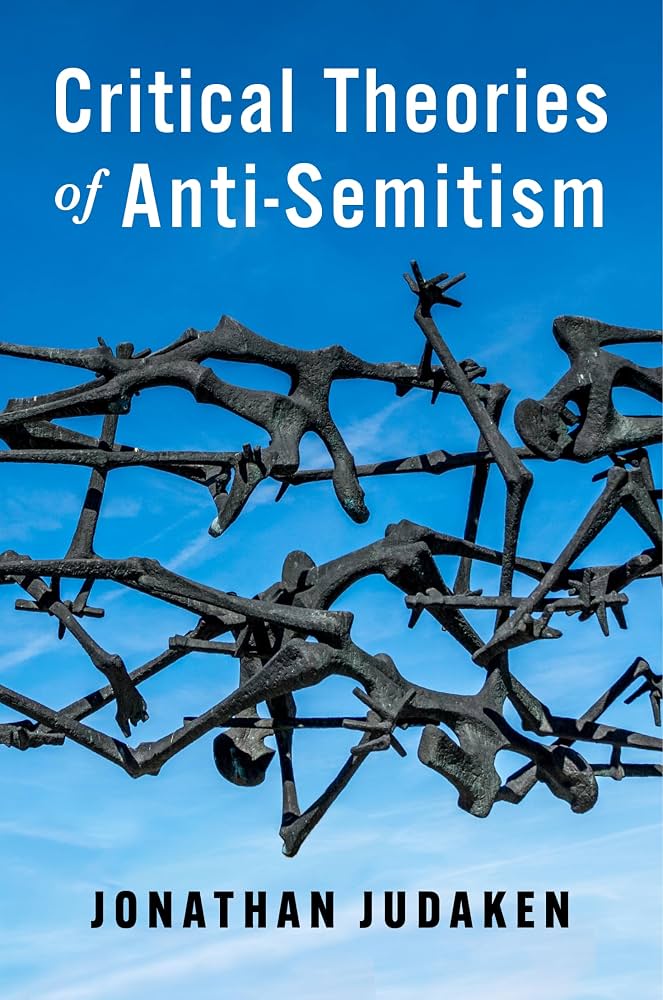
Jonathan Judaken’s Critical Theories of Anti-Semitism begins by observing that few topics such as antisemitism have been, at the same time, the object of so much attention and so many publications and are so significantly undertheorized. The book is an attempt to remedy that condition by returning to some of the most influential twentieth-century thinkers who tried to explain the phenomenon, and by asking what their theories can (and cannot) do for us today.
The book appeared in June 2024, in Columbia University Press’s “New Directions in Critical Theory” series. It arrived at an exceptionally charged moment. It was published months after the Hamas attack of 7 October 2023, and the war that followed, while encampment protests were unfolding on campuses in various parts of the world. The book can be read as a work of intellectual history and conceptual critique, and it can be also seen as an intervention in the most polarizing political argument of its day.
Judaken is well positioned to write such a book. He is a scholar of modern European intellectual history, and his first monograph, Jean-Paul Sartre and the Jewish Question, treated representations of Jews as a lens on the role of the French intellectual.1 His engagement with the conceptual problems of antisemitism harks back several years, with contributions in prestigious journals.2 This 2024 book can be read as the full elaboration of those earlier reflections on the category of antisemitism and its flaws. It is a synthesis of a career, and it is also a sustained argument about the need to reorganize the field.
The book has a double character, and Judaken is explicit about it. It is at once a theoretical reflection on the methodological and conceptual problems in analyzing antisemitism and a history of a series of very different yet undoubtedly relevant authors or schools. Its introduction presents the state of the art, the tensions existing in the field, and the severe limits of the debates on antisemitism. Judaken invites the reader to consider hostility towards Jews as one racism among others, historically specific, discursively unstable, but analytically comparable, rather than as a timeless and singular “longest hatred.” He very clearly outlines his intent: to promote a different category, that of Judeophobia, and to do so by engaging with some of the main reflections on antisemitism that developed in the wake of Nazi racism and the Holocaust. Each chapter then takes on a major thinker or tradition, considered as representatives of significant conceptual frameworks that Judaken qualifies as: “existentialist, interactionist, socio-psychoanalytic, sociological, postmodern, and historical” (p. 19). Each is used in turn to test and complicate the others. The result is a survey as well as a sustained conversation among interpreters whose disagreements are treated as productive.
The first thinker analyzed in depth is Sartre, on whom Judaken is an expert. The relevant chapter concerns the argument of Anti-Semite and Jew (1944), that the Jew is in an important sense produced by the antisemite’s gaze, and that antisemitism is a passion, a choice of hatred as a way of being, rather than an opinion. Judaken traces the evolution of Sartre’s thought from existentialism to antiracism. That trajectory matters because Sartre’s later anticolonial writing, including his engagement with Frantz Fanon and Albert Memmi, connects the analysis of antisemitism to a wider critique of racism and imperialism. This is exactly the connection Judaken wants the field to make. Yet the author does not spare criticism for Sartre, as he does for the other authors considered. The author analyzed thus appears as both a resource and an admonition.
The second chapter turns not to a single intellectual but to a wider circle: the Frankfurt School. The relevant texts include the “Elements of Anti-Semitism” chapter in Horkheimer and Adorno’s Dialectic of Enlightenment, the empirical Studies in Prejudice project, Franz Neumann’s Behemoth, and the institute’s wider analyses of fascism, authority, and mass culture. The chapter’s importance for Judaken’s larger thesis lies in the Frankfurt School’s insistence that antisemitism is inseparable from the structure of modern society and cannot be blamed on aberrant individuals or a discrete ideology. Its limitations, notably a tendency to treat Jews as objects of projection rather than as historical agents, are also part of the story.
With Hannah Arendt, the third chapter takes up one of the most influential and possibly most contested accounts of modern antisemitism. The relevant portion of The Origins of Totalitarianism rejects both the eternal-hatred thesis and the scapegoat thesis. The chapter’s subtitle signals an interest in Arendt’s “story” of history.
The fourth chapter pairs two sociologists across a generational divide, Talcott Parsons and Zygmunt Bauman. Parsons’s 1942 essay on the sociology of modern antisemitism analyzed the phenomenon as an expressive reaction to strain and anomie in a society undergoing rapid modernization, with Germany as the crucial case. Bauman, writing decades later in Modernity and the Holocaust and in his reflections on “allosemitism,” transformed the question by arguing that Jews occupied the position of the stranger, the figure who defies the categories by which modern order is maintained, and who therefore provokes both fear and fascination. Bauman’s emphasis on ambivalence supplies the theoretical basis for Judaken’s insistence on the plasticity of anti-Jewish imagery. Because the Jew can be made to signify almost anything, from capitalist to communist, from cosmopolitan to clannish, the concept resists any single explanatory frame.
Jean-François Lyotard is the object of the fifth chapter, and he represents the book’s most philosophically demanding turn. In Heidegger and “the jews” (1988), Lyotard used a lowercase, quoted plural to name not an empirical people but a figure of what the European tradition cannot assimilate, an alterity that Western thought has repressed and then tried to eliminate. This is a powerful move, and a risky one. It turns the Jew into a philosophical trope, and critics have long worried that such tropes can displace actual Jews from view. Judaken’s engagement with Lyotard also matters for a later reason, since the notion of the “differend,” a conflict in which no shared rule of judgment exists, mentioned and discussed also in relation to Sartre, reappears in the conclusion as a way of framing the conflict in Israel-Palestine and its representations.
The two final chapters move on to treating the work of historians, analyzing the works of Léon Poliakov and George Mosse. It is a puzzling twist, one might wonder what these two influential, and among themselves distant scholars, have to do with critical theory. Judaken himself registers that Poliakov was not a theorist, and that for Mosse theory remained implicit. Together they let Judaken pursue the issues of continuities and disconnects between traditional anti-Judaism and the Holocaust. They also supply, at least partially, a historical depth that the earlier, more abstractly theoretical chapters lack.
The conclusion, entitled “Critical Theory and Post-Holocaust Judeophobia,” is intended as the culmination of this intellectual tour de force. Here Judaken applies the preceding analyses to the contemporary situation. He treats definitions, including the recent controversies over working definitions of antisemitism, the relationship between anti-Zionism and Judeophobia, and the hatred of Jews in the postcolonial and Middle Eastern contexts. He describes a decoupling of Jews and Muslims, in which, beginning in the 1930s the demonization of Jews became more common in the Islamic world, drawing on the European antisemitic arsenal, while anti-Arab racism spread among Jews. This chapter carries the book’s most direct claims about the present.
Overall, the book deserves praise for a clarity of writing and a command of a wide ranging scholarship which lead to the production of a well informed and useful text. The book gathers, in one place and in a single interpretive voice, a body of work that is usually encountered in fragments, and it puts thinkers who rarely appear together into productive tension. This makes it a valuable resource for students and scholars alike. At the same time the selection inevitably appears idiosyncratic and eclectic. The canon Judaken assembles is made up of European and American theorists, mostly men, mostly of Jewish origin, and mostly writing between the 1940s and the 1990s (but with a strong emphasis on the 1940s). It is defined, for the most part, by the attempts to understand the catastrophe during the war and right after its conclusion. That selection is defensible, yet it sits somewhat uneasily with the book’s own claim that the study of antisemitism should absorb the insights of postcolonial and decolonial thought.
The book’s larger methodological wager also deserves to be discussed. To insist that antisemitism be studied comparatively and as part of interlaced histories is to take a position against a widespread tendency to treat it as sui generis. It is an evident reaction to a tendency of segments of intellectual and academic circles, mostly in the American setting, to set it aside when confronting issues such as racism or postcolonial conflicts. The value of a connection between these theoretical strands and scholarship on antisemitism is more presented as a given rather than discussed in depth, and one might also wonder if a rapprochement between decolonial thought and scholarship on antisemitism is even possible considering nature of the current debates and clashes.
Another critical remark concerns the defining concepts presented in the introduction and central to the book’s arguments which would have merited a more thorough discussion. The very concept of critical theory (or theories), which lies at the heart of the book, is not presented with the same clarity and discussed with the same scrutiny as applied in the core chapters of the book. The same could be said for postcolonial and decolonial theories, often cited jointly by Judaken, but which are different and each hold significant polarities and tensions within. Similar considerations are prompted by the treatment of religious hostilities towards the Jews and by the post-war intertwining of Judeophobia and anti-Zionism. Religious prejudice is presented basically as a mere precursor, or as one of the elements on which modern antisemitism builds its profile, through shifts and changes. Yet the specificity of anti-Judaism, be it Christian or Islamic, is not considered, nor is its persistence and autonomy, even in the modern and contemporary, age given sufficient consideration. As for anti-Zionism, with scant exceptions the authors selected by Judaken and thoroughly analyzed in this book concentrate on Nazi antisemitism, and one may wonder how useful those theories are to confront with what has been dubbed a decisively “post-Nazi” form of hostility, which develops in the post-war years and which is more connected with events in the Middle East than with the traditions of modern racist thought.3
The conceptual problems are mixed with a terminological issue of great consequence. Judaken prefers Judeophobia as the name for both the fear of and the fascination with Jews across history, and makes quite a compelling case for this. He essentially proposes that antisemitism proper be confined to the era of modern racism in which the word was coined, a period reaching its climax in the Holocaust, and that the phenomenon after 1945 be called post-Holocaust Judeophobia. Whether this distinction effectively clarifies or obscures is one of the central questions the reader is confronted with. It seems relevant to note that while he claims to prefer the term Judeophobia, yet the book uses antisemitism in the title, and both terms are used throughout the book. If Judeophobia is chosen to enable conceptual precision and periodization, then the book should use it with precision. If the two terms are used interchangeably, the periodizing argument is undercut. Finally, it should be noted that the author reacts to the processes of delegitimation and erosion of meaning of the term antisemitism, something that has emerged repeatedly in scholarship in recent years.4 As is often the case, these reactions are of interest and should be considered for what they reveal about the state of the discipline, its current crisis and the efforts made by some to be accepted and recognized in wider cultural trends and academic fields. In this case it would be about making antisemitism (or Judeophobia) relevant for critical theory, as well as for the fields of racial, postcolonial and/or decolonial studies.
Furthermore, one may notice that the concluding chapter is too compressed for its own ambitions. In the conclusions the sustained historical analysis of the earlier chapters gives way to a briefer and more assertive treatment of the contemporary Middle East, of definitions of antisemitism, and of the relation between anti-Zionism and Judeophobia. This is possibly unavoidable, yet the reader remains with the feeling that said chapter tries to accomplish too much in too little space.
None of these critiques diminish the book’s principal achievement. It is a serious and generous work of intellectual history that treats over eight major interpreters with empathy and critical rigor, illustrating how their explanations complement and contradict one another. It raises important questions concerning the value of bringing antisemitism within the orbit of general theories of racism, modernity, and the nation. It makes a compelling case that the field has too often relied on unexamined categories, on the assumption of uniqueness, and on explanations that cannot account for the concept’s mutable content. It also makes a genuine contribution to the history of ideas by reconstructing debates that are often forgotten or misread.
1 Jonathan Judaken, Jean-Paul Sartre and the Jewish Question: Anti-antisemitism and the Politics of the French Intellectual (Lincoln: University of Nebraska Press, 2006).
2 Jonathan Judaken, “So what’s new? Rethinking the ‘new antisemitism’ in a global age,” Patterns of Prejudice 42, nos. 4-5 (2008): 531-560; Jonathan Judaken, “Rethinking anti-Semitism,” American Historical Review 123, no. 4 (2018): 1122-1138.
3 Pierre-André Taguieff, La Nouvelle judéophobie (Paris: Fayard, 2002).
4 Among the most radical and provocative positions on the subjects see David Engel, “Away from a Definition of Antisemitism: An Essay in the Semantics of Historical Description,” in Rethinking European Jewish History, eds. Jeremy Cohen and Moshe Rosman (Oxford: Littman Library of Jewish Civilization, 2009), 30-53; David Engel, “Thinking about ‘Antisemitism’,” in Antisemitism and the Politics of History, eds. Scott Ury and Guy Miron (Waltham, MA: Brandeis University Press, 2024), 33-44.
