


Why Allied leaders didn’t do more to try to save millions of Jews being murdered during World War II is explicable, if regrettable. The Jews were trapped behind enemy lines and significant operational and strategic obstacles existed to rescuing them.
Why Allied leaders didn’t say more about the ongoing Holocaust, however, is harder to comprehend once the immediate post-war explanation—that the leaders didn’t know or didn’t trust the information they were receiving—dissolved in an avalanche of scholarship proving otherwise. No logistical impediments stood in the way of Allied leaders speaking.
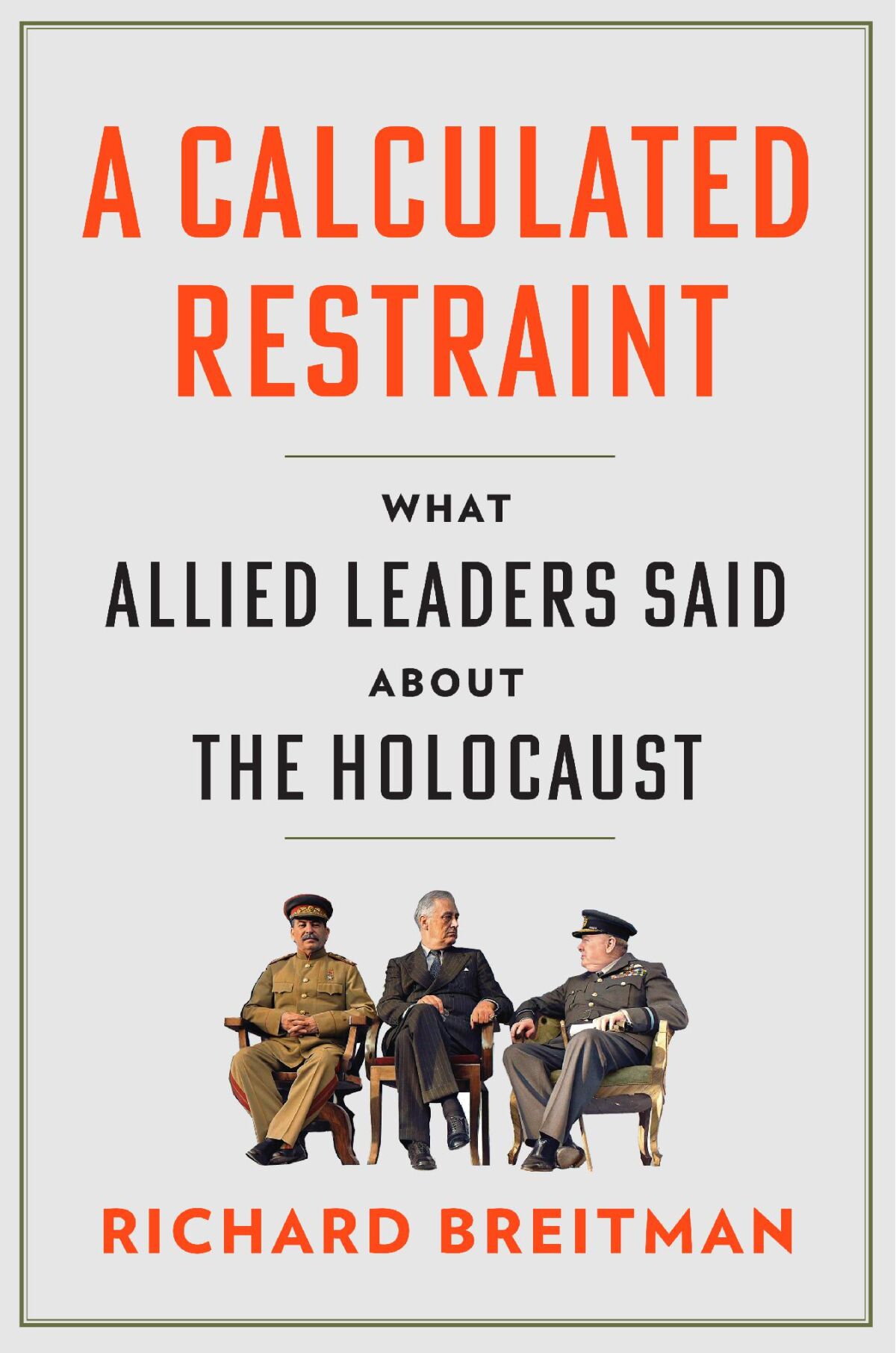
Yet, neither Roosevelt, nor Churchill, nor Stalin spoke directly and consistently about the extermination campaign during almost six years of war. In A Calculated Restraint, Richard Breitman, the leading contemporary scholar on America and the Holocaust, tackles the question of why that was. Breitman seeks to connect “analysis of what Churchill, Stalin and Roosevelt knew about the Holocaust to what they said about it in their most important statements on the subject,” (p. 3) and then endeavors to explain their muted response.
Breitman acknowledges the difficulty of the task. None of the three kept diaries. FDR refused to allow minutes of cabinet meetings or notes of his conversations. Roosevelt, Churchill and Stalin didn’t correspond among themselves or with others on the topic. As a result, “direct evidence of their reactions is limited,” Breitman writes (p. 4). Instead, he analyzes the text of their speeches, statements in the press, and the writings of staff and those trying to influence the leaders.
The resulting book expertly weaves the events of the Holocaust as Allied leaders then understood them with the daily military challenges they faced. It also presents a concise and compelling account of Allied knowledge of the Holocaust as it unfolded.
What A Calculated Restraint doesn’t do as successfully is answer the central question: Why were Allied leaders so restrained in their public pronouncements? This is especially vexing because Breitman concludes that the leaders’ statements “would have mattered at the time,” perhaps convincing “more Jews to flee” or go into hiding, and more non-Jews and neutral governments to help them (p. 7).
One problem is that Breitman doesn’t tally Roosevelt’s and Churchill’s major speeches and statements about the Holocaust (Stalin gave just one speech), nor compare them to the otherwise voluble leaders’ overall speechifying. With seemingly few Holocaust statements to work with, Breitman at times loses sight of the thesis. The book often wanders into ancillary territory: Hitler’s speeches, US journalists’ internment, Jan Karski’s mission. By the end, controversies such as the bombing of Auschwitz and the blood-for-trucks negotiations overwhelm Allied leaders’ statements. Ultimately, A Calculated Restraint reads more like an update on the US response to the Holocaust than a deep dive into the perplexing question of Allied silence.
To start, Breitman doesn’t grapple with whether Allied leaders actually wanted to address the Holocaust. To prove the response was calculated not callous, Breitman needed examples of Roosevelt, Churchill and Stalin desiring to speak but being convinced not to for well-substantiated reasons. There aren’t any.
When Breitman does land on an overarching explanation for the Allied leaders’ restraint, it’s basically the one scholars have proffered before—Roosevelt and Churchill feared emphasizing atrocities against the Jews would feed into Nazi propaganda and thus harm the war effort. “Experts in psychological warfare in Washington and London” warned against helping the Jews because of “the high level of existing antisemitism” (p. 264). But Breitman’s discussion of this intelligence—if it is indeed intelligence and not supposition—is thin. What were Allied leaders being told about possible responses to knowledge of the atrocities, by whom, for what reasons, with what credibility and what certainty of a particular outcome?
Breitman offers a different explanation for Stalin referring to the Holocaust specifically only once; the Soviet dictator said during a November 1941 speech that the Nazis were “carrying out medieval ‘pogroms’” (p. 91). Stalin never again mentioned the mass murder of Jews publicly, preferring to fold the genocide of Soviet Jews “into the larger crisis of the war and huge civilian and military casualties” (p. 93). Still, the Stalin chapter proves illuminating. While Stalin wasn’t speaking, the Soviet press and some of his advisors were. Breitman’s recounting of what they said about the early massacres and what the Western press picked up (or didn’t) provides insight into this frequently overlooked aspect of the Holocaust.
Breitman’s discussion of Churchill seems primarily intended to dispel the notion that the British prime minister was more concerned about the Holocaust than the American president. Churchill’s 24 August 1941 speech, with its evocative description of a “crime without a name,” is often considered “a warning about the Holocaust” (p. 38). Breitman disagrees. British intelligence had in fact detected the first stages of the Holocaust as the Germans conquered Soviet territory, eventually killing more than one million Jews. (This also prompted Stalin’s single reference). But Churchill “said nothing about the fact that most of the victims were Jews,” Breitman reports (p. 47). Protecting British code-breaking operations wasn’t the reason; Churchill revealed other sensitive information in the same speech. “If he was trying to preserve the secrecy of Bletchley Park’s successes, he said too much,” Breitman writes. “If he was trying to warn about what later was called the Holocaust, he said too little” (p. 65). Churchill didn’t follow up. Breitman cites other examples of Churchill’s disinterest, including his repeated failure to meet with Jewish representatives.
Not surprisingly, Breitman, author of FDR and the Jews,devotes most attention to the American president. He explains the military and public relations challenges FDR faced when in December 1942 he declined to make a statement in advance of the 11 Allied nations’ confirmation of the extermination campaign, and when in March 1944 he agreed to such a statement as Hungarian Jews faced deportation to their deaths. A few weeks before the December declaration, FDR told Jewish representatives requesting such a statement that his comments would only strengthen the German people’s will to fight and complicate the situation with Muslims in North Africa. Neither explanation seems particularly persuasive, especially when the president’s words could be chosen to try to avoid such problems. Breitman justifies FDR’s reticence, however, by citing the ultimate success of the North African campaign and the difficulty of saving Jews at the time. In the first instance, Breitman engages in the type of retrospective analysis for which he often admonishes “twenty-first-critics.” In the second, he assumes there would have been no value in informing the public unless immediate action followed.
State Department officials, who were “skeptical and unsympathetic,” might have influenced FDR (p. 145). Breitman doesn’t say why State officials took that position when in late 1942 skepticism was manifestly unjustified, or why FDR listened to them. He also describes State officials as believing “that the United States could not effectively fight the war and try to defend the Jews” (p. 146). But again, Breitman doesn’t explore how State officials came to this conclusion. Did they consider rescue measures or did they simply assume the easiest stance?
Circumstances had changed by the time FDR denounced, during a 24 March 1944 press conference, the “blackest crimes of all history […] the wholesale systematic murder of the Jews of Europe” (p. 210). The tide of the war had turned and an American agency to help rescue Jews was in place. Still, the process to get FDR to issue the statement was tortuous, involving multiple edits and even a draft that went missing for weeks and turned up in Roosevelt’s bedroom. Nor did a torrent of statements follow condemnation of “the blackest crimes of all history.” In public, FDR was almost as quiet as before and in private, he wasn’t pressuring recalcitrant government agencies to assist the new refugee board.
It may be that Allied leaders and their advisors believed what was convenient to believe about acknowledging the Holocaust and didn’t test their assumptions. As Breitman writes in a different context, contemporary authors “put more effort and thought into what would or would not have worked to destroy the gas chambers than the military and government officials did at the time” (p. 257). The same can be said of Allies’ decision-making over publicizing the Holocaust. Allied leaders’ silence speaks volumes not merely about the obstacles they faced but also about their interest in overcoming them.
