


As much as I don’t recommend institutions for children in ordinary times–boarding schools, etc.–at a time like that, being in the same boat was, in fact, very important.
Gaby “Niny” Wolff Cohen1
I hope you know what role you have played in our existence.
Elie Wiesel, to Taverny director
Judith Hemmendinger2
Introduction3
In his 2021 memoir, Boy from Buchenwald, Robbie Waisman (1931) wrote, “I began to see that the Holocaust wasn’t all I needed to talk about. […] I found there was another story inside me.”4 Orphans, including Robbie, known then as Romek, somehow survived concentration and slave labor camps, death marches, starvation, and illness. One part of the story of their childhoods is about unfathomable cruelty and unimaginable loss. The other part is what happened after the Holocaust when, alone in the world, they first comprehended the magnitude of their losses—their families, their homes, their communities—and had to learn how to go on living.
After the liberation of the camps vast numbers of orphaned and refugee children—many more than expected—emerged from camps, hiding places, and forests where they had somehow managed to survive against all odds. Of the estimated 175,000 Jewish children who survived the Holocaust, a few thousand found their way to Jewish children’s homes scattered throughout Europe.5 The American Jewish Joint Distribution Committee (known as “Joint”) sponsored most of these, approximately 300 in total scattered throughout Europe, housing 25,000 Jewish child survivors, mostly orphans. In France alone, they worked with the Oevres de Secours aux Enfants (OSE) to fund 61 homes, serving 15,000 Jewish children; the Committee for the Care of Concentration Camp Children (CCCCC) of Central British Fund (CBF) sponsored 732 orphans who lived in 47 hostels in England, Scotland and Wales; and in Allied-occupied Germany, they helped fund 13 Jewish homes.6
For decades, most scholarship about the immediate post-Holocaust period focused on adult survivors. In the last two decades, a wealth of scholarship has drawn attention to rescue operations like the Kindertransport as well as child survivors of the Holocaust. Rebecca Clifford’s 2020 book, Survivors, is perhaps the boldest, most comprehensive effort to address this gap, and other scholars including Boaz Cohen, Joanna Michlic, Daniella Doron, Joanna Sliwa, Sharon Kangisser Cohen and Dalia Ofer have centered on child survivor stories told in their own voices, giving them agency and bringing them from the silent margins to the center of Holocaust and post-Holocaust history.7 Some of these scholars have also focused attention on the adults who cared for child survivors, especially orphans, in post-Holocaust children’s homes.8 Most of these studies have focused on caregivers in a single home or national setting, but much can be learned by comparing and contrasting the efforts of caregivers, all focused on children’s recovery but in very different circumstances and settings. Such comparisons allow us to identify specific differences as well as draw general conclusions about caregivers’ challenges and accomplishments in aiding the recovery of child survivors in post-Holocaust Europe and bringing the “surviving remnant” [She’erit Hapletah] back to life.
In most cases, directors of children’s homes were women, while policymakers in aid organizations, governments and military occupation forces were almost exclusively men. Some authors have noted that in this case, traditional roles defining women as caregivers gave them an advantage in taking on leading positions in agencies focused on children but that as a result, their work in post-Holocaust Europe was often overlooked and undervalued. For example, Christine Schmidt and Dan Stone show how women aid workers who ran the Child Search Branch of the United Nations Relief and Rehabilitation Administration (UNRRA) charged with locating families of unaccompanied children received little attention despite the critical nature of their work because “gendered assessments of ‘care’ and ‘feminine’ roles in UNRRA/IRO [ …] have hidden their activities as a subject worthy of analysis.”9 They argue for elevating the importance of their work by redefining carework in less gendered terms, since “the roles held by women such as [Eileen] Blackey [director of UNRRA’s Displaced Persons Child Search and Repatriation team] were complex and involved high-ranking executive decisions as well as leadership.”10 While this is undoubtedly true, I would suggest that “masculinizing” their work to make it appear important essentially misses the truly transformational impact of exceptional caregiving work. Instead, I argue for measuring their success by how they were able to improve individual children’s lives in significant ways by creating deeply personal caring environments for survivors of trauma.
In this study, I focus on some Jewish care homes in England, France and Germany, citing examples of similarities and differences in the selected cases. Rich primary source material, particularly first-person accounts, testimonies, memoirs, photographs, and personal papers continues to be recorded, transcribed, catalogued and made available digitally.11 They reveal caregivers’ and child survivors’ personal understandings of the immediate post-Holocaust period and the contexts in which directors operated. As Sharon Kangisser Cohen has suggested, testimonies must be read with an eye to the context and circumstances of their recordings, but nevertheless can contain “nuggets of experiences.”12 I have found many such nuggets, especially since interviewers often fail to ask questions about children’s post-Holocaust experiences and, yet, they mention them anyway. Directors’ personal papers and official agency correspondences offer valuable insight into their efforts to define their vision and advocate for resources. Finally, reunions became occasions for survivors to share their painful memories, inspiring a series of publications containing their testimonies about individual children’s homes.13
By carefully examining these primary sources, I have identified specific features present in all homes, while differences in political and cultural contexts, personalities and biographies of staff and the makeup of the child survivor groups account for distinct “care cultures.” Successful directors shared a holistic—that is, not purely psychological—understanding of trauma before the concept was popularized. Their agendas shared certain key features, including: restoring Jewish identities; meeting educational needs; building trust; minimizing control and maximizing freedom; creating communities of shared loss; advocating for child survivors; meeting special needs; and challenging established policies when they did not represent the interests of the children in their care.
Before they began their work in mid-1945, children’s home directors faced a major challenge. They had been trained to work with children, but were the young, slight people with the faces of “old men”14 really children? While officially no one over the age of 16 was permitted to live in a children’s home, many residents had reduced their actual age by a few years. Some were in fact as old as 20 or 21.15 Aside from this technical issue, did it make sense to apply the term “child” to those who had been robbed of their childhood? Elie Wiesel (1928), speaking especially for young concentration camp and death march survivors, responded with a clear “no,” arguing that: “The youngest among us had a fount of experiences more vast than the oldest of them [the directors and counselors].”16 Each director wrestled with this significant issue: children who had experienced more tragedy and loss than much older adults still needed comfort, safety and care, but they refused to be patronized or treated as victims. Time and time again, child survivors described the moment they arrived at children’s homes mature beyond their years and deeply mistrustful, followed by the moment they realized they could let down their guard. While some claimed that in the homes they could “be children” again, others resigned themselves to having lost their childhood in the Holocaust. Wiesel summarized: “We became their counselors,”17 implying that a director’s first job was to listen.
Exceptional Homes18
As UNRRA officials tried to figure out how to manage the refugee crises in post-liberation Europe, individual aid workers and Jewish organizations wasted no time locating Jewish children in camps and orphanages throughout Eastern Europe. As one child survivor of Theresienstadt who spent time in various UNRRA care homes put it, he felt “at the mercy of the authorities, who didn’t show concern for our identities as Jews.”19 Soldiers of the Jewish Brigade20 were often the first to identify unaccompanied Jewish children and appealed to organizations like Joint and Jewish Agency for Palestine (the primary Jewish aid organization in Palestine headed by David Ben-Gurion). The atmosphere at numerous CBF care homes and hostels in Britain, OSE homes at Ambloy and Taverny in France, and the Warburg estate in Blankenese, near Hamburg, Germany, differed markedly from UNRRA facilities at Aglasterhausen, Kloster Indersdorf, Prien and elsewhere, that housed hundreds of child refugees. Jewish children’s homes allowed for smaller groups to live together with caring adults. In most cases, the directors were themselves Jewish refugees who had lost most if not all of their extended families in the Holocaust.
Weir Courtney (Lingfield)
Over the course of a period of years—from August 1945 to April 1948—five groups of Jewish concentration camp survivors arrived in England as part of a rescue effort initiated by Leonard Montefiore, Elaine Blond, and Lola Hahn-Warburg (known as the CBF’s “Triumpherate”). The CBF had lobbied the British government for permission to house up to 1000 Jewish unaccompanied child survivors in Britain temporarily until family could be located, adoptive parents found or they received visas to immigrate elsewhere.21 A moderate and pragmatic voice in Reform Judaism in London, Leonard Montefiore “firmly believed that the child Holocaust survivors needed to be cared for in a Jewish environment.”22 Homes (also referred to as hostels) for no more than 30 child survivors were organized according to age, places of origin, and degrees of religiosity. When the Central British Fund considered saving costs by increasing the number of children per home, Montefiore balked, threatening to resign as treasurer of CBF and chairman of CCCCC if they decided on “ ‘mass immigration’ of young people from the Continent to be cared for here in large units.”23 Of the 732 child survivors that made it to Britain24 who were known (misleadingly) as the “Boys” (even though 204 of them were girls or young women), only a few were under the age of ten.25 Young children were placed temporarily under separate care, toddlers first at a home called Bulldogs Bank, and the others at Weir Courtney, an estate of Sir Benjamin Drage, a leader of the West London Reform synagogue. There, Alice Goldberger, a trained kindergarten teacher from Berlin who fled to England, along with four other primary caregivers, lived with a total of 24 young children, including six older girls between the ages of 13 and 16. A mansion in Loughton, Essex, just north of London became the home for a group of young, mostly Polish survivors. Here, they formed a close knit group under the directorship of Oscar Friedmann and Heini Goldberg.26 When Loughton hostel closed in 1947, many Loughton boys moved to London where they mostly lived independently, meeting regularly at a center for young Jewish refugees and English Jews they called the Primrose Club after the local phone exchange.
When asked in 1977 by the psychologist Sarah Moskovitz how she ended up taking the position at Weir Courtney in Lingfield, Alice Goldberger shared feelings about the family she had lost in the Holocaust, including guilt that she had failed in her efforts to rescue them. Interned as an “enemy alien” (she was a German Jew) after her arrival in England, she was unable to arrange her family’s escape.27 Her despair motivated her to help children in the internment camps and, later, to create a home for orphans. Manna Weindling, also a German Jew who had lost most of her family in the Holocaust, had been working with Anna Freud at the War Nurseries in north London28 and was recruited to assist Alice. Manna recalled:
Coming to Lingfield that spring morning was a stirring moment in my life…a salvation…I was so moved, I couldn’t stop crying. I put my suitcase and violin case down and watched with tears streaming. When I recovered I just joined in and started dancing the hora, laughing and crying at the same time.29
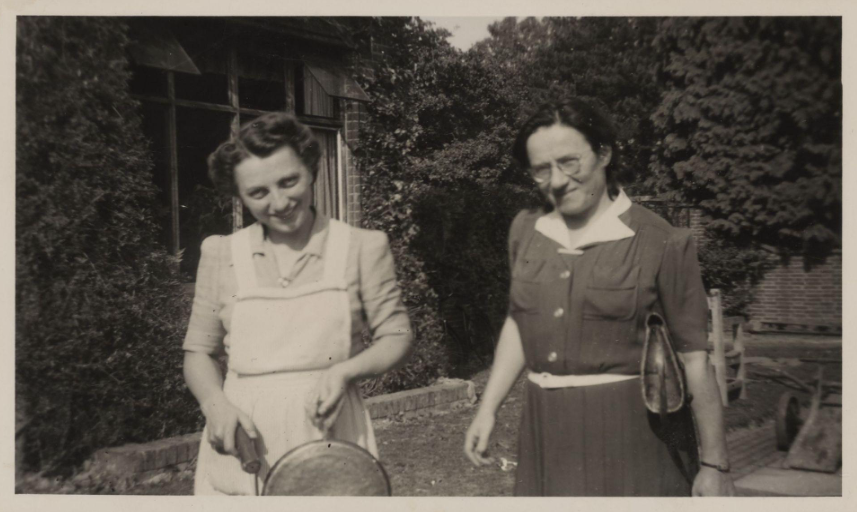
Loughton Hostel (Essex) and Primrose Club (Belsize Park)
Following Oscar Friedmann’s directive not to break up groups of friends, 26 older boys who, as Roman Halter (1927) put it, “got on so very well together,”30 were assigned to the Loughton hostel in Essex, not far from London. Friedmann and Heini Goldberg, the two directors at Loughton, were German Jews who fled Nazi persecution in the late 1930s. Friedmann had worked at homes for young offenders and had a strong interest in psychoanalysis. Heini’s background had been in youth work and religious instruction; he developed a good rapport with the boys, quickly winning their affection. Heini, who had belonged to Habonim, a Jewish socialist movement founded in Britain in 1929, set the Zionist tone at Loughton and had an infectious energy. Paul “Yogi” Mayer was involved with the boys primarily as the director of the Primrose Club, a social center in north London founded in 1947 to allow the young refugees to remain connected after the hostels closed. Yogi, also a German Jew, had been a professional athlete and sports journalist until he fled Germany in 1939. In London, he became a youth leader working with boys in East London. The three men’s personalities, interests and approaches could not have been more different. Oscar Friedmann was serious and intense, an intellectual who strongly encouraged independence and often lacked warmth. Of the three men, he acted as manager and psychological counselor, setting policies for the homes, reporting to Montefiore and the other trustees, and tenaciously lobbying the CCCCC for funds for the Primrose Club.
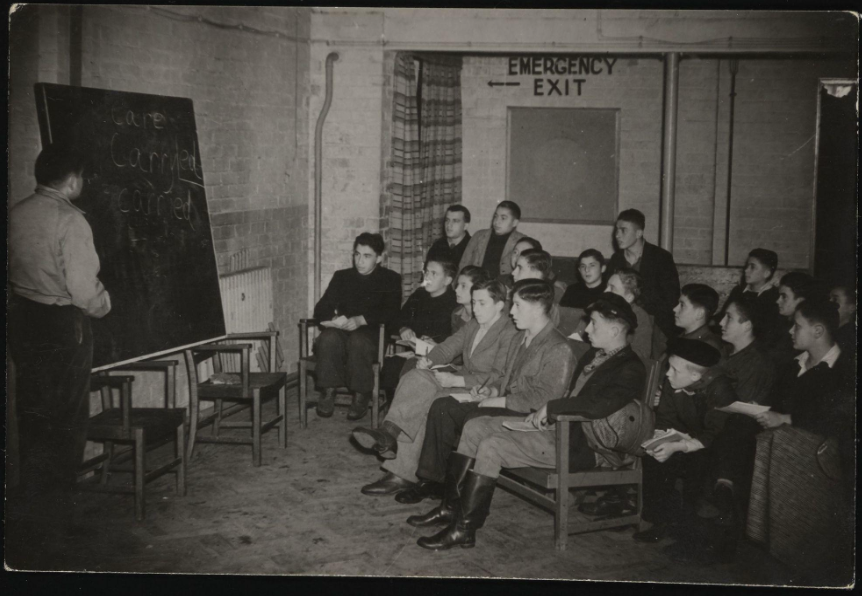
Taverny
In France, the OSE had rescued many Jewish children from the Nazis already before and during the war and began establishing children’s homes for young Jewish survivors immediately after the liberation of the concentration camps.31 More than 400 of the so-called Buchenwald Boys, most of them between the ages of 12 and 21 arrived at Ecouis, a former Army barracks, in late June 1945.32 Then twenty-two-year-old OSE social worker Judith Feist33 recalled: “Their eyes spoke of sadness and suspicion, for the supervisors of the home seemed to be no better than the guards of the camps.”34 Counselor Leo Margulies who also survived Buchenwald understood why a group of emaciated Orthodox survivors refused food that was not kosher. He lobbied on their behalf, and as a result the OSE established an Orthodox hostel for older boys in an old chateau in Ambloy. When they arrived in Ambloy, however, the director there “was upset about the boys’ aggressiveness toward him.”35 According to Judith, “he believed they were true psychopaths, cold and indifferent by nature and that is why they were able to survive the camps.”36 She took issue with him and decided to take on the directorship together with Gaby “Niny” Wolff37 who, like Judith, had lost many close family members and her home in the Holocaust; shortly after, they moved to the home in Taverny. Robert Krell, a psychologist and Holocaust survivor who came to know Judith well, suggested what drew her to the boys: “They no longer had a home. Neither did she. So Judith decided to build together with them ‘our home’.”38 The boys, including future Nobel Prize winner Elie Wiesel, were immediately drawn to Niny who exuded youth leader energy and enthusiasm. Leo Margulies became their teacher and mentor. When OSE tried to recall Leo to their office in Paris, the boys protested and the OSE relented. According to Judith, Leo was “their spokesman in all management matters,” he was “honest and pious,” he listened to them, and they listened to him: “... for him, the children behaved properly without need for drastic measures.”39
Warburg Estate (Blankenese)
In the Hamburg suburbs less than one hour from the Bergen-Belsen concentration camp, groups of young Jewish survivors found a home in the Villa Warburg, a sprawling estate on a hillside overlooking the river Elbe. The Warburgs, a wealthy banking family, fled Germany in 1938. Eric Warburg, one of the estate’s owners who became a colonel in the U.S. Army during World War II, gave permission first to UNRRA then Joint to use the house for a Jewish children’s home, allowing unaccompanied children in Belsen to be transferred to Blankenese. The first two groups of children arrived under the supervision of Zionist youth leaders, each staying for only a few months before immigrating to Palestine. Beginning in Spring 1947 Joint’s Betty Adler and the Jewish Agency’s Reuma Schwarz were appointed co-directors of the home.
Correspondence records reveal how the young, devoted directors at Blankenese had the support of the Joint’s regional director Sylvia Markowitz, who was not afraid to push back against her superiors in order to defend Betty and Reuma’s work. When Erich Warburg requested they allow some of his displaced German friends to move into the guest house, Markowitz intervened: “...right now during the next coming months we have a duty and an obligation to the children from Belsen, and sincerely feel that the new tenants of the Guest House can wait a few months, until we have serviced the children.”40 When Warburg continued to insist on housing the guests, she challenged the benefactor, citing incidents of antisemitism directed against survivor children: “We have spoken with several of the prospective German tenants who do not feel comfortable having Jewish children in such close proximity.” She continued “... the children should feel free in their new environment,” insisting that the guest house was needed to house support staff.41 Finally, Markowitz put her foot down: “It is impossible for us to do this now.” On 4 August 1947, Erich Warburg responded that “we have come to a complete meeting of the minds, which I never doubted,” asking only for regular reports.42 With Markowitz’s backing, the co-directors, a team of counselors, health care workers, and groundskeepers created a comfortable home for the children. They agreed to devote all buildings at Blankenese exclusively to Jewish child survivors and staff with one primary goal: creating a safe, supportive, loving home life where the Jewish children could remain together as a group until their emigration. This example illustrates how competent, courageous persons who recognized children’s needs in this unprecedented moment were able to secure resources that otherwise would not have been provided, resources that proved life-changing for many child survivors. It appears that such instances—and powerful allies like Sylvia Markowitz—were rare.
Like Judith, Reuma was only 22 when she became co-director of Blankenese. Betty Adler, who had been recruited from Brooklyn, NY, was a bit more experienced, but just a few years older. Reuma confessed, “I had neither experience nor confidence and I was made further insecure because I knew people doubted me. Only Betty supported me and so we became friends.”43 Both were committed to working with Zionist youth organizers who served as counselors and teachers. Berta Reher and her husband, who worked as housekeepers at the estate, reported to Anna Warburg, the original owner of the house and mother of Eric: “With Betty and Reuma, order returned to the house. Betty was so young but very clever and energetic. She had a calm, formal nature, the children hung on her like barnacles, and Reuma, too.”44
Exceptional Caregivers
Aid organizations paid special attention to professional qualifications and experience when selecting children’s home directors, though many were not much older than the oldest survivors.45 Judith and Niny at Taverny and Betty and Reuma at Blankenese all were under 25 years old and unmarried. Exceptional caregiving in crisis contexts questioned established standards of professionalized, institutionalized care. Since the 1920s, social workers in the United States, for example, were warned against “putting too much of one’s own prejudices, sentiments, loves and hates into one’s job,”46 acting less as a motherly caregiver than as the “dispassionate expert.”47 Also beginning in the 1920s, psychoanalysis had become increasingly popular, providing a set of scientific methods and tools for diagnosing children’s behavior.48 In contrast, a number of caregivers in children’s homes in post-war Europe recognized that the opposite was needed for child survivors of trauma: personal relationships with individual children. These caregivers embraced the model of the home rather than the institution as the ideal setting for healing and recovery. In most cases, directors of Jewish children’s homes had gathered experience working with displaced children during the war and early liberation period, voluntarily providing relief, comfort and activities for them in dangerous and chaotic contexts.49 Exceptional care home directors recognized this particular, unprecedented period of history as a chance to follow their own visions and impulses rather than strictly adhere to policy guidelines, to respond to needs in ways that felt authentic and personal. As Taverny co-director Niny Cohen phrased it: “we didn’t think, we lived the thing.”50
How exactly did they “live the thing”? First of all, most of the children’s home directors accepted that they could not fully relate to the children who had survived the concentration camps and understood why they sometimes dismissed them as a result. Elie Wiesel remembered how distraught and unruly he and the others were when they were first brought to Ambloy and Taverny. “We totally refused you. We did not want your help, your understanding, your psychological tests, your charity.”51 Decades later, he asked: “How did you succeed, Judith, to tame us?”52 This question can be asked of all the adults who devoted themselves to Jewish child survivors.
Restoring Jewish identities
In an effort to make the house feel like a home, Alice and Manna celebrated the children’s first post-Holocaust Shabbat on the day they moved into Weir Courtney in 1945. On Jewish holidays, the children created elaborate decorations, gifts, meals, and performances. Shabbat, celebrating holidays, and deepening connections to Jewish culture were part of life in each hostel. Even though not necessarily believers, the boys at Loughton were “very strong in their involvement in living Judaism,” Yogi recalled.53 Some Loughton boys adopted Zionism in reaction to the Holocaust, largely as a result of Heini Goldberg’s influential lessons of Zionist history and ideology.54 Future Olympian Ben Helfgott, who survived Buchenwald, Schlieben and Theresienstadt, described Heini’s crucial impact: “Although most of us were Zionists in the sense that we ardently believed in a Jewish State… He was a clear thinker, and whenever he spoke we devoured his words voraciously.”55
In France, the homes at Ambloy and Taverny were defined by their commitment to Orthodox Judaism and keeping kosher. Taverny attracted mostly boys who had as children been steeped in Orthodoxy in tight-knit Jewish communities in Eastern European schtetls. Judith and Niny, who both had been raised Orthodox themselves, understood their demands for kosher food and Talmudic instruction. Religious instructors encouraged them to put this latest chapter into historical context: the long history of antisemitism and persecution but also of Jewish survival and resilience. The boys adopted Hebrew at Taverny, distinguishing themselves in this way from the other homes where usually Yiddish was spoken. The Taverny group was largely defined by the so-called “intellectuals” that included Elie Wiesel and others who spent their days studying and debating Talmudic teachings.
In Blankenese, the goal for all orphans was emigration to Israel, though directors believed children with relatives elsewhere should choose for themselves. In a letter to her parents, co-director Reuma Schwarz56 referred to the Blankenese children as “Israel’s orphans.”57 Co-director Betty Adler, calm and soft-spoken, was entirely committed to restoring and deepening the children’s understanding of Judaism and traditions. She had grown up in an Orthodox family in New York steeped in Jewish tradition, culture and history and spoke fluent Hebrew.58 Living in a Jewish community with child survivors in Blankenese affected her deeply and strengthened her commitment to Zionism. According to the account of one of the teachers there, she was visibly moved when the children and counselors organized a celebration of the U.N.’s recognition of the Jewish homeland in November 1947: “Her whole body shook and she muttered, more to herself than to those standing around her, ‘I am part of all this. I am witnessing the salvation of the Israeli people’.”59 Through music, celebration, and even parades in which children waved Israeli flags as they marched through the streets of Blankenese, they restored children’s pride in being Jews. Zvi Sohar (1931) remembered: “My time in Blankenese was the gateway to immigration, the point of transfer, during which I began to develop my Israeli identity. I left Herschel and the Polish language behind and became Zvi, who spoke Hebrew and was fascinated by religious stories and Jewish histories.”60
Meeting educational needs
When it came to education, all directors agreed there was little time to waste: the children had missed years of classroom instruction, had to learn the local language (in Britain and France) and, in the case of older teenagers, had to begin training for work or for immigration to Palestine. Directors all understood that these children faced greater challenges than just catching up on subject matter. As Judith Hemmendinger put it: “It was clear that all traditional methods of education were bound to fail.”61
The young children in Lingfield and Loughton were strongly pushed to learn English so that they could attend school in town or participate in job training programs and apprenticeships. Alice and Manna created a home life rich in opportunities for developing skills and pursuing interests. Both creative and handy, they taught them crafts, games, and songs, and since both directors were familiar with the progressive pedagogy of Pestalozzi, Montessori and others, they knew young children enjoyed organized activities and could assume responsibilities in and around the home and garden. All the children—older and younger—worked together to create elaborate celebrations, birthday parties and feasts for special occasions. Manna liked to play her violin, and the children learned traditional Jewish folk songs and dances. In one of the many pictures from Weir Courtney documenting these activities, Manna, laughing or perhaps singing, is leading a chain of hand-holding children, skirts and shirts fluttering, dancing the hora on the lawn in front of the house in Lingfield. Art and creative writing was also important. For Alice’s birthday, the children created an extraordinary scrapbook in which some wrote joyful poems and each drew pictures in bright colors depicting their favorite activities or adventures at Lingfield.
The residents of Loughton received on site lessons in English in order to participate in job training programs and apprenticeships and to begin to earn a living. The older youths were encouraged to attend the Organization for Rehabilitation through Training (ORT) School in South Kensington. ORT was active throughout Europe, supported by Jewish communities and organizations globally.62 The London ORT schools, a relatively short commute from Loughton, taught engineering, welding, drawing, electrical skills, and radio mechanics. Girls, including some of the teens at Lingfield, had one option: dressmaking.63 Montefiore suggested they learn a useful trade, keeping ambitions low so as not to draw the attention of the majority of Brits who were wary of assistance going to refugees. Montefiore explained: “when we asked these children what they wanted to do and occasionally were told they would like to spend seven years in this country studying to be a doctor, or a professional pianist, or to become a portrait painter, we had to say, ‘Think of something else.’”64 Sometimes he used his influence with local Jewish tradespeople, who offered them apprenticeships.
Though most young survivors were not very religious, Heini was able to ignite an interest in debate and discussion of moral and political issues. In addition to studying the Talmud and Jewish traditions, assimilation vs. aliyah, the past and future of the Jewish people, and Israeli statehood were among the subjects they discussed. Heini invited guest speakers and introduced young people to the arts, especially theater and music. Both at Loughton and later at the Primrose Club, they put on performances and listened to classical music. Barbara Barnett, one of two counselors at the Club, recalled the musical appreciation sessions there:
These became very popular. For some it was a first discovery of classical music, a newly found leisure pursuit with strong appeal; while for others powerful memories were evoked of music enjoyed in their childhood homes before all hell was let loose. Through art and music, people can find expression without any language barrier. Once that barrier disappeared I had added weekly play-reading; and later on we performed Emlyn Williams' grim tale, Night Must Fall, at St Peter's Church Hall in Belsize Square. […] Nowadays art and music and drama are recognised as valued outlets for self-expression. We did not know that then.65
The educational agenda in the children’s homes in France had been the subject of heated debate within the OSE leadership. At an educational congress in 1946, the organization left room for directors to specify the educational program within a broad framework: education should be “neutral,” by which they intended to distance themselves from the Zionist ideological fervor of some of the youth groups; but it should be “respectful of the Jewish collective soul to achieve the maximum development of each personality.”66 Most of the boys had come from Eastern Europe and spoke Yiddish which quickly became the language of instruction (Judith, who spoke only German and French, also made a concentrated effort to learn Yiddish.) They learned Hebrew and were taught Jewish religion and history, mostly by Leo, who ignited their interests in these subjects by inviting Jewish scholars to Taverny. Heady classroom lessons and discussions ran parallel to practical concerns about the future. Leo understood that their studies could be welcome distractions and helped them to think deeply about their place in the world.
Judith and Niny managed to convince a number of reluctant boys to attend training programs offered by ORT. France was home to more ORT schools than any other country in Europe, 21 in Paris alone.67 Judith recalled: “When we asked the older ones what they might want to learn, the adolescents looked at Niny and me in complete bewilderment.”68 When they asked them about their fathers’ occupations, they discovered that a few were interested in carrying on the family tradition. Some boys traveled back and forth to Paris, sometimes residing at the school for months at a time, developing skills, or taking language or math classes. Solomon Hans (1928) trained at ORT to make pocketbooks.69 Allan Weiss (1929), another Taverny boy, traveled daily to Paris to work as an apprentice to a jeweler.70 Though ORT provided community centers for Jewish youth to socialize and relax, he, like most others, preferred to return to Taverny at the end of the day.
At Blankenese, children who mostly had been living with constant upheaval as they made their way from Eastern to Western Europe were expected to learn in a structured environment and received education in Hebrew language and history as well as music, art and sports, before making aliyah to Palestine: “When the groups arrived at Blankenese, they were no longer divided up according to youth movement affiliation, but were schooled and housed according to age and academic requirement.”71 The teachers at Blankenese were known to be strict and the lessons challenging, especially Hebrew. According to Israel Wiesel (ca. 1934) Reuma often took issue with the Polish educators’ approach, insisting they be more open and patient with the children.72 Unlike in the other western European homes, the children at Blankenese did not have access to an ORT school, but the curriculum included developing skills for kibbutz life, particularly gardening.
In caring for children, directors also brought their talents, interests and passions into the life of the home, that in turn lit creative energies in the children. Alice and Manna brought an infectious joy to group projects—murals, albums, celebrations, poetry evenings, musical performances—at Weir Courtney. With Yogi, it was sports that had come so naturally to him and that were his way of relating to the boys, and the boys’ memories of the sports teams were usually among their most vivid ones.73 Reuma, who played the flute, created a musical group of kindergartners who entertained the other children, arranged for piano lessons and even gifted her flute to Israel Wiesel after he developed a strong interest in playing it.74 This practice of “letting your life speak”75 encouraged children to do the same. In children’s testimonies, children often recalled moments in which caregivers expressed themselves creatively, evidence that caregivers’ lives spoke loudly and resonated deeply. In Israel Wiesel’s words, “After Blankenese I was never again offered music lessons and I never had any again. […] I will never forget this episode.”76 And he held on to the flute as a memento.
Building trust
As a psychoanalyst, Oscar Friedmann believed survivors should be encouraged to speak about their Holocaust experiences, but they were often unwilling to do so. Especially survivors of the camps struggled with trusting adults and preferred to confide in the younger youth movement leaders and counselors who assisted in many of the homes. Wolfgang Gordon, a member of Hashomer Hazair youth group and staff member at Windermere, where most of the first child survivors arrived, trusted the “Boys” instinctively and the feeling appeared to be mutual. He reported that
they talked freely about their sufferings. […] The reason for this success lies, in my opinion, in the fact that most of the workers were young and experienced youth leaders. That they were also Jewish, and that all that had happened to the children could have happened to them, made it undoubtedly easier for them to gain their confidence.77
While youth movement experience may have helped to win the trust of older children, younger children often looked for substitute parent figures who could show them love and affection. Felizitas Sonnenschein Hart (1939) was 6 when she moved into Weir Courtney. She was very shy and almost never spoke. Occasionally she would act out, though decades later she could not explain why. She felt marginalized by the other children and tried to avoid them, but she took to Alice:
I could hold her hand and follow [her around], someone who would play with me sometimes. I remember she had things to do and I was holding her hand and she’d say she’d come to me in a minute. And I’d wait and I’d go up and say, Are you ready now?78
Alice’s ability to give her some focused attention made a difference to her and remained her strongest memory of the home.
The young directors at Taverny knew better than to expect the Buchenwald survivors who had been humiliated and debased to trust them, but they could see beyond their rough exteriors. As Elie Wiesel put it, speaking of Judith and Niny: “You bet on us to recover.”79 One boy remembered that some of their outbursts would have appeared “mad” but in the group at Taverny, he felt able to express his pain like in a “surrogate family.”80 George Citrom (Georg “Laci” Czitrom–1931), a Romanian-born Buchenwald survivor, was 14 when he first arrived in France. He was intimidated by the “undisciplined” boys who stole and boldly asserted themselves. Niny noticed and reached out to him, and they quickly developed a special relationship whose emotional impact was evident in his testimony more than sixty years later, when he spoke about his experiences for the first time:
Interviewer: What was so special about Niny? Why did you trust her?
George Citrom: Maybe I needed a mother. I have no answer for you. Maybe I needed a person that can guide me. And she was willing. She was the right person.81
She met with him often after he began living with a family and going to school in Paris. At Blankenese, Yehuda Margalit (ca. 1934) remembered how they sometimes referred to Betty as “America” and Reuma as “Israel.”82 The terms suggest that they may have felt less comfortable with Betty, since she was a “foreigner” from a place the children only knew about from the GIs in the DP camps. Reuma, who had been associated with the youth groups for a long time, probably felt more familiar. But the children soon “adopted” Betty as a mother figure. She was dedicated to helping them fulfill their dream of emigration and shared their enthusiasm for Israel. They also sensed—and some likely knew—that she had conveniently looked the other way when they escaped from the American zone to the British zone which at that time greatly increased their prospects of gaining legal passage to Palestine. “We knew she belonged to us.”83
Minimizing control, maximizing freedom
The children’s home at Lingfield was known as “the hostel without punishment.”84 Alice’s focus was on making children’s lives as comfortable, beautiful and carefree as possible. The children each had spaces in the house reserved for them, that they could decorate and enjoy as they saw fit, and they had acres of outdoor space for playing and taking care of their many pets. Zdenka Husserl (1939) remembered: “We had dogs, we had a guinea pig, rabbits, my chickens… and it was me that used to go once a week to order the food for the animals. So, I liked doing that, I went on a bike.”85 As she described the countryside surrounding the Lingfield house to an interviewer, child survivor Judith Singer Sherman (1940) recalled her first feeling of freedom. At the Ravensbruck forced labor camp where she was imprisoned she also had noticed the surrounding natural beauty. At Lingfield, she remembered feeling, “If there was a beautiful place, you could go there.”86 In July 1952, Alice wrote to some donors: “In a place like ours where the children feel free and completely at home, they are not always at their ‘best behavior’ and show and express their difficulties and dislikes quite strongly.”87 The fact that the children did so and were still loved and accepted made it possible for them to slowly venture out into the world, meeting friends from school and “organizing their days by themselves.”88
As for the teenage Loughton boys, the best approach, according to Friedmann, was to allow them, even push them, to experience independence and autonomy. His approach fit well with Montefiore’s impulses: “We have only aimed at giving freedom, freedom of movement from place to place, freedom to choose employment, and, so far as funds permit, freedom to choose training and education.”89 Outside the hostel, their freedom was inhibited by the constant stream of suspicion and rejection they faced from landlords, employers, and the public. CBF program director Helen Bamber recalled: “The young people did not feel that we could give them what they needed—and how could we?” They needed support, which she admitted she misunderstood at the time, and they also needed space; she learned “not to invade it.”90 Once they had left Loughton, many young survivors turned up at the Primrose Club in Belsize Park, London, after work and on weekends. In photos of Club outings to the seaside, young men and women clad in fashionable bathing costumes, bodies loosely intertwined, smile into the camera, appearing comfortable with themselves and with each other. Generally, adolescents found solidarity with each other regardless of the attitudes of directors. In this regard, the children’s home directors were much like parents—people whom teens challenged, tested and sought independence from. It seemed to work since they knew they had support if they needed it.91
At Taverny, maximizing young survivors’ freedom included allowing them to select their roommates (which usually meant those who came from the same region, had lived in the same camps and spoke the same language). The boys were told: “This is your home, everything is at your disposal.”92 This included the pantry. Judith and Niny’s approach stood out: “The Directors of other homes also housing children from Buchenwald had been selected according to their ability to command authority. […] They could not understand why our liberal methods were so successful.”93 Among these liberal policies were complete freedom to leave the grounds, and most of the boys frequently went into town to spend their pocket money. They made almost daily excursions into town to have their photos taken together, often asking Niny to join them. By swapping outfits and accessories, and posing by themselves and in groups, they made bold statements “to show themselves still existing.”94 Many of them also took photos in the clothes they were wearing when they arrived in France by train from Buchenwald—their striped concentration camp uniforms—perhaps to bear witness and signal their resilience.
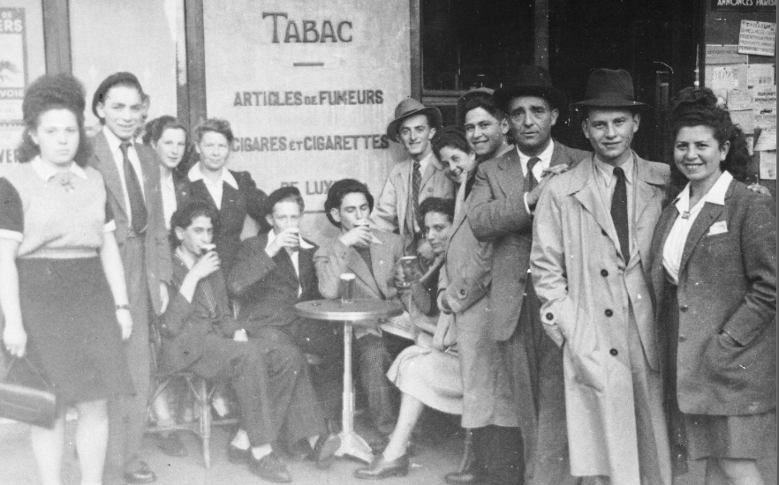
At Blankenese the children were younger, ranging in age from 8 to 13. They led a fairly structured existence, largely isolated from the surrounding communities and closely chaperoned by leaders of different youth groups. It was very important to the Warburg estate staff that the children be given free reign of the 16-acre grounds, which extended from the top of a large hill to the banks of the Elbe. Due to their age and the hostility of the outside world, the children’s freedom ended at the property perimeter unless they were with adults. Despite the legitimate outside threat, the adults at Blankenese refused to allow fear to permeate the home. The adults modelled freedom and courage when on the day the UN approved the formation of the state of Israel in 1947, they paraded with the children through the streets of Blankenese, joyfully waving their blue and white Israeli flags, singing folk songs in Hebrew.
Creating communities of shared loss
All directors agreed that creating communities around Jewish culture and tradition was vital for giving young survivors hope for the future, but they differed on whether to press child survivors to speak about the past. Oscar Friedmann felt that individual sessions for sharing their experiences were necessary. On this point, he differed from Yogi, who believed their future depended on building confidence in their abilities—on the sports field and in their training programs—and blending in as much as possible with the British, who did not want to hear the details of survivors’ experiences.95 Yogi recalled: “I had to leave it to Oscar Friedmann to try, as a psychologist, to relieve the pressure of the past. Some hated those sessions like the dentists’ chair. Others found the sessions a great relief.”96 Whether they did or did not speak of the past, the powerful sense of shared loss that only they could understand created a powerful bond and became the unspoken link that led to the creation of the Primrose Club after the homes closed in 1947.
Most children of Weir Courtney and Lingfield House did not recall being asked directly to speak about the Holocaust. Judith Sherman regarded this as a good thing: “None of us ever talked about the camps. We were not discouraged and we were not encouraged. But the whole thrust was towards healing and the future.”97 The refuge they created focused on restoring normalcy and creating a harmonious environment but very young children like Joanna Millan (Bella Rosenthal–1942) felt confused about what to do with their recent memories and feelings of loneliness and fear that often overcame her. When she was adopted by a family, she felt suddenly cut off from fellow survivors who shared their past experiences, suffering from being cut off from fellow survivors and from their past. 98
Initially at Écouis, many of the Buchenwald Boys refused to speak to anyone who had not experienced the horrors of the concentration camps. The only exception was Leo Margulies, who also survived Buchenwald. For Niny, asking the boys about the past felt like a violation: “Some of them talked, some of them didn’t talk.”99 But Hemmendinger understood the value of a community based upon shared trauma, that after leaving the home in Taverny, “they lost an environment where awareness of the wartime past was always close, always alive….”100 Reflecting back decades later Niny conceded that while she was not an advocate for communal living in ordinary times, “at a time like that, being in the same boat was, in fact, very important.”101
Like most of the other children at Blankenese, Zvi Sohar recalled, “We did not speak of the Holocaust.”102 Only after they arrived in Palestine/Israel, where few people seemed to speak of the Holocaust, did they miss the unspoken shared sense of loss. For a few, meeting with fellow survivors and children’s home staff were occasions—sometimes the only occasions—when they spoke openly about the past. At a reunion fifty years later in Tel Aviv, survivors from Blankenese insisted that the atmosphere at the children’s home, which focused their attention on a future in Israel, helped them survive: “How do you close the door to hell? One looks forward into the day, into the light, in the moment. They made that possible for us in Blankenese.”103 But, on the other hand, many expressed isolation and loneliness when memories of the past resurfaced.
Many testimonies from child survivors reveal that whether in Britain, the U.S., Israel or elsewhere, when they needed or wanted to speak about the past no one wanted to listen. Decades later, survivors told stories they were only able to tell in the company of child survivors from the children’s homes. Even child survivors who settled in Israel experienced the harsh judgment of sabras and found consolation and community with others from the homes. Naphtali (1926) one of the oldest Buchenwald Boys at Taverny, initially felt welcome and accepted by native Israelis, but the distinction between sabras and survivors never entirely disappeared. He spoke of his past mainly with his younger brother “Uncle Lulek” (Israel Lau–1937) who Naphtali protected in Buchenwald.104 A version of these stories was true of many of the children who spent time in an exceptional children’s home:
Linked together in a strange communion
Linked by a past that none could foretell,
And none understand,
Unless he’d seen Hell.105
Advocating for child survivors
The children who ended up in Britain attended local schools and training programs where they came in contact with British people on a regular basis. The fact that they were “foreign” was enough to warrant unwanted attention. Denny Muench (1940), who lived at Weir Courtney, recalled that some of the children in the village school they attended identified his German accent. When Alice learned that one of the student teachers had told him would look good in a Gestapo hat, she scolded teachers and administrators, reminding them of the impact such unchecked actions had on the children.106 In monthly reports to the American Foster Parents, a group of Jewish philanthropists in the New York area, she focused on a specific child, explaining how funds were filling their particular needs.107 In her eulogy at Alice’s funeral, Zdenka Husserl referred specifically to Alice’s selfless advocacy: “She did not expect us to be grateful.” She treated them with dignity, “never as victims.”108
Loughton resident Roman Halter recalled that the English often believed that their experiences in the camps “perverted us and brutalized us and certain families felt that children should not be associated with us.” Montefiore constantly spoke out in their defense. He told CBF leaders, “They represent the survival of the bravest and the most gallant but also the toughest, the sharpest, the most ingenious, in finding ways and means of escape,”109 and asked an audience of Cambridge students to consider the dehumanizing environment where only the group and not the individual matters. After some time of recovery, they, too, would adjust to their new, democratic environment: “Let them become individuals, each with a mind and an opinion of his or her own, not selfish but social, not egotistic but co-operative.”110
Leo, Judith and Niny fiercely defended the Buchenwald Boys against people within the OSE who argued they needed to be contained and controlled. Witnessing how counselors stood up for them clearly contributed to rediscovering their direction and directing them “toward confidence and reconciliation.”111 Directors also intervened in individual cases, helping survivors secure visas and travel papers, chasing down embassy and local officials and rushing the boys to ports and train stations. In one case, a boy had received word that his uncle would sponsor his immigration to the U.S. Since he had once illegally used someone else’s train pass, he had a criminal record; after Hemmendinger negotiated with local police, they cleared his record and he was free to travel.112
Reuma and Betty were very wary of lingering antisemitism in the local population and felt very protective of the children, deciding mostly to keep the children on the Kösterberg property. When they went on outings, Jewish Brigade soldiers and youth movement leaders acted as security guards. When children had to be treated in local hospitals, one director always went along. Reuma recalled, when a young girl developed acute appendicitis, medical staff in a Hamburg hospital questioned whether they had to admit a Jewish child. As a result, she and Betty took turns keeping watch over children to ensure the children received proper treatment and care.113
Meeting special needs
While many children suffered from the effects of malnutrition, disease and abuse, some children were significantly disabled. Children’s home dictors made extra efforts to meet individual needs, and by insisting that everyone was part of the community, influenced healthier children to care for those who otherwise might have been excluded or dismissed.
1) Lingfield: Margot
One 11-year-old girl in Alice and Manna’s care, Margot (1935), appeared to be very mentally disabled, unable to attend school with the other children.114 Anna Freud saw her weekly before determining she likely would never be able to live independently and found her a place in a care home in Edinburgh, Scotland. Alice accompanied her, wrote and visited her annually. When Margot’s mother suddenly contacted her in 1952, requesting that her daughter come to live with her in Germany, Alice traveled from Edinburgh to Dortmund with Margo, who would have preferred to stay in Scotland, to make sure she “fits in with her new environment.”115
2) Treating TB at Ashford and Quare Meade
Forty of the “Boys” contracted serious cases of TB in the camps and needed long-term care. When they were denied entry into Britain as a result, the two female members of the “Triumpherate” sprang into action, arranging for a doctor at Ashford, a sanatorium near London, and, later, Quare Meaade, to admit and care for them. Lola Hahn-Warburg, one of the Triumpherate, was committed to visiting them regularly, making sure they had books and other supplies to ward off some of the boredom, loneliness and depression. The director, a nurse, reported, “It needs some experience not to be shocked at their talk, and to take them as they are because of their past.”116 They formed a closed community, resting for 4-5 hours a day (or longer) and otherwise moving about freely, reading, playing chess and learning English from the nurses. Some of the children remained there until 1950, their expenses covered by CBF. Mayer Perlmutter (1929) recalled one nurse they all liked who “cared for us all lovingly.”117
3) Taverny: Eric
Eric was born without hands or feet but managed to survive the war in an OSE orphanage in France. His parents had immigrated to the U.S. in 1938, reluctantly leaving him behind since, “Only people in good health were accepted by America,” Judith wrote, “and Eric was refused entry.”118 At Taverny, he waited for a visa so he could join his family. Judith admitted to being shocked by his condition: the 16-year old looked like a boy ten years younger. But despite his disabilities, he was able to eat, write and even knit, and he “soon became everyone’s friend.”119 An academically gifted student, Judith drove him to school on her bicycle. There he excelled, found a friend and experienced “joy.”120 He wrote to Judith shortly after immigrating to the U.S., pleading to be able to return to Taverny.
4) Blankenese: Grischka
When six-year-old Grischka arrived at Blankenese, he did not speak. Noting decades later that he likely was “autistic,” Reuma recalled: “I decided to get closer to this child.”121 Once, when he fell off a high beam, he began screaming, completely helpless. She dusted him off and gave him a kiss and from then on, he clung to her. She always remembered this occasion because after that he began to develop: “I loved him very much, him in particular, because he was a very problematic child and had no family.”122 Personal attention and affection, even without psychological diagnosis, seemed to help him.
Pushing the envelope
In late 1945, the CCCCC board accepted the policy that adoption almost always was in the “best interests” of orphaned child survivors, especially the youngest ones.123 Alice was expected to help facilitate these adoptions and did so at first. In time, Alice began asserting that the children needed contact with other survivors and pushed back on the adoption policy. For more than a decade Alice successfully challenged the central assumption of agencies dealing with orphaned survivors, namely that living in a nuclear family was preferable to living in a loving group home. She also challenged the idea that healing would be quick, constantly fundraising for the children by holding craft bazaars and lobbying the American Foster Parents. By mid-1947, the CBF was facing a grave financial crisis,124 but Friedmann, too, insisted on continuing support for older youth. Faced with increasing donor fatigue, he faced an uphill battle.125 He gained a few years of support until the board finally voted to close the Club in 1950.
Judith proved that she was willing and able to challenge OSE policies. She recalled one occasion when four older girls arrived at the home in dire need, as was sometimes the case when stray refugees heard about Taverny. They stayed for a few days before OSE administrators insisted they be transferred, since it was inappropriate for girls and boys to be living together in an Orthodox home. Judith escorted the girls by train to what was to be their new home in Versailles. As it came time for her to leave, she noticed the girls’ desperate expressions and gave in to their plea to be allowed to return to Taverny. Afterwards, they told her it had felt like “a death sentence” to be taken from a place where they had begun to trust people.
In Blankenese, directors were daring and skilled in circumventing British policies. Reuma explained, “We had to hide the fact from the British that the children weren’t from the British zone.”126 Most of the children there had been smuggled from the American zone into the British zone where they had better chances of receiving emigration visas to Palestine. Reuma told authorities the children were there only temporarily to attend a recovery camp. Reuma wrote to her parents: “In my eyes, Germany at this time looks like a sinking ship, and everyone is looking for rescue options. Every Jew sailing on this ship is trying to get a spot on the few available lifeboats. … People are pushing ahead at the price of small children and other helpless beings. Only those with strong elbows win.”127 Largely because of their clandestine activities (and strong elbows), about 300 child survivors at Blankenese received visas to emigrate to Palestine.
Providing direction
Initially, CBF wanted to assure the British public that the refugees were only temporarily enjoying their generosity and hospitality and were “preparing for Palestine.”128 Home directors were mostly convinced that England offered them and young survivors the best opportunities for education, jobs and a peaceful existence. Directors also encouraged children to go where they had family—the U.S., Australia and, in some cases, Israel. The older boys, influenced by Zionist youth movements, protested the British government’s Palestine policy, and a few enlisted in the army to defend the newly-declared Israeli state in 1948. Most returned to England at the end of the war.
At Taverny, some of the Buchenwald Boys were or became Zionists and joined the clandestine emigration movement, aliyah bet. A few joined the famous Exodus voyage, were turned back by British troops, and ended up in internment camps in France or Germany. Others who sailed illegally to Palestine were sent to Cyprus where they waited months in order to enter Palestine.129 Some of them fought in the Arab-Israeli War and settled in Israel. Some young survivors stayed in France or moved to the U.S., Canada, and Australia. Judith and Niny supported their choices; Niny stayed in her home country of France, while Judith eventually settled in Israel.
In contrast, virtually all Blankenese children went to Palestine/Israel. Staying in Germany, though possible, was not an option for most children since they did not have family there. Repatriation either to Germany or elsewhere in Eastern Europe where antisemitic pogroms were driving hundreds of thousands of refugees to DP camps in western and southern Europe, also was not desirable. By mid-1946, the JDC policy had shifted and the organization supported legal and illegal emigration, convinced that Palestine offered the best solution for most orphaned refugees. Betty, Reuma and the rest of the Blankenese staff were united in the effort to prepare children for resettlement in Palestine. Reuma accompanied the last boat load of children leaving Blankenese and arrived in Haifa harbor just as the Arab-Israeli war broke out. If she had any regrets about bringing children into a war zone, she committed none to writing: “I arrived in the ship with the children, gunfire ringing all around us. We left the harbor in a tank from Solel Bone. … I came exactly at the right time on the ninth of May, and on the fourteenth of May, the British left the country.”130
Conclusion
In a 2013 tribute to Manna Weindling Friedmann,131 Lingfielder Judith Sherman reminisced about Manna’s caregiving skills: “... those training analysts at the Freud Institute learn[ed] about child development from an expert—by watching you in action.”132 Implicit in this statement is that there was something beyond professional training that made a difference in Sherman’s life. Exceptional directors of Jewish postwar children’s homes used a combination of knowledge, experience, intuition and love to react to countless uncertain and unprecedented situations in real time. Caring, listening and accepting took precedence over pedagogical or social work methodologies, and celebrating Jewish identity was central.
Given the impact of their work, it is important to note that while policymakers who led organizations—almost exclusively men—were offered opportunities to continue to apply their experience and receive compensation for it. But in most cases, caregivers—mostly women—were dismissed as soon as carehomes closed. Manna, Judith, Niny, Betty, and Reuma married soon after; only Niny continued working for OSE while the others focused on raising families and remained active in their communities, in some cases pursuing education and continuing caregiving in other forms. Alice, much older than most other directors, decided to continue caring for child survivors voluntarily. Though Montefiore and the CCCCC had concluded in 1957 that the young people, now between 15 and 21 years old, were “self-supporting and in need of periodic assistance or advice only”133Alice still insisted that some of the young people wanted—even needed—to live with other survivors and were not ready to strike out on their own. Four children moved into a flat in Hampstead with Alice while they began first jobs, completed apprenticeships and continued training programs.134 Despite recognizing her thirteen years of service, Montefiore balked when some committee members suggested paying Alice, who was 61 years old in 1958, a “proper pension.”135 Economist Nancy Folbre has noted in her celebrated book, The Invisible Heart, that understanding why caregivers receive so little compensation—something she called the “pink collar penalty”—goes beyond any market-based explanations but instead correlate with gender stereotypes (and the sex of the majority of the workers in a certain field). Referencing the work of sociologist Paula England, she states simply, “... jobs that require nurturance are paid less, all else being equal, than other jobs. Jobs that involve exercising authority over other people, on the other hand, are paid more.”136
The long-term impact of children’s home caregivers can best be measured in qualitative terms, by the testimonies of child survivors, many of whom stayed in touch with them until the end of their lives. At children’s home reunions, they spoke out about the importance of that first post-war community; their first taste of security and stability; the therapeutic effects of home and nature; the moment they felt hopeful again; and the process of finding their way back to the realm of the living.137 Adult testimonies are peppered with deeply personal and vivid memories of places, people, and personal interactions rendered with honesty, emotion, affection, humor, and, in some cases, self-deprecating embarrassment. Often grown-up child survivors confessed they had not spoken with anyone, not even their partners and children, about what had happened to them during the Holocaust and how it felt to be alone without family. Many found their voices only when surrounded again by the children and caregivers from the children’s homes. Those who listened to them then were present again, each emotional statement, tear and hug an indicator that their work had made a significant difference.
In some cases, the directors initiated these reunions when, later in life, they recognized just how significant and transformative the children’s home years were for them as well. At one such reunion in 1995, Reuma, who had become Israel’s First Lady after her husband Ezer Weizman was elected President by the Knesset, recalled how the short time at the Warburg estate had changed her life: “My entire effort was directed towards this work. I loved the children and felt very close with them. Before I worked there [at Blankenese], I had not realized how much I loved children and how much I wanted to help them.”138 At the same reunion, Betty also confirmed the impact of their shared experiences: “Today we all see each other again and feel as though the fifty years that have passed did not exist. We are still close even though we only spent a short time together.”139
When Niny, who spent her entire career working with children, was asked late in her life about whether she thought much about the Taverny years, she responded that she thought about the children more and more often: “I realize that those two, three years spent with the group… take up more and more space in the end.”140 Why would they become more rather than less important with time? Many of the children reached similar conclusions in their later years. They felt more compelled to speak about their experiences both in the camps and in the children’s homes, in part because they were asked by children and grandchildren and felt they owed them the truth. More than a few boys from Taverny who could not “open up” sent their children and grandchildren to Judith “so I could reveal the story.”141
Further research is needed to shed light on caregiving work in restoring Jewish communities after the Holocaust and in establishing new ones throughout the world, particularly comparing homes in western Europe and Germany to homes in Eastern Europe, where the influence of Zionism was strongest.142 Much work remains to be done also in comparing caregivers in children’s homes to those in kibbutzim, youth camps and other contexts where unaccompanied and orphaned children spent the days, months and years after the Holocaust, waiting to settle permanently in homes of their own and the life-long connections between caregivers and child survivors. Caregivers’ lives speak not only about the past but also offer hope for the present and future. Today, children are still at risk everywhere, and, more than ever, “the world must care that all children are protected, to allow them to grow, to develop.”143 These messages and their testimonies along with their life-long caregiving work are their legacies. Their work connects them with countless caregivers who have helped and will help child survivors of war, loss and abuse return to life.
Appendix: Overview of Children’s Homes
| Name of directors/key staff | Town/ country | Number of children | Ages/gender of children | Dates |
| *Alice Goldberger *Manna Weindling Friedmann *Sophie Wutsch, Gertrude and Sophie Dann | Weir Courtney in Lingfield; Lingfield House in Isleworth, London ENGLAND | 24 children | Mostly young children; 4 older girls | 1945-1957 |
| *Leonard Montefiore *Dr. Oscar Friedmann *Heini Goldberg *Paul “Yogi” Mayer | Loughton (Essex); Primrose Club, Belsize Park, London ENGLAND | 26 youths | Older boys | 1945-1950 |
| *Judith Feist Hemmendinger *Gaby (“Niny”) Cohen Wolff *Leo Margulies [Margolis] | Ambloy; Taverny FRANCE | ca. 100 youths, not all at the same time | Almost all older boys, young men | 1945-1948 |
| *Reuma Schwarz Weizman *Betty Adler Rozensztok | Warburg estate (Kösterberg), Blankenese GERMANY (British Zone) | 150 children | Young boys and girls (under 13) | 1947-1948 (3rd group only) |
1 See n. 50.
2 Elie Wiesel, “Forward,” in Judith Hemmendinger and Robert Krell, The Children of Buchenwald: Child Survivors of the Holocaust and their Post-War Lives (Jerusalem-New York: Gefen, 2000), xii-xiv: xiv.
3 This article was made possible thanks to the author’s tenure as a 2025-2026 Broadening Academia Initiative Hybrid Fellow at the Jack, Joseph and Morton Mandel Center for Advanced Holocaust Studies, United States Holocaust Memorial Museum. The author wishes to thank Susan Perlman, Emily Klein, and the BAI fellows for their encouragement and feedback.
4 Robbie Waisman (with Susan McClelland), Boy from Buchenwald: The True Story of a Holocaust Survivor (London: Bloomsbury, 2021), 7.
5 Tara Zahra, The Lost Children, Reconstructing Families After World War II (Cambridge, MA: Harvard University Press, 2015), 11.
6 “JDC in the 1940s.” Website of the JDC, accessed August 17, 2026, https://archives.jdc.org/our-stories/history-of-jdc/1940s/.
7 Boaz Cohen, “The Children’s Voice: Postwar Collection of Testimonies from Child Survivors of the Holocaust,” Holocaust and Genocide Studies 21, no. 1 (2007): 73-95; Cohen, “Young witnesses in the DP camps,” Journal of Modern Jewish Studies 11, no. 1 (2012): 103-125; Joanna Michlic, “What does a child remember? Recollections of the war and the early postwar period among child survivors from Poland,” in Jewish Families in Europe, 1939-Present: History, Representation, and Memory, eds. Sylvia Barack Fishman and Joanna Michlic (Waltham, MA: Brandeis, 2017), 153-172; “The Aftermath and After: Memories of Child Survivors of the Holocaust,” in Lessons and Legacies X: Back to the Sources: Reexamining Perpetrators, Victims, and Bystanders, ed. S. Horowitz (Evanston, IL: Northwestern University Press, 2012), 141-189, and, “Rebuilding Shattered Lives: Some Vignettes of Jewish Children’s Lives in Early Postwar Poland”; Daniela Doron, Jewish Youth and Identity in Postwar France: Rebuilding Family and Nation (Bloomington, IN: Indiana University Press, 2015); Joanna Sliwa, Jewish Childhood in Krakow: A Microhistory of the Holocaust (New Brunswick, NJ: Rutgers University Press, 2021); Sharon Kangisser Cohen and Dalia Ofer, eds., Starting Anew: The Rehabilitation of Child Survivors of the Holocaust in the Early Postwar Years (Jerusalem: Yad Vashem, 2019).
8 See for example: Boaz Cohen, “Survivor Caregivers and Child Survivors: Rebuilding Lives and the Home in the Postwar Period,” Holocaust and Genocide Studies 32, no. 1 (2018): 49-65.
9 Christine Schmidt and Dan Stone, “Women in child search: a gendered view of post-World War II reconstruction,” European Review of History: Revue européenne d’histoire 30, no. 6 (2023): 888-906. Accessed August 17, 2026, www.tandfonline.com, 22.
10 Ibid., 22.
11 These include collections at the United States Holocaust Memorial Museum archives (hereafter referred to as USHMMA), the Visual History Archive of the USC Shoah Foundation (hereafter referred to USCSF), the Fortunoff Video Archive the Imperial War Museum (hereafter referred to as IWM), the Wiener Holocaust Library (London), the Ghetto Fighters House Archives (Jerusalem); the online archives of Jewish organizations including CBF, OSE, JDC and ORT; and the collections of regional Holocaust-related museums, local archives and survivor websites.
12 Sharon Kangisser Cohen, “Who? Where? and How? Establishing the Story: Early Recollections of a Devastating Past,” Yad Vashem, accessed August 17, 2026, https://early-testimony.ehri-project.eu/exhibits/show/about/kangisser-cohen-introduction.
13 These include Sarah Moskowitz, Love Despite Hate: Child Survivors of the Holocaust and Their Adult Lives (New York: Schocken Books, 1983); Judith Hemmendinger, Survivors: Children of the Holocaust (Palo Alto: National Press, 1986); and Verein zur Erforschung der Juden in Blankenese, ed., Kirschen auf der Elbe: Das jüdische Kinderheim Blankenese, 1946-1948 (Hamburg: Klaus Schümann Verlag, 2006). I will refer to this edited collection in future citations as Kirschen auf der Elbe.
14 Hemmendinger, Survivors, 13. Hemmendinger referred specifically to the “Buchenwald Boys,” hence the term “men.”
15 In this article, birth years have been noted in parentheses following the names of child survivors mentioned.
16 Elie Wiesel, All Rivers Run to the Sea: Memoirs (New York: Schocken, 1996), 111.
17 Ibid., 111.
18 For an overview of children’s homes and caregivers discussed in this paper, see Appendix.
19 Gershon Willinger (1942), testimony for Surviving Memories exhibit, n.d., The Holocaust Survivor Memoirs Program. Azrieli Foundation website, accessed August 17, 2026, https://memoirs.azrielifoundation.org/fr/exhibits/sustaining-memories/gershon-willinger/.
20 The Jewish Brigade was the name for regiments of Jewish soldiers mostly from the Yishuv in Mandatory Palestine serving in the British army in World War II.
21 152 children from DP camps around Munich arrived in Southampton in October 1945; 149 arrived from Prague in March 1946; 101 from Prague via Paris in June 1946 and a final group of 21 from Poland in April 1948, after the British had agreed to let children stay indefinitely. See, “The Boys’ Story.” Website of the ‘45 Aid Society, accessed August 17, 2026, https://45aid.org.
22 Ibid.
23 “Minutes of Working Committee for Care of Children from the Camps,” June 3, 1946, “Post-war: Working Comm for the Care of Children from the Camps: Minutes, 29 Oct 1945-1. Feb 1950,” HHNJPW 727582627, GALE, 1. Accessed at Wiener Library London.
24 This number fell short of the 1000 for whom the CBF had secured visas. As Zionists became more vocal and organized, the CBF—and Montefiore in particular—faced strong opposition from Zionist leaders in Palestine and in DP camps to efforts to resettle Jewish children of the “surviving remnant” to places other than Palestine, since that would divert from the drive to establish an independent Jewish state. Since the British government initially had limited refugee visas to two years, Montefiore and others on the CCCCC were under pressure to find permanent homes for their charges. With hundreds of young Jews waiting to begin their lives, Montefiore saw few other options, however distasteful he found political Zionism. For more on Montefiore’s views on Zionism, see Leonard Montefiore, “Address given to the Cambridge University Jewish Society,” October 18, 1946, Shoshannah Gallowski Fine papers, RG-19.041, Series 3, File 2, USHMM Archives, 8. For more on Zionist leaders’ claims on Jewish child survivors: Avinoam Patt, Finding Home and Homeland: Jewish Youth and Zionism in the Aftermath of the Holocaust (Detroit: Wayne State University Press, 2009); “The Future of the Jewish People: Youth and Education in the DP Camps,” in Cohen and Ofer, eds., Starting Anew.
25 For an overview, see Martin Gilbert, The Boys: Triumph Over Adversity (Vancouver: Douglas and McIntyre, 1996).
26 Of all the directors, Oscar Friedmann is the only one who is almost never referred to by his first name. Since he generally insisted on formality, he was referred to even by his fellow directors as “Dr. Friedmann.” It therefore seemed appropriate to refer to him by his last name in this article. I refer to the others by their first names, as the children did.
27 Moskovitz, Love Despite Hate, xv.
28 For more on this, see Christiane Ludwig-Körner, The Women of Anna Freud’s War Nurseries: Their Lives and Work (London: Routledge, 2024).
29 Ibid., 36.
30 Roman Halter, interview with Lyn E. Smith, January 12, 1996. Catalog number IWM17183, Imperial War Museum, accessed August 17, 2026, https://www.iwm.org.uk/collections/item/object/80016549.
31 The work of OSE historian Katy Hazan provides a summary of the OSE children’s homes. See especially, “Hidden Children, Found Children: Child Survivors of the Shoah,” Les cahiers de la Shoah 1, no. 9 (2007): 181-212; Katy Hazan and Georges Weill, “The OSE and the Rescue of Jewish Children, from the Pre-war to the Post-war Period,” in Resisting Genocide: The Multiple Forms of Rescue, eds. Jacques Semelin, Claire Andrieu, and Sarah Gensburger (Oxford-New York: Oxford University Press, 2014), 245-263. See also the OSE website, accessed August 17, 2026, https://www.ose-france.org/memoire/.
32 Officially, only “children” 16 or younger were accepted in children’s homes, but many of the Buchenwald survivors registered themselves as younger than they actually were in order to be able to avoid DP camps.
33 She later married and became Judith Hemmendinger.
34 Hemmendinger, Survivors, 20.
35 Ibid., 23.
36 Ibid.
37 She later married and went by Gaby or Niny Wolff Cohen (or just Cohen).
38 Hemmendinger and Krell, Children of Buchenwald, xx.
39 Hemmendinger, Survivors, 39.
40 Letter to Erich [sic.] Warburg from AJDC Hamburg (Sylvia Markowitz), May 6, 1947, JDC online archive.
41 Ibid.
42 Letter to Miss Sylvia Markowitz [AJDC] from Eric M. Warburg, August 4, 1947, JDC online archive.
43 Reuma Schwarz-Weizman, “Auftrag in Blankenese,” in Kirschen auf der Elbe, 70.
44 “Auszüge aus einem Brief des Ehepaar Reher an Frau Anna Warburg (und Dr. Fritz Warburg–den Besitzer des ‘Weißen Hauses’) in Stockholm vom 27.2.1949,” reprinted in Kirschen auf der Elbe, 236-237.
45 In order to be taken into a home, Jewish organizations determined that a “child” could be no older than sixteen. As a result, many claimed they were younger than they actually were, often as old as 18 or 19.
46 Daniel J. Walkowitz, citing Hazel Newton, in “The Making of a Feminine Professional Identity: Social Workers in the 1920s,” American Historical Review 95, no. 4 (1990): 1051-1075; 1051. Newton’s article, “Miss Case-Worker Goes Scientific,” was published in 1930 in Survey, a journal devoted to social service reform.
47 Walkowitz, “Making of a Feminine Professional Identity,”1075.
48 Zahra, Lost Children, 71.
49 Alice Goldberger, for example, had established a kindergarten in an internment camp on the Isle of Man and Niny Cohen had worked in OSE children’s homes in Vichy France.
50 “Gaby Cohen (née Wolff),” interview with Catherine Bernstein, 24.
51 Elie Wiesel, “Forward,” in Hemmendinger, Survivors, 8.
52 Ibid.
53 Gilbert, The Boys, 384.
54 “Obituary: Heini Goldberg [Chaim Golan],” Journal of the ‘45 Aid Society 16 (1993), 51, accessed August 17, 2026, https://45aid.org/wp-content/uploads/2013/07/Issue-Number-16-1993.pdf.
55 Ben Helfgott, quoted in Gilbert, The Boys, 349.
56 Reuma Schwarz later became Reuma Weizman after marrying Ezer Weizman, an Army general who became Israel’s president in the 1990s.
57 Schwarz-Weizman, “Letter to her parents,” May 23, 1947, in Kirschen auf der Elbe, 81.
58 Betty Adler, “Von Brooklyn nach Blankenese,”in Kirschen auf der Elbe, 115.
59 Chana Dichter, “Eine Schule für Überledende der Shoah,” in Kirschen auf der Elbe, 106.
60 Zvi Sohar, Aus der Finsternis zum Licht (Konstanz: Hartung-Gorre Verlag, 2012), 54.
61 Hemmendinger, Survivors, 33.
62 For more on the almost 150-year-old organization founded in Tsarist Russia, see the ORT website (ort.org), accessed August 17, 2026, https://ort.org/en/about-ort/history/.
63 ORT Union, “Report on the ORT Activities: August 1946-July 1947 [Great Britain].” Submitted to the meeting of the Central Board of the World ORT Union in Paris, July 6-7, 1947, 37, accessed August 17, 2026, https://dpcamps.ort.org/dp-reports-intro/united-kingdom-ort-report/.
64 Montefiore cited in Gilbert, The Boys, 362.
65 Barbara Barnett, “Some personal reflections–your influence on my life,” Journal of the ‘45 Aid Society 24 (2000).
66 “OSE, A Century-Old History,” 4-5, Website of the OSE (Oeuvre de secoures aux enfants), ose.org, accessed August 17, 2026, www.osefrance.org/je-decouvre/histoire/histoiredelose/.
67 ORT Union, “The Work of the ORT in Europe, January-May 1946 [France].” Report presented to a meeting of the members of the executive committee of the ORT Union, Geneva, May 26, 1946, 30, accessed August 17, 2026, https://dpcamps.ort.org/dp-reports-intro/france-ort-report/.
68 Hemmendinger and Krell, Children of Buchenwald, 20.
69 Solomon Hans, interview with Marlyn Alkins, February 10, 1997. Interview 25814, USCSF, Visual History Archive, https://vha.usc.org/25814, accessed August 24, 2026.
70 Allan Weiss, interview with Sandi Pelly, January 16, 1995. Interview 665, Visual History Archive, https://vha.usc.org/665, accessed August 24, 2026, USCSF.
71 Chana Dichter, “Eine Schule für Überlebende der Shoah,” in Kirschen auf der Elbe, 97.
72 Israel Wiesel, “Die Geschichte der Gruppe ATID,” in Kirschen auf der Elbe, 163.
73 Robin Frydman, for example, recalled how her father, Gershon Frydman (1923), often told stories about the success of Loughton boys’ soccer team in local leagues and their reputation as fierce competitors. Phone interview with the author, May 14, 2025.
74 Reuma told the story about Israel and the flute at a reunion a few decades later, sharing that it had not been easy for her to part with it. Wiesel, “Geschichte,” 164.
75 This phrase comes from Parker Palmer, Let Your Life Speak: Listening to the Voice of Vocation (Hoboken, NJ: Jossey-Bass, 1999).
76 Wiesel, “Geschichte,” 165. He was only there for three months before receiving permission to resettle in Palestine.
77 Wolfgang David Gordon, “Some Notes on the Work with Continental Youth from the Concentration Camps,” Journal of the ‘45 Aid Society 9 (1981): 22-28; 23, accessed August 17, 2026.
78 Felizitas Hart, interview with Vanessa Ring, February 27, 1995. Interview 1224, USCSF, Visual History Archive, https://vha.usc.org/1224, accessed August 17, 2026.
79 Ibid.
80 Hemmendinger and Krell, Children of Buchenwald, 58-59.
81 George Citrom, interviewed by Nancy Fisher, February 11, 2010. Interview 52023, VHA, USCSF.
82 Jehuda Margalit, “Ferne Tage,” in Kirschen auf der Elbe, 169.
83 Margalit, “Ferne Tage,” 169.
84 Goldberger, “Report to Foster Parents, January 1952,” Alice Goldberger papers, Series 4. Accession Number 2007.423.1, USHMMA.
85 “My Faith: Zdenka Husserl,” interviewed by A. Riffat, August 18, 2015. The National Holocaust Centre and Museum website, accessed August 17, 2026, https://www.holocaust.org.uk/my-faith-zdenka-husserl.
86 Judith Sherman, interview with Eileen Molfetas, October 23, 1996. Interview 21687, VHA, USCSF. Emphasis mine.
87 Goldberger, Report to Foster Parents, July 1952.
88 Ibid.
89 Montefiore, Cambridge University speech, 8.
90 Helen Bamber, interview with Vera Frankl, December 28, 2003. Accession number 2003.443, RG-50.030.0482, The Jeff and Toby Herr Oral History Archive, USHMMA.
91 After leaving the homes, most “Boys” still received allowances. CCCCC records indicate that they often received requests for financial and other support that were considered on an individual basis. The committee usually honored these requests, sometimes over Friedmann’s objections. They also reached out to each other for financial and other forms of support, well-documented on the ‘45 Aid Society website.
92 Hemmendinger, Survivors, 24.
93 Ibid., 38.
94 Cohen, interview with Catherine Bernstein.
95 “Paul ‘Yogi’ Mayer.” Website of the ‘45 Aid Society, accessed August 17, 2026, https://45aid.org/carers/paul-yogi-mayer/.
96 Mayer, quoted in Gilbert, The Boys, 383.
97 Sherman, interview by Eileen Molfetas.
98 Born in 1942, Joanna Millan was one of the youngest children at Lingfield. She had been part of a group of toddlers first housed at Bulldogs Bank in Sussex. Joanna Millan, interview by Shirley Murgraff, February 15, 1998. Interview 37960, VHA, USCSF.
99 Cohen, interview with Catherine Bernstein, 29.
100 Hemmendinger and Krell, Children of Buchenwald, 124.
101 Cohen, interview with Catherine Bernstein, 24.
102 Sohar, Aus der Finsternis, 55.
103 Jizchak Tadmor, “Vorwort für die deutsche Ausgabe,” in Kirschen auf der Elbe, 14.
104 Hemmendinger and Krell, Children of Buchenwald, 115-116. Napthali became a journalist and diplomat, assistant to Moshe Dayah; Israel became Israel’s chief rabbi.
105 Michael Etkind, “The Reunion,” Journal of the ‘45 Aid Society (1977): 23-24: 23. Accessed August 27, 2026, https://45aid.org/wp-content/uploads/2013/07/Journal-issue-3-1977.pdf.
106 Denny Muench, quoted in Moskovitz, Love Despite Hate, 96.
107 The Alice Goldberger papers (Series 4) at the USHMM contain each of these reports from 1945 to 1957 when the Foster Parents abruptly cut her funding.
108 Zdenka Husserl, “Eulogy.” National Holocaust Centre and Museum, NEKHC: 2009.216.1-5, accessed August 17, 2026, https://www.holocaust.org.uk/eulogy.
109 Montefiore, CBF speech, 4.
110 Montefiore, Cambridge speech, 12.
111 Wiesel, “Forward,” in Hemmendinger, Survivors, 9.
112 Hemmendinger, Survivors, 49.
113 Schwarz-Weizman, “Auftrag,”in Kirschen auf der Elbe, 75.
114 Goldberger, Report to foster parents in America, September 1946.
115 Goldberger, Report to foster parents in America, October 1952.
116 Eva Kahn-Minden, The Road Back: Quare Meade (Self-published manuscript, 2017), 5.
117 Michael Perelmuter, as quoted in Gilbert, The Boys, 353.
118 Hemmendinger and Krell, Children of Buchenwald, 66.
119 Ibid., 67.
120 Ibid., 68.
121 Schwarz-Weizman, “Auftrag,” in Kirschen auf der Elbe, 74.
122 Ibid., 74.
123 For a critical discussion of the notion of “best interests” in post-Holocaust child recovery efforts, see Zahra, Lost Children.
124 Henry Oscar Joseph, “The C.B.F. has a crisis too,” C.B.F. News Bulletin, (October 1947): 4. Shoshanna Gallowski Fine papers, 1995.A.0112 RG-19.041, Series 5/File1, USHMMA.
125 In CCCCC board meetings, Montefiore often spoke about his efforts to wrangle funds from potential donors. One one occasion, a wealthy donor admitted she had been fearing another one of his letters. Montefiore quipped: “Poor woman! She dreaded my letter! I feel like a murderer.” Leonard Montefiore, Memo to Robin, March 7, 1947. Correspondence of Leonard Montefiore (microfilm), File D003752, 27/21/112, Wiener Holocaust Library. Gale Primary Sources. Refugees, Relief, and Resettlement series, HHNJPW 727582627.
126 “Reuma Weizman, wife of President Ezer Weizman, talks about her work with child Holocaust survivors,” Yad Vashem YouTube channel, accessed August 24, 2026, https://www.youtube.com/watch?v=h81JFAXjGT0.
127 Schwarz-Weizman, “Letter to her parents,” June 23, 1947, in Kirschen auf der Elbe, 83-84.
128 “Preparing for new home–Palestine,” Chigwick Times and West Essex Star, April 13, 1946. Shoshanna Gallowski Fine papers, Series 5/File2, USHMMA.
129 Much has been written on this subject. See for example, Ruth Gruber’s well-known coverage of the events in her book, Witness: One of the Great Correspondents of the Twentieth Century Tells her Story (New York: Schocken, 2007).
130 Schwarz-Weizman, “Auftrag,” in Kirschen auf der Elbe, 77.
131 Manna married Oscar Friedmann in 1956.
132 Sherman, Untitled tribute on behalf of the Lingfield children to Manna Friedmann, November 23, 2013, Alice Goldberger papers, USHMMA.
133 Ibid.
134 Record of Iselworth residents and their places of work, 1957. MF Doc 27/37/200, Wiener Library.
135 Letter from Alfred Rubens, treasurer of Lingfield House, to M. Stephany, Central British Fund, April 22, 1955. After referring the matter to the Central British Fund, the chairman responded that they “do not contemplate paying pensions to their former employees.” See: Letter from M. Stephany to Alfred Rubens, April 25, 1955.
136 Nancy Folbre, The Invisible Heart: Economics and Family Values (New York: The New Press, 2001), 44-45.
137 The survivors who lived in hostels in the United Kingdom formed an association known as the ‘45 Aid Society; for years, they published a journal, and established a tradition of an annual reunion in London, continued by second and third generations. The first reunion of Taverny children took place in New York in 1965. Reuma organized a reunion for Blankenese children at the President’s villa when she was First Lady of Israel in 1995. They held subsequent reunions in the former children’s home in Blankenese in 2005 and 2006.
138 Schwarz-Weizman, “Auftrag,” 73.
139 Betty Adler, “Von Brooklyn nach Blankenese,” in Kirschen auf der Elbe, 117.
140 Gaby Cohen (nee Wolff), Interview with Catherine Bernstein [transcript], 37.
141 Hemmendinger, Survivors, 141.
142 This article is part of a larger study that includes children’s homes in Zakopane and Otwock, Poland, and Selvino, Italy, focusing on the work of Lena Küchler Silberman, Luba Blum-Bielicka, and Moshe Ze’iri.
143 Gaby “Niny” Cohen (nee Wolff), Interview with Catherine Bernstein, 38.
