

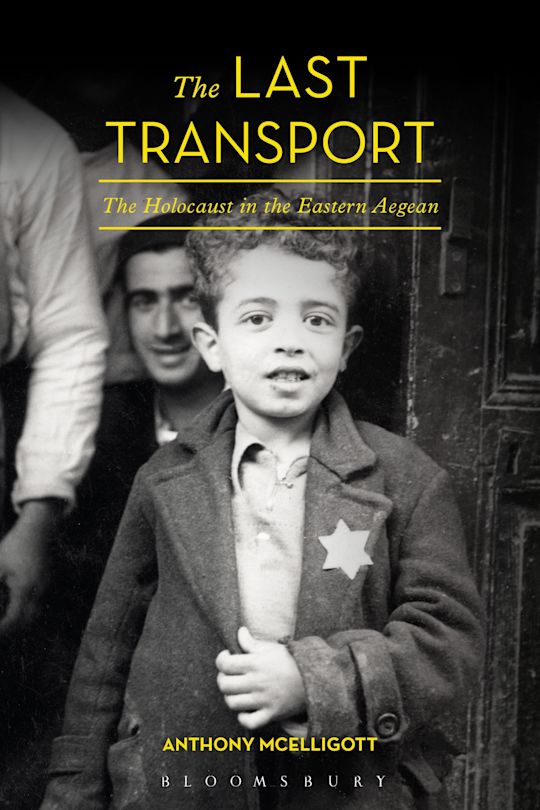
In July 1944, Nazi German forces deported the ca. 1800 Jews of Rhodes and Kos with the aid of the Italian authorities of the Dodecanese. Only about 200 (just above 10% of the 1939 population) survived the deportation to mainland Greece and then Auschwitz, the relocation to other concentration camps, and the hardship of post-war displacement and scarcity. The Last Transport by Anthony McElligott, a renowned scholar in German and Holocaust history, is the most thoroughly researched work on this historical rupture in the Aegean to date. The book is the result of more than a decade of research that started with the idea of retracing the identity and life of the young boy appearing on the book’s cover.1 Organized into a preface, nine chapters, and an epilogue, this book ambitiously ventures back into the history of Ottoman Rhodes (before 1912) and the subsequent Italian rule (before 1938). It also provides perspicuous discussions on the aftermath of the deportation by examining postwar trajectories and testimonies as well as memory practices observable until recent years. It is therefore part of an expanding scholarship in the long history of this community.2
Chapter 1 frames World War II and the Holocaust within the longer history of Rhodes and Kos. This section offers data and figures useful to grasp the Aegean setting in comparative European perspective and cogently illustrates that the decisive turn leading to the 1944 deportation was the adverse military situation for Nazi Germany in the Mediterranean in late 1943, which increased the strategic importance of the Ionian and Aegean islands. Chapters 2 and 3 change the approach by investigating everyday life in the Jewish neighborhood of Rhodes before the war. This section has the merit of questioning the idea of a secluded or harmonious community, analyzing their relations to non-Jewish “neighbors” and Italian authorities. The Italian police (the Carabinieri) files (acquired by the Greek State Archives in the early 2010s, used by a handful of historians, and in recent years much more difficult to access) are used to reconstruct experiences and the urban landscape destroyed by the Holocaust. Yet, Chapter 2 arguably the book’s weakest, often indulging in detailed, yet overall pointillist descriptions and anecdotes. Interesting as a prehistory of a catastrophe that precipitated from Italy’s Racial laws of 1938 onwards, this chapter points to intercommunal encounters. Yet, its scope does not allow for a real comparative analysis of the Greek, Muslim, and Catholic communities in Rhodes. Their multiethnic “shared world,” based on pragmatic coexistence, is only touched upon, a limit common to narratives focused on a single Ottoman or post-Ottoman community. On the contrary, Chapters 4 and 5 are the finest. When discussing the arrival of German troops in 1943 and the 1944 deportation, McElligott delivers a logically adamant and empirically fine-grained analysis. Interesting findings compared to existing literature are those about German commander Kleemann’s “cordial relations” (p. 127) with the Jews until the arrival of Adolf Eichmann’s trustee Anton Burger and his crew in early July 1944. Accordingly, the deportation was planned ahead of this date in Germany and Athens, not in Rhodes. Another important feature of these chapters is the actors-centered narrative. This also applies to the perpetrators (both the military and bureaucrats, in Rhodes as well as in the Haidari concentration camp) and, more rarely, those who attempted to save Jewish lives. Chapter 5 sheds new light on the Turkish consul Selahattin Ülkümen’s “rescue” of Jews claiming Turkish origins. McElligott demonstrates how wealth, rather than legal belonging, was determinant in the last-minute attempts to prevent the deportation of some dozen Jews. In Chapter 6, the book turns to life and death in Auschwitz and other camps. This is another brilliantly composed section, in which survival testimonies are orchestrated with historical rigor. The choral narrative connects individual accounts produced after the war. This is rewarding for the general reader as well as for the historian interested in the material reality of events narrated through memory. Worth highlighting is the use of sources from the ITS Arolsen Archives that allow us to follow transfers and to document death with accuracy. Chapter 7 turns back to Rhodes to address the confiscation, pillage, and seizure of Jewish property after the deportation. Discussing the archival sources of a sub-commission created ad hoc by the Italians in the wake of the deportation, McElligott argues that institutional confiscation aimed above all to secure law and order. Neither did the administration wish to protect Jewish property, nor to favor savage looting. The fate of Holocaust survivors is the main topic addressed in Chapter 8 through sources of the United Nations Relief and Rehabilitation Administration and the International Refugees Organization (after 1947). This chapter tackles complex and often arbitrary decisions affecting the survivors and their attempts at “cementing the bond of survival learned in the camps” (p. 256). Many were caught in bureaucratic anomalies, ambivalent legal belonging, and contradictory accounts of their journey to and from the camps. The last chapter describes how the trauma of the deportation reverberated in postwar testimonies and attempts to reconstruct a diasporic community. Its strength is the conceptual discussion of memory and silences between individual and collective experiences, arguing that “positing a binary between memory and history about the life of the Jewish community […] does not do full justice to the complexity of the past” (p. 290).
McElligott’s book can be commended for three main reasons. Firstly, it is the most valuable study on World War II (writ large) in the Aegean, especially due to the use of German sources. Secondly, the taste for local details coexists with an excellent composition of diverse sources from Rhodes, Germany, the UK, and international organizations. In this sense, it frames the Aegean islands as part of broader Mediterranean, European, and global history in accessible and captivating prose. The book will make the fate of the local Jews known to a wide readership but also encourage further studies on the Dodecanese. A third merit is the narrative’s human dimension. A wide range of actors whose emotions, decisions, beliefs, resources, luck, and misfortunes populate a vivid narrative. As the author states in the epilogue, the main objective of “seeking a greater alignment between archivally grounded lived experience and the memory of it” (p. 305) is masterfully achieved.
The book contains numerous geographic, phrasal, and historical inaccuracies; yet they do not primarily apply to the main events and protagonists.3 Although the book skillfully uses sources in Greek, German, English, French, Ladino, and Hebrew (translated), a further issue is the spelling mistakes, too frequent, alas, to be left unmentioned. This mostly applies to text in Italian such as place names, persons, institutions, and sources, especially in the endnotes, and risks reproducing mistakes when this book is cited, as will certainly happen frequently due to its value.4 This does not diminish the quality of the research and the analysis, but it is an editorial problem that most proficient readers cannot overlook. Those interested in the history of Rhodes and the Dodecanese, the Holocaust, World War II and its aftermath will nonetheless greatly appreciate this contribution crowning several years of impressively meticulous research.
[1] The author had already published a chapter on the topic in 2018: Anthony McElligott, “The Deportation of the Jews of Rhodes, 1944: An Integrated History,” in The Holocaust in Greece, eds. Giorgios Antoniou and A. Dirk Moses (Cambridge: Cambridge University Press, 2018), 58-86.
[2] Pierre Sintès, “(Re)construire la Djuderia de Rhodes,” Ethnologie Française 43, no. 1 (2013): 19-30; Andreas Guidi, “Defining Inter-Communality between Documents, Tradition and Collective Memory: Jewish and Non-Jewish Capital and Labor in Early Twentieth Century Rhodes,” Southeast European and Black Sea Studies 17, no. 2 (2017): 165-80; Aron Rodrigue, “The Rabbinical Seminary in Italian Rhodes, 1928-38: An Italian Fascist Project,” Jewish Social Studies 25, no. 1 (2019): 1-19; Marco Clementi, Storia della comunità ebraica di Rodi (1912-1947) (Roma: TAB, 2022); Dario Miccoli, “Tierra Prometida: Jews from Rhodes in the Belgian Congo and Southern Rhodesia, 1910s-1960s,” Jewish Historical Studies 55, no. 1 (2024): 152-75.
[3] To give a few examples: the Venetians never ruled over Rhodes or Kos, and the Genoese only occupied Kos (p. 9); the mention of Ankara as the center of Ottoman power in 1912 (p. 11); the camp of Ferramonti indicated as being in Sicily instead of Calabria (p. 129); the puzzling sentence “the inverse appearance of Abraham [instead of Moses!] leading the Jews to the Promised Land” (p. 151); the mention of a “Fascist Republican government of Rome” instead of Salò (p. 217); the Fossoli camp situated in the South of Italy whereas it is close to Modena (p. 253); Samos is erroneously included in the Dodecanese territory but not Castellorizo, Casos, and Patmos (p. 327).
[4] Among the most important ones: the mayor of Rhodes Antonio Macchi spelled as Macci, Vice-Governor Iginio Ugo Faralli spelled Farelli, the Metropolitan bishop spelled Apostolides (instead of Apostolos), the village of Peveragno spelled Pervegna, Cypress instead of Cyprus.
