


Introduction
The history of the Jewish community in Modena, a city in the Emilia-Romagna region of northern Italy, offers a revealing lens through which to explore central questions in contemporary Italian Jewish studies, particularly those related to emancipation, integration, and identity—issues that have generated a lively historiographical debate in recent decades.1 Despite this scholarly attention, the period between Jewish emancipation and the rise of Fascism remains relatively understudied.2 While the Jewish presence in Modena from the Middle Ages through the early modern period has been extensively studied, particularly in relation to the city's role as the capital of the Duchy of Modena and Reggio,3 Jewish communal life, and ghettoization under ducal rule,4 and has also been covered in publications aimed at a broader readership,5 the post-Unification era remains comparatively unexplored. Research has concentrated primarily on the Shoah and rescue networks,6 leaving a gap in understanding the transformations of the community during the liberal period, Fascism, and the postwar years.7 This essay presents the first results of a broader research project tracing the trajectory of Modena’s Jewish community from Unification to the end of the Second World War,8 focusing here on the period from 1861 to the early twentieth century. Adopting a multidimensional approach, it integrates economic, political, social, urban, and cultural perspectives to examine how individual and collective trajectories shaped the city’s fabric. It explores the role of Modena’s Jews in navigating post-Unification transformations while highlighting the tensions and contradictions of emancipation. Rather than a marginal exception, the Modenese case enriches our understanding of the broader transformations that shaped Italian Jewish life after Unification.
New Trajectories: Social and Economic Reconfigurations
Although a Jewish presence in Modena dates back to the late Middle Ages,9 it expanded considerably from the second half of the fourteenth century through the early modern period,10 eventually becoming a stable and deeply rooted component of the urban fabric. Even the imposition of segregation within the ghetto (1638-1859), located in one of the city’s most unhealthy districts, did not disrupt the community’s continuity or its ties to local economic and social networks.11 The contribution of Modena’s Jews to the Risorgimento was particularly notable,12 reinforcing their aspirations for participation and recognition within the broader society. The emancipation of Italian Jews was a slow and inconsistent process that redefined individual, family, and collective identities.13 After 1861, freed from legal segregation but not yet fully integrated, many Jews developed new forms of integration, balancing national belonging with the preservation of a distinct communal identity. In Modena, these transformations began with the political changes of 1859,14 when the city shifted from ducal capital to part of the emerging unified state and new local elites rose to prominence.15 Throughout this process, the municipality served as an institutional and political bridge between the Este administration and the Kingdom of Sardinia, later the Kingdom of Italy.16 On June 13, 1859, the city formally abolished the exceptional laws governing the Jewish population, declaring them “equal to other citizens.”17 By 1859, the economic and social conditions of Modena’s Jews had already improved, as shown by the growing number of property owners, merchants, and shop agents.18 The first moves outside the ghetto, involving primarily the wealthiest families, marked the beginning of an internal residential mobility,19 as, for instance, in Venice.20 From a comparative perspective, Modena’s experience combined broader continuities with other Italian Jewish communities and specific discontinuities that reveal its distinctive character. In Florence, for instance, the Jewish elite had achieved economic and social prominence before emancipation, with some families influential in finance and commerce.21 Rome offered a contrast: its largely poor Jewish population remained concentrated in modest commercial occupations until the end of the century.22 Milan differed: its relatively recent Jewish community developed a strong specialization in banking and finance, after Italian unification.23
Building on patterns observed in cities like Venice,24 Florence,25 Parma,26 and Reggio Emilia,27the extension of full citizenship in Modena quickly translated into participation in local political and social life. In the municipal elections of 18 September 1859, Israele Guastalla28 and Giacomo Sacerdoti were elected to the city council;29 Sacerdoti was subsequently appointed municipal councilor, and both were repeatedly re-elected in subsequent years, alongside Alessandro Castelfranco (1860).30 The figure of Israele Guastalla (1825-1880) is particularly emblematic of these transformations. Born to a family that had settled in the city in the early nineteenth century, Guastalla was an entrepreneur, businessman, and financier engaged in urban modernization, remembered by the press as one of the architects of national railway development.31 His trajectory—combining local rootedness with national engagement—illustrates the opportunities afforded by the post-unification period. The latter half of the nineteenth century was a period of urban transformation and gradual economic modernization in Modena,32 during which Jews helped reshape the city’s socioeconomic profile through civic and economic engagement. Additional Jewish representatives were elected to the city council in subsequent years—including Donato Fortunato Formiggini, Angelo Formiggini, Cesare Rovighi, and Leone Sacerdoti—while others became prominent in the city’s economic and social life. When the Modena branch of the National Bank was established in 1860, industrialist Moisé G. Diena joined its board of directors, while agricultural entrepreneurs Davide Nacmani and Moisé Sanguinetti served as auditors, together accounting for 30% of the board.33 By comparison, no Jews were appointed to the board of directors at its Milan headquarters.34 In 1863, merchant Moisé Urbini became vice president of the Modena Chamber of Commerce and later served as its president (1877-1885), while the industrialist Moisè Diena served as vice president.35 By century’s end, David Diena (1877) and Giuseppe Ravenna (1895-1900) had also served as presidents, making three of six chamber presidents Jewish.36 In 1866, the entrepreneur Carlo Sacerdoti founded the local Comizio Agrario [Agricultural Committee], later serving as its vice president and promoting agricultural innovation through its publications.37 Among its active members there was the winegrower Angelo Formiggini (1824-1875), whose commitment to the dissemination of agricultural knowledge is well attested in contemporary sources.38 He was among the promoters of the Società Enologica di Modena [Modena Wine Society], which brought together several of the figures discussed above, including Giacomo Sacerdoti, Israele Guastalla, and Davide Nacmani.39 A particularly significant development was the founding of the Società Operaia di Mutuo Soccorso [Mutual Aid Workers’ Society] in 1863, out of which the Banca Popolare di Modena [Modena People’s Bank] emerged in 1867,40 providing artisans, small merchants, and workers with greater access to credit and supporting their economic growth.41 Among the Società Operaia’s councilors was the accountant Momolo Coen (1828-1895), who was also a leading promoter of the bank and its second director until his death.42 Alongside Coen, Jews represented approximately 20 percent of the members of the founding committee.43 These developments marked a significant phase of Jewish civic, economic, and social engagement in Modena, following a trajectory comparable to that of nearby Reggio Emilia.44 Many of the figures mentioned above also helped found the Società del Casino di Modena [Modena Casino Society] (1862), an elite club reflecting the rise of the emerging bourgeoisie of landowners, professionals, and entrepreneurs. Jews represented 20% of the founding membership, highlighting their presence within this new urban elite.45
Unlike Florence46 and especially Milan,47 Modena’s Jewish elite was particularly distinguished by industrial and agricultural entrepreneurship, as in nearby Reggio Emilia.48 Key industrial sectors included silk spinning and leatherworking,49 represented by firms such as Moisé Diena’s steam-powered mill and the Guastalla and Nacmani tannery,50 as well as the production of luxury furniture and beds. In the agricultural sphere, Jewish entrepreneurs were active in dairy farming and cheese production, winemaking, sericulture, and cereal cultivation. As in many other Jewish communities, traditional artisanal, manufacturing, and commercial activities remained prominent, with many Modenese Jews engaged in commercial enterprises and retail shops registered under the Italian Commercial Code (1883).51 Between 1883 and 1889, about 30% of businesses were first registered in the names of Modenese Jews.52 These firms operated across diverse sectors, from iron and paper to manufactured goods, clothing, cereals, leatherworking, and banking. The register also records frequent dissolutions, reconstitutions, and corporate transformations, reflecting a highly adaptive and mobile economic environment. The Annuario d’Italia amministrativo e commerciale [Administrative and Commercial Yearbook of Italy] of 1889 provides further insight into the occupational profile of Modena’s Jewish population.53 Although accounting for approximately 2% of the city’s population, Jews were particularly represented in several key sectors, including textiles, leather, furniture, and finance, as shown in the following table:
| Sector | Jewish-Owned Businesses | Total Businesses | Share (%) |
| Currency Exchange Offices | 2 | 2 | 100,0 |
| Bankers | 4 | 5 | 80,0 |
| Leather Goods | 7 | 9 | 77,8 |
| Furniture Stores | 6 | 9 | 66,7 |
| Fabric Stores | 26 | 39 | 66,7 |
| Silk Mills | 1 | 3 | 33,3 |
| Fancy goods | 5 | 16 | 31,3 |
| Haberdashers | 3 | 7 | 42,8 |
| Delicatessens | 6 | 39 | 15,4 |
| Grocers | 2 | 27 | 7,4 |
| Attorneys | 27 | 60 | 11,7 |
The Annuario lists silk spinning, lithography, furniture and iron-bed production, and agricultural machinery, while recurring family names—Diena, Levi, Sacerdoti, Formiggini, Modena, Vigevani, Donati, Crema, Sanguinetti, Finzi, and Teglio—reveal diversified family businesses, often organized as “Brothers,” “Heirs,” or “Company.”54 The first commercial census (1911) recorded only 59 firms with Jewish surnames among 6,207 across the province (0.95%), a much smaller share than twenty-two years earlier.55 At this stage, this decline appears to reflect both changes in entrepreneurial patterns and the community’s sharp demographic contraction, discussed below. Finally, the Annuario reveals limited Jewish participation in public institutions, with only isolated cases in fiscal and judicial administration, the military, and education, science, and culture, unlike, for example, Florence.56 The Annuari della Regia Università di Modena [Yearbooks of the Royal University of Modena]also confirm this pattern, showing sporadic Jewish representation in academic appointments until the end of the century;57 only Pio Foà, a Milanese Jew and professor at the University of Modena, appears among the members of the prestigious Accademia di Scienze, Lettere e Arti [Academy of Sciences, Letters and Arts].58
Emancipation also brought new social, cultural, and institutional challenges, including demographic decline linked to mobility and the attraction of larger urban centers.59 In Modena, however, this trend emerged only after 1881;60 until then, it was offset by arrivals from smaller neighboring towns, including Scandiano (Reggio Emilia), Carpi, and Finale Emilia (Modena).61 National censuses confirm the decline: Modena’s Jewish population fell from 1,361 in 1871 to 405 in 1911. By contrast, Bologna grew from 229 Jews in 1861 to 492 in 1881,62 while Venice declined only in the early twentieth century63 and Florence and Milan followed divergent trajectories of growth. Despite new freedoms, the poorest Jews saw little improvement in living conditions. The enduring effects of segregation meant that poverty remained a persistent feature of community life.64 For many, the situation was so severe that, in both 1862 and 1863, the municipality of Modena provided financial assistance to indigent Jews.65 A survey conducted between 1895 and 1896 by Modenese professor Carlo Levi documented the precarious sanitary conditions of the poorest Jewish residents, while also highlighting an extensive network of assistance—including a charity committee, the Società dei padrini for postpartum women, a nursery, and regular distributions of food and aid from private donors—that provided tangible support to community members.66 This demonstrates the persistence of internal communal cohesion despite the new context and emerging challenges, as evidenced by the relatively small number of “mixed marriages”67 which were expected to become more common in the following years.
Urban Space as a Mirror of the Contradictory Emancipation of Modena’s Jews
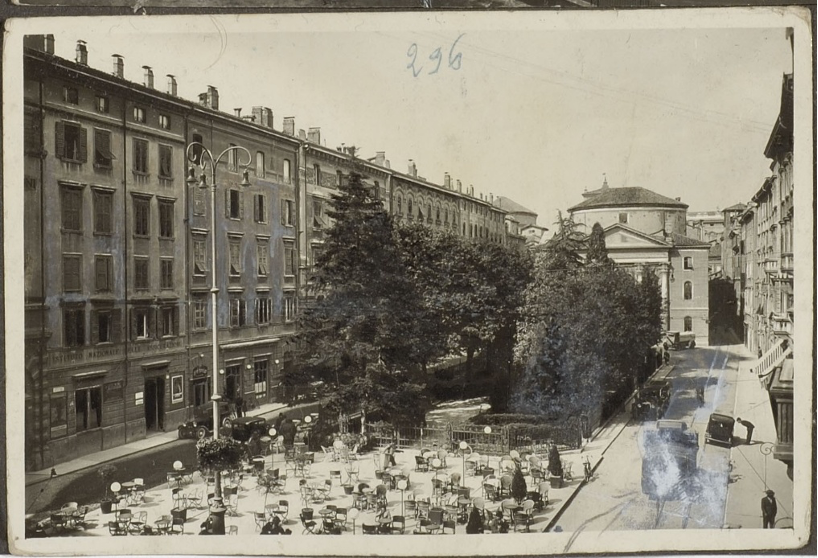
During the last three decades of the nineteenth century, monumental synagogues were built in major cities of northern and central Italy as expressions of Jewish emancipation.68 In Emilia-Romagna, this process had begun earlier, with the inauguration of new buildings or the renovation of existing ones in Soragna (1855), Reggio Emilia (1858), Carpi (1861), Parma (1866), and Bologna (1877).69 Inaugurated on 19 December 1873, the Modena synagogue70 was among the earliest post-emancipation Italian synagogues, distinguished by its prominent urban setting and, unlike earlier synagogues in the region, its purpose-built building with a monumental façade facing a major square. Designed by Ludovico Maglietta and decorated by Ferdinando Manzini, it was built in the former ghetto, whose urban fabric still shaped the cityscape.71 The Jewish community was actively involved in the project, which aimed to unify all spaces of study and worship72 while serving as a symbol of emancipation and public affirmation within the urban space. In his inaugural address, Salomone Jona, rabbi of Modena from 1870 to 1894, appealed to his coreligionists to support the construction of a building that would be “useful and glorious.”73 The project was financed through public appeals, subscriptions, and loans, with a decisive contribution from the wealthy Isacco Sacerdoti.74 Before construction was approved in 1864, the municipality had already begun demolishing surrounding buildings in 1861 to prepare the square.75 Built between 1869 and 1873, the synagogue drew local press attention and appeared in new historical-artistic city guide.76
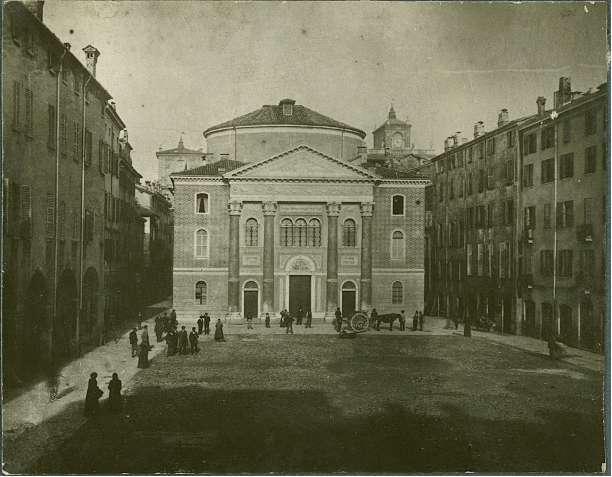
The inauguration ceremony was meticulously covered by the liberal daily Il Panaro,77 whose reporter described the interior as “a little theatrical, but elegant and harmonious,” emphasizing the respectful attention of the audience.78 Both Maglietta and Manzini were widely praised, and the Jewish University formally honored Ludovico Maglietta.79 The synagogue’s inauguration marked a milestone for the community and was widely covered by the Jewish press, which followed its civic and religious ceremonies.80 It was not merely the opening of a new Jewish “place,” but symbolically transformed the area of former segregation into a visible “space” of Jewish integration and presence within the city.81 Over the course of a few years, the entire area developed into a central urban space, also serving as a site of interaction and negotiation with the broader, non-Jewish society and local institutions.82 To mark the occasion, a booklet was published containing an Italian translation of Psalm XXX and a hymn composed by Modenese lawyer Pacifico Levi.83 The president, David Diena, also involved the poet Giovanni Vecchi from Scandiano, who, despite being absent from the ceremony, dedicated several compositions to the event.84 The volume also included texts by Luigi Vaccà, rector of the University of Modena, and Eleonora Reggianini, a prominent figure in the cultural Risorgimento landscape. Although beyond the scope of this essay, these texts show that the participation of prominent non-Jewish figures representing local patriotic culture gave the ceremony a strong civic dimension alongside its religious significance.85 The synagogue embodied Jewish integration within the urban and civic context, a narrative later reinforced by Modena’s new rabbi, Giuseppe Cammeo, who in 1894 urged community members to love their homeland, obey state laws, remain attached to Modena, and remain loyal to the monarchy.86 The evolution of Modena’s “Jewish space” can be interpreted in light of recent contributions regarding the “spatial turn,” which understand space as a social product, a site of symbolic layering, and a field of identity negotiation.87 The construction of the monumental synagogue and the surrounding initial renovations was therefore not solely architectural or urbanistic but constituted a mechanism through which the community once again had its place within the cityscape.88 Nevertheless, the former ghetto remained one of the city’s most unhealthy areas for years, as attested by contemporary reports, photographs, and later memoirs.89

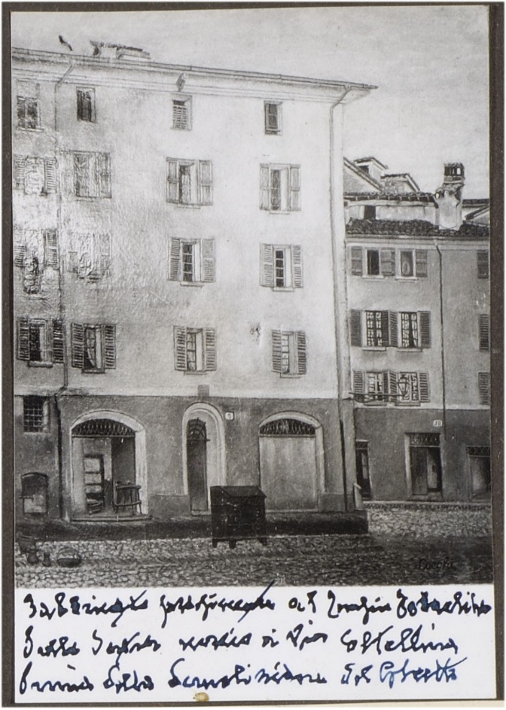
Only new urban interventions, culminating between 1889 and 1906 with the demolition of the entire block, transformed its appearance. The municipal council only gave final approval for the demolitions at the end of 1902,90 with the removal of buildings around the synagogue carried out between 1904 and 1905.91
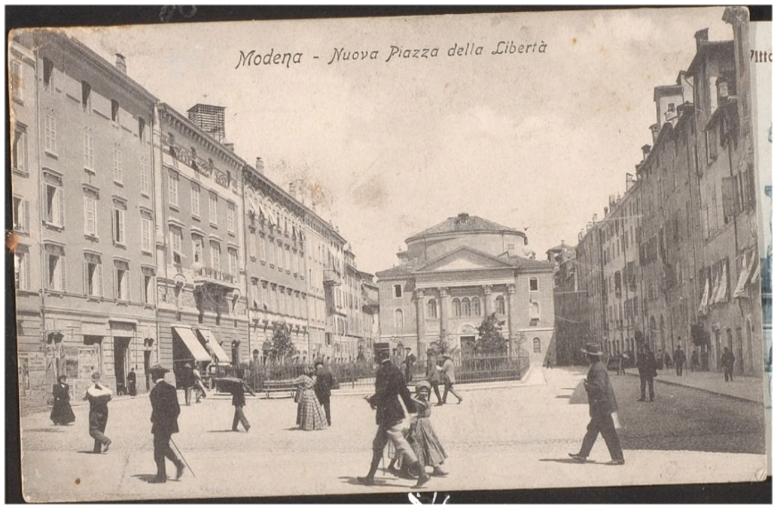
The dismantling of Modena’s ghetto formed part of a broader national process of urban renewal, although Italian cities followed different trajectories: Florence, Mantua and, later, Verona largely demolished their former ghettos;92 Venice, Ferrara, and Bologna preserved substantial portions of them,93 while Rome represented an intermediate case, combining urban demolition and transformation with symbolic continuity.94 The Modena project provoked disputes even among Jewish citizens affected by expropriations,95 as was the case with the Sanguinetti School96 or buildings owned by Michele Sacerdoti, against whom the municipality pursued legal action.97 Institutional debates and local press coverage reveal that the area’s recovery was guided primarily by aesthetic and functional criteria. The Jewish community was largely excluded, resulting in a radical transformation of the square and of Jewish space, which became increasingly invisible and unmarked. A telling example is councilor Setti’s proposal to demolish the synagogue to create a single avenue leading to the Ducal Palace.98 Within a few years, the former “Piazzetta degli Ebrei” [Jews’ Little Square] was renamed “Piazza delle Libertà” [Freedom Square] and later “Piazza Giuseppe Mazzini” [Giuseppe Mazzini Square]. The square was entirely rebuilt in line with Liberty-style principles,99 featuring an English-style courtyard in front of the synagogue, and in 1933 it saw the inauguration of the Albergo Diurno (an underground public bath and service facility),100 which gave the square a commercial and social character that continues to this day.
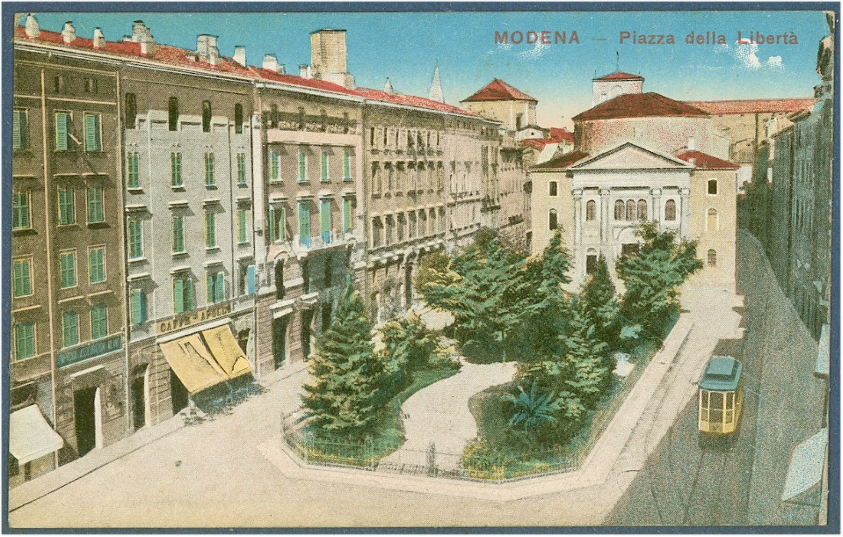
In subsequent decades, landscaping interventions—such as the thickening of vegetation to screen the synagogue façade—further contributed to the “neutralization” of this former Jewish space. Modena’s urban space was thus both a stage for Jewish emancipation and an expression of its ambivalence, with the synagogue as the city’s sole enduring marker of Jewish memory.101
Emancipation: Tensions and Contradictions
Between 1859 and 1860, while emancipation opened new avenues for integration, the controversial conversion and subsequent flight of a fourteen-year-old Jewish girl from Modena revealed the persistence of longstanding tensions. Between 1814 and the end of 1859, at least eighty-six Jews from Modena converted to Catholicism—a remarkably high number, mostly composed of young people likely motivated by prospects of social advancement.102 This phenomenon followed a long history of forced baptisms and seemingly “voluntary” conversions in the Modena (and Estense) area during the modern era, continuing into subsequent decades.103 In December 1859, the fourteen-year-old Jewish girl Benedetta Formiggini announced her intention to convert to Catholicism.104 Apparently determined in her choice, she fled from the home of a fellow community member, where she worked as a maid, and—mediated by the Catholic woman Clotilde Boschi-Benassati—went to the Educandato di San Paolo (a girls’ boarding school). Initially, her father, assisted by representatives of the Jewish community, managed to bring her home, but the case ultimately reached the courts. The Modena judiciary had to determine whether Benedetta Formiggini’s decision was truly voluntary or influenced, and thus whether the minor possessed the capacity to act with free will. Despite formal legal equality for Jews, for the Modena Tribunal, the Formiggini case had to be addressed according to the still-applicable Este Codes105 which stipulated that at that age, a person was sufficiently mature to understand and freely guide their moral actions.106 In an 1860 ruling, Giovanni Bertolucci, president of the Modena tribunal, judged that the girl was capable of independent decision-making; he ordered her legal separation from her family, placed her in the care of a Catholic household, and imposed child support payments on her father.107 Benedetta was eventually baptized under the new name Carolina Coratti.108 In the following years, the number of conversions in Modena gradually declined,109 but in 1879, even a final attempt at forced baptism was thwarted.110
Between 1874 and 1878, the Modena community and public opinion were shaken by another contested legal case. In 1866, a newborn child later registered as Enrichetta Maria Luigia Peri was abandoned in the “foundling wheel” in Carpi (Modena) and placed in the local orphanage, run by the Congregazione di Carità [Congregation of Charity].111 In January 1871, two Jews from Carpi, Buonaiuto Teglio and Speranza Giggia Levi, married and soon declared before the civil authorities that they recognized Enrichetta, by then four years old, as their natural daughter.112 She had been abandoned at birth because the couple could not care for her; after their marriage, they requested her return and legitimization. Although recognized as their natural daughter, she became the subject of a protracted legal battle with the Congregazione di Carità, which had baptized her and raised her as a Catholic. On 7 February 1874, the Modena civil court initially ruled in favor of the parents’ request to regain custody. However, on December 20 of the same year, the president of Modena’s Court of Appeal overturned the decision, allowing the Congregation to not return the child.113 The case sparked heated debate in local newspapers Il Panaro and Il Diritto Cattolico, with Il Panaro siding with the parents and comparing the case to the Mortara affair,114 while Il Diritto Cattolico condemned the ruling as “regrettable.”115 The Catholic newspaper warned the family and their lawyers: “If nothing else, the famous Mortara case should have convinced them, if they ever doubted, of this Catholic dogma, which admits no contestation.”116 Moreover, being Jewish, the Teglio-Levi family was considered “entirely hostile to the faith of the little Christian, with an evident risk of apostasy.”117 On 11 December 1875, the civil court of Modena again granted the Teglio-Levi family’s petition, a ruling confirmed by the Court of Appeal on 2 June 1876. The decision ordered that the child be returned to her parents while reserving her right to a guardian to protect her interests, particularly in light of the family’s religious differences. The couple accepted the ruling insofar as it favored them but appealed to the Court of Cassation over the appointment of the guardian. Meanwhile, the Congregazione di Carità refused to hand over the child, and a subsequent ruling on 10 July 1876, ordered that she remain in the orphanage.118 The Teglio-Levi couple petitioned the president of the Court of Appeal of Modena, with the support of the public prosecutor, but their appeal was denied on 9 September 1876. Subsequent requests to revoke the July 10 order were rejected on 16 January and 13 July 1877.119 On 21 August 1877, the public prosecutor brought the case before the Court of Cassation, challenging the earlier rulings and contesting both the legitimacy of the guardian appointed by the Congregation—by then lacking authority over the child—and the decision to remove her on the grounds of religious difference. The parents likewise appealed, alleging abuse of authority and legal errors concerning guardianship, parental rights, and religion.120 The case highlights the gap between formal legal emancipation and the persistence of prejudice in post-unification Italy. Although full parental authority was formally recognized, the court showed caution regarding the child’s return to a Jewish family, expressing concern about possible religious influence. The appointment of a guardian as a form of “preventive” protection reflects this approach, unlikely in a Catholic family context. While the Court of Cassation affirmed that religious difference could not justify the child’s removal, the case—as well as the contemporary press debate—shows how religious sensitivities shaped the practical application of civil rights, revealing subtle forms of anti-Jewish prejudice. The dispute continued for several months, with multiple appeals, judicial reversals, and interventions by the public prosecutor.121 Ultimately, in 1878, the Court of Cassation confirmed the Court of Appeal’s decision, ordering that the child be returned to her parents while preserving her right to be represented by a guardian to protect her interests.122 Nevertheless, partly for family reasons, the girl did not return to her parents but went to live in Livorno with a Jewish family.123
Between 1902 and 1903, the newspaper Il Panaro sparked another controversy, accusing the municipal administration of bias against Jewish religion teachers in elementary schools. The controversy began on 7 June 1901, when the city council announced a competition to fill vacancies in rural girls’ schools.124 The resolution authorized the administration to appoint teachers to positions becoming available during the year, without new examinations, selecting from the merit ranking established by the examining commission and comprising already qualified candidates.125 Thirty-nine individuals applied.126 On 30 August 1901, the executive board recommended that the city council appoint three teachers who were the highest-ranked candidates, noting that all were fully eligible.127 The matter resurfaced the following year. In June 1902, faced with new vacancies in the elementary schools, the board proposed the appointment of eleven teachers. The council selected them from among the top twenty-six candidates but, surprisingly, excluded Marta Teglio, who had ranked eleventh, instead appointing Giuseppina Muzzioli despite Teglio’s superior qualifications.128 The episode sparked fresh controversy and raised questions about the transparency and fairness of the appointments, casting a shadow over the administrative procedures of the time. The controversy escalated in the pages of Il Panaro. On 30 May 1903, the paper claimed that the administration was unwilling to appoint “Israelite teachers” because, as it reported, “In the countryside, our clerical-moderates say, the population does not tolerate Jewish women teachers.”129 The case concluded on 10 November 1903, when the provincial superintendent of schools confirmed Marta Teglio’s appointment as a municipal teacher in a rural girls’ school. The ruling formally closed the matter but revealed the social and religious tensions of the period. Personal memoirs reflect similar experiences of everyday prejudice.130 Modenese lawyer Enzo Levi (1889-1947), father of journalist Arrigo Levi, recalled enduring the label “Jew” as an insult in his youth: “How much bitterness, how much sorrow in my early years, over the inexplicable hostility directed against me and mine, simply because we were Jews.”131 This episode represents yet another example of the tensions—and at times open hostility—that Modenese Jews experienced during the years of emancipation.
Zionism and Jewish Mobilization in Modena
At the turn of the twentieth century, Modena’s Jewish community emerged as a true laboratory of Italian zionism, a hub of cultural and political experimentation. The year 1897 marked a turning point for European Jewry: the First Zionist Congress in Basel affirmed political zionism as an organized national project, destined to influence debates over identity and internal dynamics within Jewish communities.132 In Italy, the movement developed somewhat later in terms of mobilization and emigration,133 but it quickly emerged as a cultural force.134 After the Second Zionist Congress (1898), Zionist societies were established in Ferrara, Padua, Venice, and Turin,135 but the event of greatest significance for Italian zionism followed the Third Basel Congress (1899).136 In Modena, a city whose Jewish population was gradually declining, the twenty-one-year-old Amedeo Donati founded the Associazione Sionistica Modenese [Zionist Association of Modena] in 1900. With roughly one hundred members,137 the association became a center of cultural and political development, connecting with similar societies in Ferrara and Bologna, and anticipating the formation of the Italian Zionist Federation. After its statutes were approved, the Modenese Zionist Association was inaugurated on 25 March 1900, with a major event featuring speeches by Carlo Alberto Conigliani, Felice Ravenna—representing the Ferrara group and the Central Committee of Vienna and Basel—and the Modenese lawyer Amleto Sacerdoti. Conigliani emphasized the fight against antisemitism and solidarity among co-religionists. In an international context marked by profound inequalities, he argued that emancipated Jews had a duty to support the “weak,” preparing “salvation” for them and offering an “asylum,” while for the privileged, “emigration would be a reckless and useless sacrifice.” The association’s goals were articulated as the “Jewish colonization and the emancipation of the Israelite proletariat,” alongside “mutual defense and social education of Jews” and the struggle against antisemitism.138 Sacerdoti, while recognizing the necessity of providing a “safe haven” for persecuted Jews, insisted that in emancipated countries, zionism should primarily promote “mutual assistance and defense among co-religionists,” not separation from Christians, but to “improve ourselves” and contribute to the progress of civilization. For him, zionism represented a form of moral regeneration capable of strengthening a community weakened by centuries of segregation and countering antisemitism—a vision that reinterpreted the idea of regeneration “in a modern and secular key.”139 Beginning in 1901, the journal L’Idea Sionista was published in Modena.140 Founded by Carlo Conigliani, the periodical aimed to be “a publication dedicated to the propaganda and elaboration of Zionist ideals.”141 Its contents addressed Zionism, Jewish conditions in Europe, Palestine and beyond, poverty, antisemitism, and cultural, literary, and historical-religious issues. Despite financial difficulties, the journal was recognized by other Italian Zionist groups and testified to the cultural and political dynamism of, above all, the local community. On 20 October 1901, Modena hosted what the Italian Zionist press described as the second Italian Zionist Conference, attended by representatives from Ferrara, Modena, Milan, Ancona, Vercelli, and Naples.142 L’Idea Sionista provided a detailed chronicle of the event.143 Once again, the focus was on combating antisemitism and fostering solidarity among co-religionists, while also addressing Zionist propaganda and defining the movement’s goals: strengthening the Italian Zionist Federation, supporting the Central Committee in Vienna, cultivating solidarity and moral-intellectual growth among Jews, and promoting zionism across Italy.144 A resolution by Felice Ravenna reaffirmed the “perfect compatibility of the Zionist idea” with loyalty to Italy, stating that zionism’s “sole purpose” was to secure civil and political rights for Jews denied them in their countries of residence through “systematic colonization in Palestine.”145 At the third Zionist Congress in Ferrara, opened in his memory, Modena was represented by Giulio Foà.146 Carlo Conigliani, the driving force behind the Modenese group, died on December 6, 1901, two months after the conference, deeply affecting local Zionists. Two years later, reports of the Kishinev pogrom shocked the Jewish community of Modena.147 In 1903, L’Idea Sionista devoted significant space to documenting the violence in Bessarabia and stood in defense of persecuted co-religionists in the Russian Empire.148 Subsequently, a local support committee was established to aid the victims of the pogrom and Modena’s Jews organized public fundraising efforts and enlisted the assistance of Il Panaro to disseminate appeals.149 While many contributors came from within the Jewish community and Zionist circles, the response demonstrated widespread engagement.150 In subsequent years, the youth group “Carlo Conigliani” sustained zionism in Modena until the late 1920s, when its statutes were revised to admit non-Jews. The previously mentioned Enzo Levi recalled in his memoirs: “between 1910 and the onset of the antisemitic campaign in Italy, my attachment to Judaism grew… and I became increasingly convinced of the necessity of Zionism.”151 In an international and local context, marked—albeit differently—by social tensions and the legacies of emancipation, Zionism offered part of the Modenese Jewish community a new language through which to rethink belonging, identity, and collective responsibility.
Conclusion
Jewish “modernity” in Modena took shape as an unstable balance between integration and dispersion, belonging and redefinition. Emancipation opened new possibilities for citizenship, civil rights, and public participation, allowing Modena’s Jews to become active protagonists in the city’s transformation. Through entrepreneurial, industrial, and financial initiatives, many contributed to the economic modernization of post-Unification Modena, participating in new institutions, commercial networks, and civic engagement that connected local rootedness with broader national development. Despite demographic decline, the Jewish presence in Modena retained high civic and economic visibility, with participation in municipal institutions and entrepreneurial networks that exceeded its numerical weight. At the same time, emancipation created new vulnerabilities: demographic decline, territorial dispersion, and the weakening of traditional communal structures required new ways of articulating Jewish belonging. The construction of the new synagogue and its role within the urban landscape represented an effort to assert Jewish visibility and collective identity within the framework of civic integration. Yet persistent social prejudice, institutional tensions, and episodes of discrimination revealed the distance between formal equality and everyday experience. For some members of the community, zionism emerged not as a rejection of Italian citizenship, but as a new language of Jewish self-definition, solidarity, and collective responsibility, linking local experiences to broader European Jewish debates. The Modena case demonstrates that Jewish emancipation was never a linear process of assimilation or integration, but a continuous negotiation between participation and distinctiveness, inclusion and exclusion, national belonging and transnational Jewish consciousness. By examining economic transformations, urban spaces, and identity formations together, this study highlights the complex trajectories through which Italian Jews navigated the decades between Unification and the fin de siècle, showing that minority integration involved not only legal recognition or cultural adaptation, but also active participation in the social, economic, and symbolic construction of the modern city. The Modena case thus shows that Jewish communities in post-Unification Italy did not simply enter modernity; they actively shaped its meanings and forms.
[1] Guri Schwarz, “A proposito di una vivace stagione storiografica: letture dell’emancipazione ebraica negli ultimi vent’anni,” Memoria e Ricerca 19 (2005): 159-174; Ester Capuzzo, Gli ebrei italiani dal Risorgimento alla scelta sionista, (Florence: Le Monnier, 2004); Anna Foa, “Il mito dell’assimilazione. La storiografia sull’emancipazione ebraica negli ultimi vent’anni,” in “Ebrei e nazione. Comportamenti e rappresentazioni nell’età dell’emancipazione," eds. Carlotta Ferrara Degli Uberti and Daniele Menozzi, Storia e problemi contemporanei 20, no. 45 (2007): 17-30; Susan Zuccotti, “Italian Jews in Public Life, 1848-1922,” Studia Judaica 15 (2007): 82-90; Carlotta Ferrara degli Uberti, Making Italian Jews: Family, Gender, Religion and the Nation, 1861-1918 (London: Palgrave Macmillan, 2017), originally published as Fare gli ebrei italiani. Autorappresentazioni di una minoranza (1861-1918) (Bologna: Il Mulino, 2011); Marina Beer and Anna Foà, eds., Ebrei, minoranze, Risorgimento: storia, cultura, letteratura (Rome: Viella, 2013).
[2] For a general overview see: Elisabeth Schächter, The Jews of Italy, 1848-1915: Between Tradition and Transformation (London-Portland: Vallentine Mitchell, 2010); Cristina M. Bettin, Italian Jews from Emancipation to Racial Laws (Basingstoke: Palgrave Macmillan, 2010); Shira Klein, Italy’s Jews from Emancipation to Fascism (Cambridge: Cambridge University Press, 2018); and Michele Sarfatti, Gli ebrei nell’Italia fascista: Vicende, identità, persecuzione, definitive ed. (Turin: Einaudi, 2018), chaps. 1-2. An earlier English translation of a previous edition appeared as Michele Sarfatti, The Jews in Mussolini’s Italy: From Equality to Persecution (Madison: University of Wisconsin Press, 2006).
[3] The Duchy of Modena and Reggio was a pre-Unification Italian state ruled by the Este dynasty from 1452 to 1859. The Este family, a ruling house of medieval origin that governed Ferrara and other territories in northern Italy, established Modena as the capital of the duchy in 1598, following the incorporation of Ferrara into the Papal States. The Duchy became part of the Kingdom of Italy in 1859. For a general overview of the Este dynasty, see Luciano Chiappini, Gli Estensi. Mille anni di storia (Ferrara: Corbo, 2001).
[4] For recent studies, see: Federica Francesconi, Invisible Enlighteners: The Jewish Merchants of Modena, from the Renaissance to the Emancipation (Philadelphia: University of Pennsylvania Press, 2021); Diletta Biagini, Le confraternite della comunità ebraica di Modena (Florence: Giuntina, 2022). Among earlier studies, see: Andrea Balletti, Gli Ebrei e gli Estensi (Reggio Emilia: Anonima Poligrafica Emiliana, 1930); Geminiano Benatti, Presenza ebraica nel ducato di Modena (Modena: Lions Club, 1984); Franco Bonilauri and Vincenza Maugeri, eds., Le comunità ebraiche a Modena e Carpi (Florence: Giuntina, 1999); Diego Fulvio Papouchado, Un viaggio in un ghetto emiliano (Modena: Terra e Identità, 2007).
[5] Clara Ghelfi and Orianna Baracchi, La comunità ebraica a Modena (Modena: Comune di Modena, 1995); Luisa Modena, Il dialetto del ghetto di Modena e dintorni (Modena: Il Fiorino, 2001); Paolo Battaglia and Federica Francesconi, eds., Gli ebrei e la città (Modena: Fondazione Cassa di Risparmio di Modena, 2002); Elissa Bemporad and Federica Francesconi, eds., L’ebraismo e l’arte, gli argenti sinagogali (Modena: Comunità Ebraica di Modena e Reggio-Fondazione Cassa di Risparmio di Modena, 2003); Itinerari ebraici nelle province di Modena e Reggio Emilia (Modena: Quid-Comunità Ebraica di Modena e Reggio Emilia, 2006); Federica Francesconi and Luisa Levi D’Ancona, eds., Vita e società ebraica di Modena e Reggio Emilia. L’età dei ghetti (Carpi: Comunità Ebraica di Modena e Reggio Emilia, 2007); Luisa Modena, Il Ghetto e la Sinagoga di Modena (Modena: Guiglia Editore, 2007); Marta Affricano, Tra Naviglio e Panaro, la presenza ebraica nel territorio a nord di Modena (Modena: Guiglia Editore, 2012).
[6] Gianfranco Scaglioni, “Breve ricognizione storica sulle vicende degli ebrei modenesi e degli ebrei presenti nel modenese tra il 1938 e il 1945,” Rassegna di storia dell’Istituto storico della Resistenza in Modena e provincia 9, no. 8 (1989): 113-125; Walter Braccati, La persecuzione antiebraica nel modenese e nell’Alta valle del Reno (Bologna), 1943-1945 (Bologna: Edizioni Il Fiorino, 2008); Elena Carano, Persecuzione, deportazione, solidarietà: la comunità ebraica modenese nella seconda guerra mondiale (Modena: Edizioni Artestampa, 2009); Giulia Dodi, Nessun gesto di pietà: la requisizione dei beni ebraici in area modenese dal 1938 al 1945 (Modena: Bonomo, 2016); Carmine Piscitelli and Giulia Dodi, Francesco Vecchione, la normalità e il coraggio: l’uomo di stato che salvò gli ebrei modenesi, 1943-1944 (Naples: Giuntina, 2023);Enrico Ferri, Il sorriso dei ribelli (Florence: Giuntina, 2013); Fabio Montella, Speriamo in giorni migliori (Florence: Giuntina, 2023).
[7] Papouchado, Viaggio in un ghetto emiliano, 174-192; Fabio Montella, “Squadrismo, comunità ebraica e spazi urbani: il caso della città di Modena,” Storia Urbana 172 (2023): 107-134.
[8] For a more detailed discussion, see Federica Di Padova, “Gli ebrei a Modena. Emancipazione, persecuzione, ricostruzione (1861-1948),” in Nuove prospettive degli studi ebraici in Italia: La Fondazione CDEC e la nuova generazione di studiosi e studiose in dialogo. Atti della IV settimana internazionale di studi sull’ebraismo italiano, eds. Giordano Bottecchia, Angela Cimino, and Riccardo Abram Correggia (Milan: Fondazione Centro di Documentazione Ebraica Contemporanea, 2026), 16-20.
[9] Papouchado, Viaggio in un ghetto, 9-13; Francesco Valdrighi, Dizionario etimologico delle contrade e spazi pubblici di Modena (Modena: Andrea Rossi, 1880), 99-102.
[10] Antonella Campanini, “Tracce documentarie della presenza ebraica a Modena,” in Le comunità ebraiche a Modena e a Carpi, eds. Bonilauri and Maugeri.
[11] Donatella Calabi, “Dal quartiere ebraico alla costruzione del ghetto in Italia: il caso di Modena,”Ibid., 87-93; see also Francesconi, Invisible Enlighteners 52 and following.
[12] Papouchado, Viaggio in un ghetto emiliano, 154-167; Federica Francesconi, “From Ghetto to Emancipation: The Role of Moisè Formiggini,” Jewish History 24 (2010): 331-354; Gabriele Fabbrici, “Il contributo degli ebrei ‘estensi’ alla nascita dello Stato unitario,” in Gli ebrei italiani dai vecchi stati all'unità: atti del Convegno, 9 November 2011, Museo Ebraico di Bologna, eds. Franco Bonilauri and Vincenza Maugeri (Florence: Giuntina, 2014), 134 and following.
[13] Ferrara degli Uberti, Making Italian Jews, 13 and following.
[14] Paolo Golinelli and Giuliano Muzzioli, eds., Storia illustrata di Modena (Milan: Nuova Editoriale Aiep, 1991), 801-854; Giuliano Muzzioli, Modena (Rome-Bari: Laterza, 1994), 3-14.
[15] Roberto Cea, La città dei Notabili: Società e gruppi dirigenti a Modena dopo l’Unità (1859-1882) (Bologna: Bononia University Press, 2016).
[16] Marco Cattini, ed., Al governo del comune. Tremilacinquecento modenesi per la comunità locale dal XV secolo ad oggi, Quaderni dell’Archivio Storico (Modena: Archivio Storico del Comune di Modena, 1996), 112-117.
[17] Ghelfi and Baracchi, La comunità ebraica di Modena, 47.
[18] Ines Miriam Marach, “Demografia e composizione familiare nella Comunità di Modena,” in Le comunità ebraiche a Modena e a Carpi, ed. Bonilauri and Maugeri, 178-179.
[19] Ibid., 182.
[20] Simon Levis Sullam, Una comunità immaginata. Gli ebrei a Venezia (1900-1938) (Milan: Unicopli, 2017), 58.
[21] Barbara Armani, Il confine invisibile: l’élite ebraica di Firenze (Milan: FrancoAngeli, 2006), 115-168.
[22] Stefano Caviglia, L’identità salvata. Gli ebrei di Roma tra fede e nazione (1870-1938) (Rome-Bari: Laterza, 1996), 12 and following.
[23] Rony Hamaui, Ebrei a Milano: due secoli di storia fra integrazione e discriminazioni (Bologna: Il Mulino, 2016).
[24] Levis Sullam, Una comunità immaginata, 66-72; Donatella Calabi, Venezia e il Ghetto. Cinquecento anni del «recinto degli ebrei» (Turin: Bollati Boringhieri, 2024), chap. 8.
[25] Armani, Il confine invisibile, 333-335.
[26] Lucia Masotti, “Dopo l’emancipazione. Visibilità e invisibilità degli ebrei a Parma nella vita cittadina,” in Ebrei a Parma: visibilità e invisibilità degli ebrei nella vita cittadina, ed. Lucia Masotti (Parma: Associazione Italiana Amici dell’Università di Gerusalemme, 2005), 77-80.
[27] Alberto Ferraboschi, “L’eredità del ghetto. Gli ebrei a Reggio Emilia nell’Ottocento,” L’Almanacco 50 (2007): 77.
[28] For a portrait of Israele Guastalla and his family, see: “Adeodato Malatesta, La famiglia Guastalla, olio su tela, 1869,” Il Palazzo comunale di Modea, accessed August 11, 2026, https://salestoriche.unesco.modena.it/sala-di-rappresentanza/la-famiglia-guastalla/.
[29] For the history of these distinguished families, see: Benvenuto Donati, Genealogia della famiglia Guastalla di Modena, con note illustrative (Modena: Tipografia Ferraguti, 1942),and the entries “Guastalla” and “Sacerdoti” inBenatti, Presenza ebraica. All the names of the elected city council members are taken from: “Appendice documentaria: elenco sistematico dei consiglieri del Comune di Modena dal 1412 al 1995,” in Al governo del comune, ed. Cattini, 255-298.
[30] In the absence of reliable alternative criteria for identifying Jews active in the city's various spheres, this study adopts the onomastic criterion as a heuristic tool, while acknowledging its limitations and the risk of both omissions and ambiguous attributions. For a methodological discussion of this approach see Maida, Dal Ghetto alla città, 21-22.
[31] Donati, Genealogia della famiglia Guastalla di Modena, 9-22.
[32] Muzzioli, Modena, 81-99. For a general overview of Modena in the 19th and 20th centuries, see: Giordano Bertuzzi, Il rinnovamento edilizio a Modena nella prima metà dell’Ottocento (Modena: Aedes Muratoriana, 1987).
[33] Annuario del Ministero di agricoltura, industria e commercio del Regno d'Italia, vol. 1 (Turin: E. Dalmazzo, 1863), 638.
[34] Germano Maifreda, Gli ebrei e l’economia milanese (Milan: Franco Angeli, 2000), 175-176.
[35] Annuario del Ministero (1863), 538.
[36] Dizionario biografico dei presidenti delle Camere di commercio italiane, 1862-1944, vol. 2 (Soveria Mannelli: Rubbettino, 2005), 221-225.
[37] On Carlo Sacerdoti and his role as founder of Modena’s agricultural institutions, see: Golinelli and Muzzioli, Storia illustrata di Modena, 809.
[38] See his numerous articles published in the Bollettino del Comizio agrario di Modena and his pamphlets on the subject, including Escursioni di viticoltura nel bolognese (Modena: Tipografia sociale, 1872). See: Biblioteca Estense Universitaria, Archivio Familiare Formiggini, b. 9, file 180.
[39] Relazione della Società Enologica di Modena per Angelo Formiggini (Modena: Tip. Sociale-Palazzo Orlandi, 1870), 15-20. Formiggini published innovative studies on agriculture and developed a new winemaking technique known as the “Formiggini process.”
[40] Paolo Battaglia, ed., 150 anni di valori: Storia illustrata di BPER Banca (Modena: Artioli Editore 1899, 2017).
[41] Graziella Martinelli and Giorgio Montecchi, eds., La società operaia di mutuo soccorso di Modena (Modena: Edizioni Artestampa, 2014).
[42] Mariella Ferrari and Francesco Zaffe, eds., La società operaia di mutuo soccorso di Modena (1863-1883) (Modena: Società operaia di mutuo soccorso, 2003), 37.
[43] Battaglia, ed., 150 anni di valori, 30-33.
[44] Ferraboschi, L’eredità del ghetto, 38-39.
[45] For the list of founding members, see the appendix in Licia Beggi Miani, Dal nobile Casino dei cavalieri alla Società del Casino (Modena: Guiglia Editore, 2004); Armani, Il confine invisibile, 321 and following.
[46] Armani, Il confine invisibile, 117.
[47] Maifreda, Gli ebrei nell’economia milanese, 116-132.
[48] Ferraboschi, L’eredità del ghetto, 35-39.
[49] In Modena, the Conceria pellami fuori Porta Castello (the Modena tannery located outside the Castello city gate) was active as early as 1664; see: Benvenuto Donati, La conceria pellami di Modena fuori Porta Castello nella sua storia più volte secolare (Modena: Società Tipografica Modenese, 1945), 17.
[50] Relazione generale della Camera di commercio, arti e industrie di Modena: a S.E. il Ministro d’Agricoltura e Commercio per il biennio 1863-64 (Modena: Camera di Commercio e Industria-Nicola Zanichelli, 1865), 10, 14.
[51] Tribunale di Modena fonds, Registro delle trascrizioni delle società (Register of Transcriptions of Commercial Companies), vol. 1 (1883-1890) and vol. 2, State Archives of Modena (ASMo).
[52] This percentage was calculated by the author from a consultation of the above-mentioned register.
[53] Annuario d'Italia amministrativo-commerciale (Genoa: Annuario d'Italia, 1889), 1354-1368.
[54] See also: Tribunale di Modena fonds, Registri d’ordine delle società commerciali (Registers of Commercial Company Registrations), vol. 1, 1889-1898, ASMo, which corroborate the same patterns of surnames and economic trends.
[55] Registro delle ditte (Business Register), vols. I-II, Historical Archive of the Modena Chamber of Commerce. See a similar phenomenon in Florence: Armani, Il confine invisibile, 120.
[56] Armani, Il confine invisibile, 118.
[57] The Annuari were consulted by the author for the years 1870-1900.
[58] Francesco Barbieri and Ferdinando Taddei, L'Accademia di scienze, lettere ed arti di Modena dalle origini (1683-2005) (Modena: Mucchi Editore, 2006), 166.
[59] Roberto Bachi, “Le migrazioni degli ebrei dopo l’emancipazione,” La rassegna mensile di Israel 12, nos. 10-12 (1938): 318.
[60] Livio Livi, Gli Ebrei alla luce della statistica, vol. II: Evoluzione demografica, economica e sociale (Florence: Vallecchi Editore, 1920), 288-289.
[61] Ibid., 324. On the demographic decline of Jewish communities in the Po Valley lowlands from the 1840s onward: Daniela Bergonzoni, Gli ebrei di Scandiano (Florence: Giuntina, 1998), 43-45; Riccardo Finzi, Gli ebrei di Correggio (Modena: Bizzocchi, 1958), 6-7; Fulvio Diego Papouchado, “Il declino della comunità ebraica di Carpi. Riflessioni su un percorso storico-demografico,” in Storia di Carpi, vol. III, La città e il territorio nel lungo Ottocento (1796-1914), eds. Anna Maria Ori and Elio Tavilla (Modena: Mc Offset, 2010), 285-313; Marco Fincardi, “L’estinzione dei ghetti padani. La laicizzazione delle comunità israelitiche nella bassa pianura reggiana e mantovana,” Storia in Lombardia 16, no. 2 (1996): 5-23.
[62] Ministero di Agricoltura, Industria e Commercio, Direzione Generale della Statistica, Annali di statistica, serie III, vol. 9 (Rome: Tipografia dei Fratelli Dencini, 1884), 197.
[63] Levis Sullam, La comunità immaginata, 51-52.
[64] Stefano Arieti, “Assistenza e strutture sanitarie nella Comunità di Modena tra il XVII e il XIX secolo,” in Le comunità ebraiche a Modena e a Carpi, eds. Bonilauri and Maugeri, 95-101; Papouchado, Viaggio in un ghetto, 116.
[65] "Affari diversi riguardanti oggetti appartenenti a particolari" (3), 1817-1867, Sezione ebraica (Jewish Section), Filza A, Carteggio (1812-1867), box 41.1, file 13, Archivio Storico della Comunità Ebraica di Modena (ACEMO; Archive of the Jewish Community of Modena).
[66] Carlo Levi, “Gli israeliti poveri nel comune di Modena,” La Riforma Sociale 4, vol. 7, no. 10 (1897): 962-969.
[67] Nunzio Greco, Le scelte matrimoniali dei Modenesi nel Secondo Ottocento, Quaderni dell’Archivio Storico 23 (Modena: Mucchi Editore, 2008), 128. For ‘mixed’ marriages among Jewish families in those years: Ferrara Degli Uberti, Fare gli ebrei italiani, 63 and following.
[68] Andrea Morpurgo and Amedeo Spagnoletto, eds., Case di vita, sinagoghe e cimiteri in Italia (Genoa: Sagep Editore, 2023), 41-47, 55-59.
[69] Franco Bonilauri and Vincenza Maugeri, eds., Le sinagoghe in Emilia-Romagna: Immagini per un percorso storico di conservazione e valorizzazione (Rome: De Luca Editori d’Arte, 2003).
[70] Graziella Martinelli Braglia, Ivan Marmiroli, and Franca Stagi, La Sinagoga di Modena (Modena: Artegrafica Silva, 1997).
[71] Eugenio Salmi, Un frammento di città: Il ghetto di Modena nell’Ottocento (Modena: Terra e Identità, 2015), 34-49.
[72] Ibid., 36-37.
[73] Salomone Jona, Discorso inaugurale pronunziato da Salomone Jona rabbino maggiore della comunione israelitica di Modena addì 8 gennaio 1870 (Modena: Andrea Rossi, 1870), 14.
[74] See the materials concerning the signature-collection campaigns in fasc. “Carteggio,” Sezione Postunitaria, “Tempio”: Erezione del Tempio. Anniversario. Prestito bancario (1853-1898), b. C.29, ACEMO; materials concerning donations and offerings are also in b. C.28, “Tempio.” For expenses related to the construction of the synagogue, see also: Legato M. I. Sacerdoti. Fabbrica del Tempio, b. C.30.
[75] Giordano Bertuzzi, Trasformazioni edilizie e urbanistiche a Modena (Modena: Aedes Muratoriana, 1992), 35-69; 36; Salmi, Un frammento, 34-37.
[76] Arsenio Crespellani, Guida popolare di Modena, 1887, 38; Valdrighi, Dizionario storico-etimologico, 239-241.
[77] “Cerimonia religiosa,” Il Panaro, December 18, 1873; “Cerimonia religiosa,” Il Panaro, December 19, 1873.
[78] “Inaugurazione,” Il Panaro, December 20, 1873.
[79] “Arte locale,” Il Panaro, December 22, 1873; “Attestato di Onorificenza,” Il Panaro, December 24, 1873.
[80] “Inaugurazione del nuovo Tempio israelitico a Modena,” L’educatore Israelita, March 1874, 12-14.
[81] For the distinction between Jewish place and Jewish space: Anna Lipphardt, Julia Brauch, and Alexandra Nocke, eds., Jewish Topographies: Visions of Space, Traditions of Place (London: Routledge, 2016), 14.
[82] On this aspect: Rethinking Jewish and Non-Jewish Relations, Jewish Culture and History 21, no. 1 (2020): 1-4.
[83] Per la solenne inaugurazione del nuovo tempio israelitico in Modena addì 19 dicembre 1873 (Livorno: Costa, 1873).
[84] Nella solenne inaugurazione del nuovo tempio israelitico di Modena (Modena: Andrea Rossi, 1873).
[85] For aspects concerning the relationship between Jews and Risorgimento culture in the new homeland: Ferrara degli Uberti, Making Italian Jews, 1-3 and 169-210.
[86] Giuseppe Cammeo, Discorso inaugurale pronunziato nel Tempio israelitico di Modena il Giorno 5 gennaio 1894 (Modena: Namias, 1894).
[87] For general studies on space and place in Jewish studies: Barbara E. Mann, Space and Place in Jewish Studies (Piscataway, NJ: Rutgers University Press, 2012); Lipphardt, Brauch, and Nocke, Jewish Topographies; Mimi Levy Lipis, Symbolic Houses in Judaism (London: Routledge, 2011), who argues that “symbolic houses” and house metaphors are tools for understanding the meaning of space, community, and religion in Judaism.
[88] Natalia Romik, Architecture of Memory (London: UCL Press, 2025), on the role of architecture in structuring urban space and social-symbolic relations.
[89] Alessandro Giuseppe Spinelli, “Del ghetto e degli Israeliti in Modena,” Il Panaro, June 4, 1893; Arturo Rabetti, Modena d’una volta (Modena: F.F. Formiggini Editore, 1936), 95-96.
[90] Atti a stampa del consiglio comunale di Modena [Minutes of the City Council of Modena] 1902–1903 (Modena: Tipo-Litografia Paolo Toschi, 1905), December 10, 1902, 72–84.
[91] For a comprehensive reconstruction: Bertuzzi, Trasformazioni edilizie, 35-69; Salmi, Un frammento di città, 43-46. For a critical perspective on this project: Michele Smargiassi, “Genesi del piccone demolitore. Un secolo e mezzo di trasformazioni urbane a Modena (1760-1915),” Storia Urbana 13, no. 47 (1989): 129-173. On nineteenth-century urban transformations in Italy and large-scale neighborhood demolitions: Guido Zucconi, Le città dell’Ottocento, new ed. (Bari-Rome: Editori Laterza, 2022) and Le città degli igienisti (Rome: Carrocci Editore, 2022), 157-165 and 218-238.
[92] Piergabriele Mancuso, “Il Ghetto di Firenze: da spazio ebraico a ghetto urbano,” La Rassegna Mensile di Israel 89, nos. 1-2-3 (2023): 43-65; “La città scomparsa: la demolizione del ghetto ebraico di Mantova,” Museo di Storia del Novecento, accessed September 14, 2026, https://www.novecento.org/ipermuseo/la-citta-scomparsa-la-demolizione-del-ghetto-ebraico-di-mantova-1906/; Valeria Rainoldi, Il ghetto di Verona e la sua sinagoga. Tutela, demolizione e ricostruzione dal XVIII al XX secolo (Verona: Cierre edizioni, 2020).
[93] Franco Bonilauri and Vincenza Maugeri, eds., Ghetti e giudecche in Emilia-Romagna: immagini per un percorso storico di recupero e valorizzazione (Rome: De Luca Editori d’Arte, 2004); for a general overview, see the relevant entries in Viaggio nell’Italia ebraica (Touring Club Italiano, 2024) and Anna Foa, Andar per ghetti e giudecche (Bologna: Il Mulino, 2024).
[94] Foa, Andar per ghetti, 59-75; Serena Di Nepi, Il ghetto di Roma (Rome: Carocci, 2026), 132-137.
[95] Atti a stampa del consiglio comunale di Modena [Minutes of the City Council of Modena] 1902–1903 (Modena: Tipo-Litografia Paolo Toschi, 1905), February 12, 1903, 241.
[96] “Oratori,” Post-Unitarian Section, b. C. 27 “Tempio,” and b. C.39, ACEMO.
[97] Minutes of the City Council of Modena, February 12, 1903.
[98] Atti a stampa del consiglio comunale di Modena 1904–1905 (Modena: Tipo-Litografia Paolo Toschi, 1905), January 10, 1905, 100-103.
[99] For the new Liberty-style renovations of the façades and shops in Piazza Libertà: Graziano Manni, ed., Liberty in Emilia (Modena: Cassa di Risparmio di Modena and Artioli, 1988), 134-141.
[100] Bertuzzi, Trasformazioni Edilizie, 42.
[101] For some stimulating reflections on the relationship between architecture and space: Natalia Romik, ed., Architecture of Memory: Exploring (Post‑) Jewish Spaces in Eastern Europe (London: UCL Press, 2025); While set in a very different context from Modena, useful insights into the relationship between Jewish history, the city, and urban space can be found in Małgorzata Hanzl, Jewish Culture and Urban Form: A Case Study of Central Poland before the Holocaust (London: Routledge, 2023).
[102] The number comes from Matteo Al Kalak and Ilaria Pavan, eds., Un’altra fede. Le Case dei catecumeni nei territori estensi (1583‑1938) (Florence: Olschki, 2013), 154; the entire fifth chapter of the volume is of central importance for these events. More generally on the issues of forced and clandestine baptisms in history, see the recent volume E. Bianchi and Elèna Mortara, eds., Bambini rapiti, bambini contesi (Milan: Guerini e Associati, 2025); in particular, see the opening essay by Marina Caffiero for an updated bibliography on the subject.
[103] Al Kalak and Pavan, Un’altra Fede, 1-100; Emanuele D’Antonio, “Battesimi forzati e libertà religiosa nell’Italia asburgica,” Passato e Presente 40, no. 115 (2022): 142-160.
[104] The story of Benedetta Formiggini is reconstructed in detail in Al Kalak and Pavan, Un’altra Fede, 168-180, but it can also be summarized through a court ruling: Ordinanza dell’avvocato Giovanni Bortolucci presidente del tribunale di prima istanza in Modena profferita sul fatto della fuga della giovinetta ebrea Benedetta Formiggini all’oggetto di abbracciare la religione cristiana cattolica (Bologna: Nicola Zanichelli, 1860).
[105] Al Kalak and Pavan, Un’altra Fede, 177.
[106] Ibid.
[107] Ordinanza dell’avvocato Giovanni Bortolucci, 18-19.
[108] Al Kalak and Pavan, Un’altra Fede, 180.
[109] Ibid., 180 and following.
[110] Ibid., 189.
[111] The case is reported in N. De Crescenzio, “Udienza 27 Febbraio 1878, Pres. De Ferrari P. P., Est. Agnelli, P. M. Robecchi, Avv. Gen. (Concl. Conf.) — Coniugi Teglio (Avv. Prof. Erio Sala) c. Congregazione Di Carità Di Carpi (Avv. Feri),” Il Foro Italiano 3, no. 1 (1878): 315-328. See also: Papouchado, Viaggio in un ghetto, 177-178; Daniele Scalise, Il caso Mortara (Milan: Arnoldo Mondadori Editore, 1997), 211-213.
[112] De Crescenzio, “Udienza 27 Febbraio 1878,” 316.
[113] Ibid.
[114] “Una notevole sentenza,” Il Panaro, March 12, 1874; “La fanciulla Teglio,” Il Panaro, March 14, 1874; and “Il nuovo fanciullo Mortara,” Il Panaro, March 17, 1874.
[115] “Un fatto deplorevole,” Il Diritto cattolico, March 14, 1874.
[116] “La congregazione di Carità di Carpi, e l’appello da essa interposto,” Il Diritto cattolico, March 19, 1874.
[117] Ibid.
[118] Hearing on February 27, 1878, 316.
[119] Ibid., 317.
[120] Ibid.
[121] “Ultime notizie,” Il Diritto cattolico, March 18, 1874.
[122] For example:“La leggenda dell’ebreo errante,” Il Panaro, May 28, 1874. The term “archivio antiebraico” is taken from S. Levis Sullam, L’archivio antiebraico (Rome-Bari: Laterza, 2008). For a bibliography on liberal antisemitism (an area still largely unexplored): Ulrich Wyrwa, Come si crea l’antisemitismo (Florence: Giuntina, 2020), especially 9-21.
[123] Scalise, Il caso Mortara, 212.
[124] Atti a stampa del consiglio comunale di Modena 1900–1901 (Modena: Tipo-Litografia Paolo Toschi, 1902), June 7, 1901, 305.
[125] Ibid., 305-306.
[126] Ibid., August 30, 1901, 491-493.
[127] Ibid.
[128] Ibid., June 30, 1902, 229-237.
[129] “Le maestre acattoliche nelle scuole elementari di Modena,” Il Panaro, May 30, 1903.
[130] Atti a stampa del consiglio comunale di Modena 1903–1904 (Modena: Tipo-Litografia Paolo Toschi, 1904), November 10, 1903, 91-92.
[131] Enzo Levi, Memorie di una vita: 1889-1947 (Modena: Mucchi Editore, 1972), 11-12.
[132] Arturo Marzano, Storia dei Sionismi (Rome: Carrocci Editore, 2017), 33 and following.
[133] Arturo Marzano, Una terra per rinascere (Genoa-Milan: Marietti 1820, 2003); Mario Toscano, “Judaism, Zionism, Society: The Italian Case (1896-1904),” in M. Toscano, ed., Judaism and Antisemitism in Italy: From 1848 to the Six-Day War (Milan: Franco Angeli, 2003).
[134] Ferrara Degli Uberti, Making Italian Jews, 183. Marco Bencich, “Protagonisti e correnti del sionismo italiano fra Otto e Novecento.” (PhD diss., University of Trieste, 2012/2013), 204-223.
[135] Ibid., 91.
[136] Ibid., 192-193.
[137] Della idea sionista e dei suoi fini nei riguardi delle associazioni locali. Discorsi pronunziati nel giorno dell'inaugurazione dell'Associazione sionistica di Modena (Modena: Tipografia degli Operai, 1900).
[138] Ibid.
[139] Ferrara Degli Uberti, Making Italian Jews, 185.
[140] Bencich, Protagonisti e correnti, 49 and following.
[141] L’idea Sionista 1, nol. 1 (January 31, 1901).
[142] Bencich, Protagonisti e correnti, 204 and following.
[143] L’Idea Sionista 1, nos. 10-11 (October-November 1901): 73-77.
[144] Ibid., 75.
[145] Ibid.
[146] L’Idea Sionista 3, no. 1 (January 1903): 2.
[147] Steven J. Zipperstein, Pogrom: Kishinev and the Tilt of History (New York: Liveright Publishing Corporation/W.W. Norton & Co., 2018).
[148] Numerous articles were published in L’Idea Sionista, Anno III, nos. 4-5 (April-May 1903): 38-41.
[149] “Per gli israeliti di Kiscihew,” Il Panaro, May 19-20, 1903.
[150] “La sottoscrizione a favore degli ebrei di Kiscihew,” Il Panaro, May 20-21, 1903; “Sottoscrizione a favore degli Israeliti a Kischinew,” Il Panaro, May 21-22, 1903.
[151] Memorie di una vita, 30.
